
The Ultimate Fate of Earth: How Our Planet Will End
A Rare Oasis in the Cosmic Void
Floating through the cold vacuum of space, Earth is the third planet from the Sun. Among all known planetary bodies across the solar system, Earth stands out as an exceptional biological oasis. Abundant liquid oceans give our world its iconic pale blue appearance from deep space—a fragile sanctuary supporting millions of living species.
The “Just Right” Goldilocks Zone
All terrestrial life relies directly or indirectly on solar radiation for sustenance. Situated approximately 150 million kilometers from the Sun, Earth occupies the circumstellar habitable zone—the “Goldilocks Zone.” In this orbital sweet spot, solar radiation maintains temperate conditions where liquid water can stably persist. Yet astrophysicists note that this habitable window is inherently finite.
Stellar Evolution and the Solar Lifecycle
The lifespan of Earth is inextricably bound to the lifecycle of our host star. The Sun formed approximately 4.6 billion years ago through gravitational collapse within a molecular cloud. In its core, hydrogen atoms fuse into helium through thermonuclear reactions, releasing the immense radiative energy that illuminates our solar system. As core hydrogen is consumed over billions of years, helium accumulates, increasing core density and temperature. Consequently, the Sun grows steadily hotter and more luminous—brightening by roughly 10 percent every billion years.
The Moist Greenhouse Effect and Climate Tipping Points
While the Sun will not exhaust its core hydrogen for another 5 billion years, planetary life faces existential challenges far earlier. Within approximately 1 to 1.5 billion years, heightened solar luminosity will trigger a moist greenhouse effect. As global temperatures climb, planetary oceans will evaporate rapidly. Water vapor, itself a potent greenhouse gas, will trap thermal radiation in the troposphere, accelerating runaway warming.
As moisture reaches the stratosphere, ultraviolet radiation will dissociate water molecules into hydrogen and oxygen, allowing light hydrogen to bleed irreversibly into outer space. Deprived of water, Earth’s tectonic cycle will stall, leaving behind a scorched, barren wasteland resembling present-day Venus.
The Red Giant Phase and Planetary Consummation
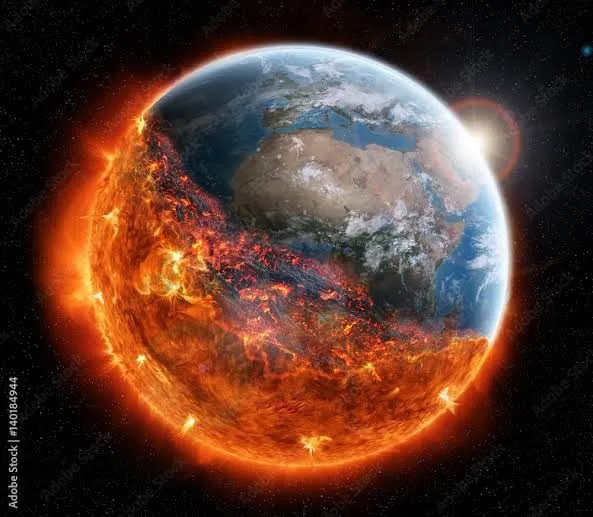
Roughly 5 billion years from now, the Sun will exhaust its core hydrogen, triggering shell fusion and swelling into a colossal red giant. Expanding hundreds of times its current diameter, the outer solar envelope will engulf Mercury and Venus, and likely consume Earth entirely. Even if Earth manages to barely evade physical engulfment, it will drift as a lifeless, cinder-burned rock orbiting a slowly fading white dwarf.


