Solar System Exploration: The Grand Human Odyssey

When we gaze into the nocturnal sky and watch countless stars twinkle, our own star system quietly spins in the dark—the solar system. It is far more than a simple cosmic family of the Sun and eight planets. It is an ongoing 4.6-billion-year epic of creation, violent disruption, and continuous reformation.
At the heart of the solar system blazes the Sun—a colossal sphere of incandescent plasma where nuclear fusion converts millions of tons of hydrogen into helium every second. The staggering energy born from this engine streams into the void as photons, providing the vital light and warmth that sparked life on Earth. The Sun’s gravity acts like an invisible tether, keeping every world in the solar system bound in orbital harmony.
Circling this central star are worlds of bewildering variety: rocky inner planets, gas giants, and frozen ice worlds. In orbit around them travel scores of moons, each representing a distinct, alien landscape.
Mercury and Venus: The Scorched Neighbors
Mercury and Venus reside closest to the Sun. Both worlds journey alone, devoid of any natural satellites. Yet human ingenuity has refused to leave these lonely, scorched worlds unvisited.
Mariner 10 was the first probe to visit Mercury in 1974–75. Decades later, the MESSENGER spacecraft (2011–2015) mapped Mercury’s cratered surface in comprehensive detail for the first time. Today, the joint European-Japanese BepiColombo mission is closing in to study Mercury from even closer quarters, preparing for its final orbital arrival.
Exploration of Venus once sparked fierce international drama. In the 1960s and 1970s, the Soviet Union’s Venera program achieved historic firsts by touching down on the hellish surface of Venus, sending back photographs before succumbing to crushing atmospheric pressure and heat hot enough to melt lead. Later, NASA’s Magellan orbiter (1990–1994) used synthetic-aperture radar to peer through the planet’s impenetrable blanket of clouds, unveiling its vast volcanic landscape.
Earth and the Moon: Our Oasis and Its Companion
Next sits the third planet from the Sun—our home, Earth—accompanied by its solitary satellite, the Moon. The Moon governs our ocean tides and stabilizes the tilt that gives us our seasons. In 1966, Luna 9 achieved the first soft touchdown on lunar soil. Three years later, in 1969, humanity achieved one of its greatest technological milestones when Apollo 11 landed humans on the Moon. Through 1972, five more Apollo missions followed, bringing back 382 kilograms of lunar rock and soil samples that revolutionized planetary science.
Today, a new era of lunar exploration has dawned. NASA’s Artemis program is paving the way to return humans to the Moon. In parallel, India’s Chandrayaan-3 and China’s Chang’e probes have advanced our understanding of the mysterious, ice-bearing south pole. Within the coming decade, permanent human outposts on the Moon may finally transition from science fiction into reality.
Mars: The Next Frontier for Humankind
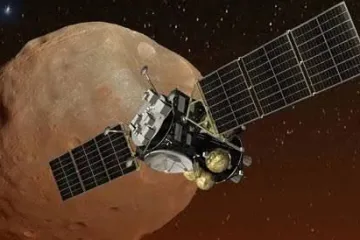
Beyond Earth lies Mars, the red planet that has captured human imagination like no other. Accompanied by two potato-shaped moons, Phobos and Deimos, Mars is humanity’s primary proving ground for extraterrestrial exploration. To date, NASA, the Soviet Union/Russia, the European Space Agency, India, the United Arab Emirates, and China have all successfully delivered spacecraft to the red planet.
In 1976, Viking 1 completed the first successful Martian surface landing. Decades later, robotic rovers like Spirit, Opportunity, and Curiosity traversed its dusty terrain, revealing ancient riverbeds and lake basins. Today, the Perseverance rover is actively scouring Jezero Crater for biosignatures of ancient microbial life.
The Reign of the Gas Giants: Jupiter and Saturn
Beyond the asteroid belt, planetary scales expand dramatically into the realm of the gas giants. Jupiter is so gargantuan that roughly 1,300 Earths could fit inside it. With over 95 known moons, Jupiter resembles a miniature solar system in its own right. The Galileo mission (1989–2003) unlocked profound insights into its stormy atmosphere and icy moons, while NASA’s Juno probe has been providing mesmerizing close-up views of its swirling polar cyclones since 2016.
Saturn follows with its breathtaking ring system—a masterpiece of cosmic architecture. Saturn hosts over 145 confirmed moons. Between 2004 and 2017, the Cassini-Huygens mission illuminated this intricate world, deploying the Huygens probe directly onto Titan’s frigid surface, proving that complex hydrocarbon weather and liquid methane seas exist beyond Earth.
The Outer Frontiers: Uranus, Neptune, and Pluto
Deeper in the darkness drift Uranus and Neptune—frigid, blue-green ice giants swept by supersonic winds. To this day, our only close-up glimpses of these distant worlds came from Voyager 2’s historic flybys in the late 1980s.
At the frozen frontier of the planetary system, New Horizons made history in 2015 by flying past Pluto, capturing unforgettable high-resolution images of its nitrogen ice plains and prominent “heart-shaped” glacier. The encounter revealed that even a tiny dwarf planet with five moons can boast astonishing geologic complexity.
Asteroids, Comets, and Crossing the Cosmic Frontier
Human curiosity does not stop at planets. In 2001, NEAR Shoemaker landed on asteroid Eros. Later, Japan’s Hayabusa and Hayabusa2 missions, alongside NASA’s OSIRIS-REx, retrieved pristine samples from near-Earth asteroids and brought them home to terrestrial laboratories. In 2022, the DART mission proved that humanity could intentionally alter an asteroid’s trajectory, validating planetary defense technology.
Meanwhile, Voyager 1 and Voyager 2—launched in 1977—stand as silent sentinels of humanity’s longest voyage, having crossed the heliopause into interstellar space.
Between Mars and Jupiter stretches the main asteroid belt; beyond Neptune lies the Kuiper Belt, and far further sits the Oort Cloud—the primordial reservoir where long-period comets originate, preserving pristine chemical records from the dawn of our planetary nursery.
Birth, Evolution, and Cosmic Chaos
Approximately 4.5 billion years ago, our solar system formed from the gravitational collapse of a giant molecular cloud of gas and interstellar dust. As the cloud collapsed, it flattened into a protoplanetary disk from which the Sun, planets, and moons coalesced. That ancient rotation explains why most planets orbit in the same plane and direction to this day.
Yet the solar system is far from orderly. It bears the scars of colossal impacts and orbital turbulence. Venus rotates backward in retrograde spin, as if an ancient collision flipped its axis. Uranus rolls on its side with an axial tilt of 98 degrees. Mercury’s perihelion precesses in a manner that once puzzled astronomers until Albert Einstein’s general theory of relativity solved the enigma.
Even our Moon is believed to be the offspring of a giant impact between the proto-Earth and a Mars-sized body named Theia. Out of this primeval chaos emerged the delicate gravitational balance that sustains our world today.
Future Missions: Humanity’s Expanding Horizon
The most remarkable aspect of this story is that humanity is no longer a passive spectator. Where our ancestors once stared up in silent wonder, today our probes and instruments navigate the void firsthand.
Even greater adventures lie ahead. The Artemis missions will return humans to the lunar surface. Europa Clipper will probe the habitability of Jupiter’s subsurface ocean. NASA’s Dragonfly rotorcraft will soar through the dense atmosphere of Saturn’s moon Titan. Step by step, the solar system is becoming part of humanity’s broader neighborhood—a shared home for future generations.