Epigenetics and Genetics: Nature or Nurture Debate
Are all human characteristics carved in stone at the moment of conception? Are we bound from birth by an inescapable biological blueprint? The question sounds simple, but the biological reality is profoundly nuanced. Inside the single cell that starts our life lies a vast genetic code: our DNA. Enclosed within that molecular library are instructions for eye color, skin pigmentation, height potential, and even subtle behavioral predispositions. At first glance, our destiny seems predetermined. Yet looking deeper into biology reveals that life’s narrative is rarely linear.
Genes and Environment: The Enduring Debate
Here lies the classic debate of nature versus nurture. Evolutionary biologist Richard Dawkins famously described organisms as survival machines for their genes—a concept popularized in his landmark work The Selfish Gene. The perspective is compelling and holds undeniable biological truth: genes build our physical architecture and set the boundaries of our biological potential. Yet how that potential unfolds in practice depends decisively on another profound force: the environment.
Observing two siblings within the same household makes this reality immediately evident. Despite sharing roughly half of their genetic inheritance, they grow into distinct personalities. One may be calm and introspective while the other is energetic and impulsive; one is bold, another reserved. These distinctions take shape through their unique developmental pathways, shaped by education, social relationships, and personal life experiences.
Identical Twins and the Mystery of Epigenetics
The most fascinating proof surfaces in monozygotic or identical twins. Possessing virtually identical DNA sequences, they nonetheless diverge noticeably over time. One twin might develop an autoimmune illness while the other stays healthy; their habits, temperaments, and disease susceptibilities often drift apart. Behind these differences lies an invisible regulatory layer that does not alter the underlying genetic letters, but dramatically changes how those letters are read and expressed—acting like an array of microscopic biological switches turned on or silenced by environmental cues.
This regulatory mechanism is known as epigenetics. In essence, epigenetics controls gene expression without altering the underlying DNA sequence. Tiny molecular tags, such as methyl groups attached to DNA or modifications to histone proteins around which DNA coils, dictate whether a specific gene is activated or suppressed. Crucially, these epigenetic marks are dynamic: nutrition, chronic stress, sleep, physical activity, and toxic exposures continuously influence them. In certain instances, researchers have even documented how these epigenetic signatures can cast faint echoes into subsequent generations.
Environmental Influence on Genetic Expression
In day-to-day life, this interaction is unmistakable. Consider two children with the genetic potential for tall stature. If one receives nourishing food, healthcare, and safety while the other suffers from chronic malnutrition and neglect, their adult heights will differ substantially. The identical genetic potential yields vastly different physical outcomes depending on environmental conditions.
Similarly, an individual may carry a genetic predisposition toward type 2 diabetes. A balanced diet, consistent exercise, and weight management can keep that susceptibility dormant. Conversely, a sedentary lifestyle and poor dietary habits can flip the switches that bring the disease to full fruition.
Mental Health and Environmental Interplay
The same intricate dance governs psychological well-being. Someone may inherit a vulnerability toward anxiety or depression, yet supportive relationships, emotional stability, and a nurturing environment can buffer against distress. Conversely, enduring severe trauma or prolonged adversity can amplify that vulnerability into debilitating illness.
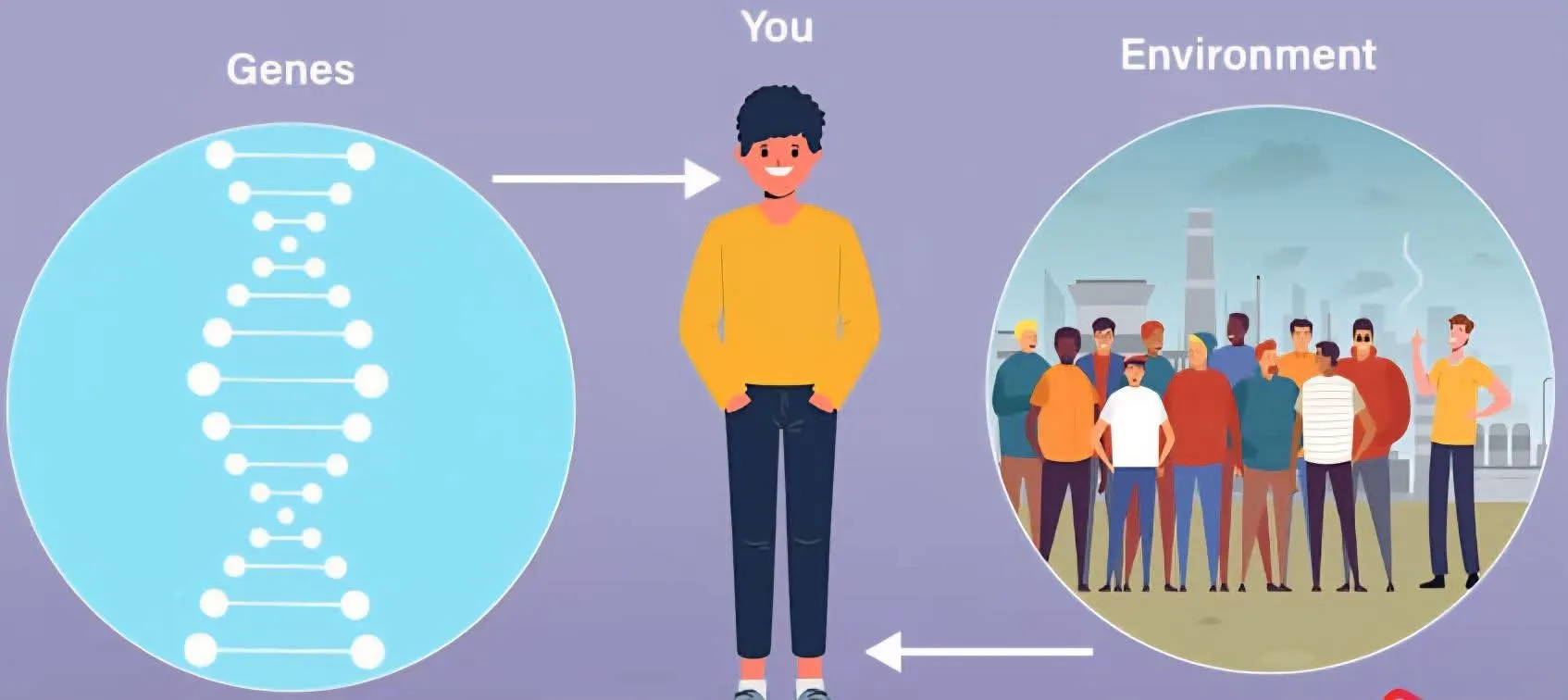
Science increasingly reveals that genes and environment are not opposing rivals, but inseparable collaborators. Genes provide the biological canvas, but the environment paints the picture. The human story is not inscribed in static DNA alone; it is continually shaped by time, experience, and living reality. Within this ceaseless molecular dialogue lies the wondrous diversity of humankind, making every human journey entirely unique.