Apollo 13 Mission: A Masterpiece of Crisis Management
April 1970. An electrifying chapter in the history of human space exploration was underway. Just a year earlier, Apollo 11 had carried humans to set foot on the lunar soil for the first time. Soon after, the Apollo 12 lunar expedition succeeded as well. Following these two historic triumphs, NASA prepared once again to send humans to the Moon. The new mission was christened Apollo 13.
On April 11, 1970, Kennedy Space Center trembled once more beneath the thunderous roar of the colossal Saturn V rocket. Piercing through towering sheets of flame and billowing clouds of smoke, Apollo 13 soared into the void. Aboard were three astronauts: Commander Jim Lovell, Command Module Pilot Jack Swigert, and Lunar Module Pilot Fred Haise. Their objective was to land on the lunar surface and conduct an ambitious suite of scientific experiments.
For the first few days of the journey, everything proceeded smoothly. The spacecraft steadily pulled away from Earth, drawing closer to the mysterious, cratered realm of the Moon. The three astronauts were confident and high-spirited. Yet in the unforgiving arena of space exploration, moments arrive where a single hidden flaw suddenly upends every human calculation.
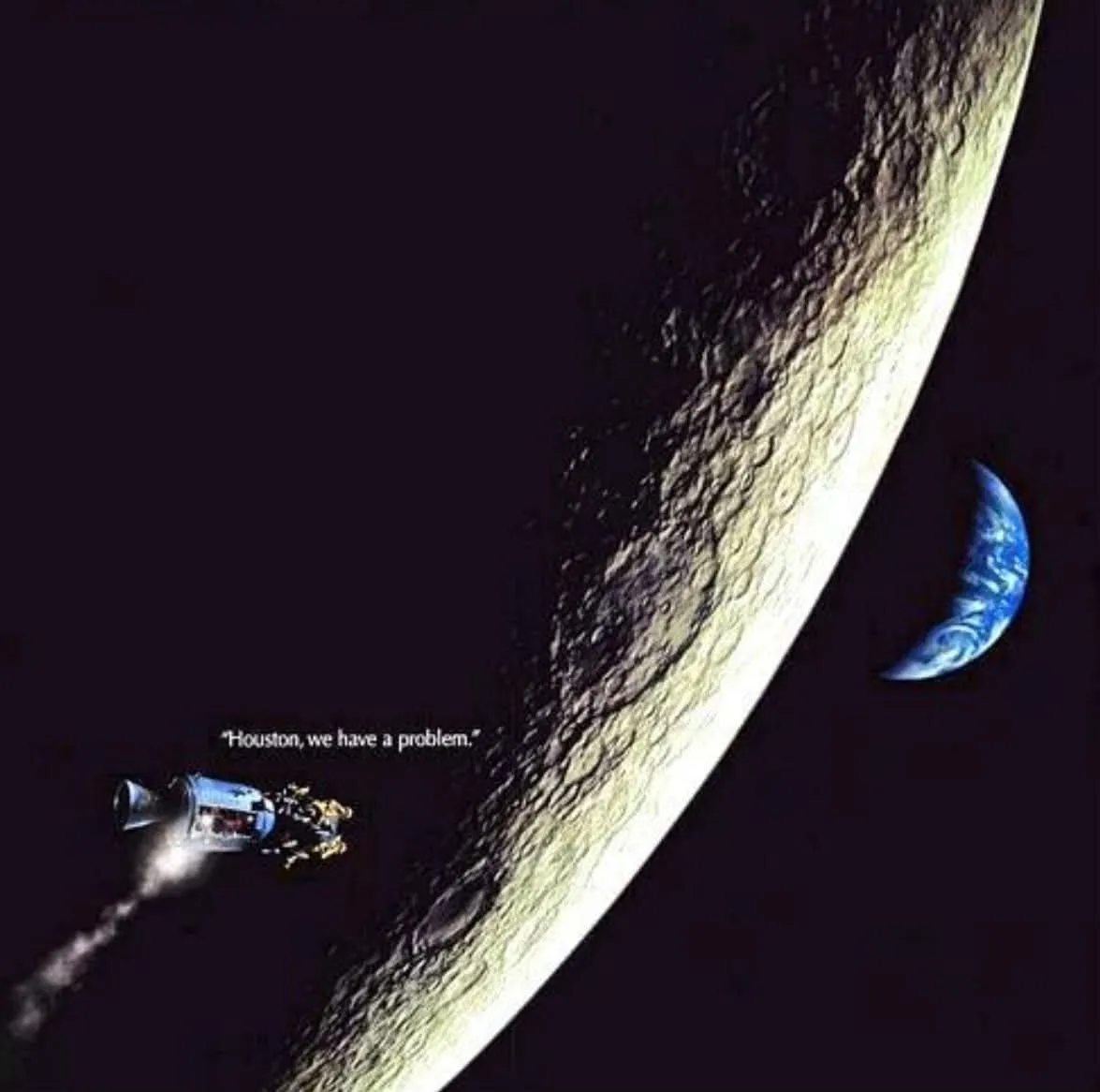
On April 13, 1970, nearly three hundred thousand kilometers from Earth, Apollo 13 was speeding toward the Moon. Inside the spacecraft, a loud bang abruptly echoed—an explosion shook the hull. Warning lights instantly flared across the instrument panels. An oxygen tank in the service module had catastrophically ruptured. Within minutes, electrical power and critical life-support systems began failing rapidly. In that perilous moment, Commander Jim Lovell radioed mission control on Earth: “Houston, we’ve had a problem.”
That terse sentence would go down as one of the most famous utterances in spaceflight history. Following the blast, it became swiftly apparent that a lunar landing was out of the question. Only a single objective remained: bring the three astronauts back to Earth alive.
With the Command Module crippled and bleeding vital power, the astronauts took refuge inside the Lunar Module—a vehicle designed solely to support two men on the Moon for a short stay. It now became their makeshift cosmic lifeboat. Meanwhile, inside mission control in Houston, scientists and flight controllers did not rest for a second. Day and night, they worked out the exacting physics of how to guide this wounded spacecraft home with critically depleted electricity, scarce oxygen, and dwindling reserves of drinking water.
Those subsequent days were the most harrowing of all. The cabin temperature plummeted to near-freezing levels. Water rations and electrical consumption were cut to absolute survival minimums. Then another lethal menace emerged: carbon dioxide began climbing dangerously inside the Lunar Module. The dilemma was surreal: the Lunar Module’s air scrubber required round canisters, but the crew only had spare square canisters from the Command Module. Guided by engineers on the ground, the astronauts improvised an adapter using plastic bags, cardboard flight-plan covers, and gray duct tape. This crude yet ingenious hack scrubbed the poisonous gas from the cabin air, keeping the crew breathing.
Simultaneously, flight dynamics specialists plotted a specialized course harnessing the Moon’s gravity to swing the spacecraft back toward Earth: a free-return trajectory. Along this natural orbital path, the Moon’s gravitational slingshot whips the vehicle around its far side and hurls it straight back into Earth’s gravitational embrace without requiring a major engine burn.
After days of relentless tension and uncertainty, Apollo 13 finally re-entered Earth’s atmosphere on April 17, 1970. Millions of people across the globe held their breath. Minutes later, parachutes blossomed above the Pacific Ocean, and the capsule splashed down safely into the waves. All three astronauts returned home alive.
In the final phase of their return, the astronauts had faced one last formidable hurdle. The Lunar Module had served as their salvation, but only the Command Module possessed the heavy heat shield capable of enduring the fiery inferno of atmospheric reentry. The crew therefore had to migrate back into the cold Command Module and cast off their faithful four-day haven into the depths of space.
This maneuver carried immense risk. Most of the Command Module’s electrical systems had been shut down for days to conserve power and oxygen. Bringing them back online required painstaking precision under extreme resource constraints. Fortunately, the carefully preserved reserves proved sufficient, and flawless navigation brought the three men safely through the searing heat and crushing deceleration.
Apollo 13 never landed on the Moon. On paper, the expedition was a failure. Yet in the broader tapestry of human achievement, it stands as an extraordinary triumph. When confronted with mortal peril, human intellect, courage, cooperation, and cool-headed composure turned an impossible catastrophe into a legendary rescue.
That is why, throughout the history of space exploration, Apollo 13 is remembered forever as a “successful failure.”