BepiColombo at Mercury's Door

After nearly eight years in flight, BepiColombo has arrived at the door of its destination. Ahead of it lies the planet closest to the Sun and one of the most puzzling in the solar system — Mercury. The mission is named after Giuseppe ‘Bepi’ Colombo, the Italian astronomer whose work opened the way to understanding that planet.
Reaching Mercury, though, is not the end of the job. The hardest part of the mission is only beginning. Over the coming months, one precise manoeuvre after another has to bring BepiColombo’s two spacecraft into orbit around the planet.
Eight years, and a very long way round
BepiColombo, a joint mission of the European Space Agency and Japan’s space agency, was launched on 20 October 2018. Mercury is not far from Earth as planetary distances go, yet sending a spacecraft there is surprisingly hard.
Move towards the Sun and its enormous gravity pulls a spacecraft along faster and faster. To slip into orbit around Mercury rather than race past it, all that extra speed has to be shed. That is the real challenge.
So BepiColombo has been flown on a vast looping path through the inner solar system for eight years: once past Earth, twice past Venus and six times past Mercury itself, borrowing a little help from each planet’s gravity — nine planetary flybys in all. Solar-electric ion engines have been at work throughout the journey.
The final chapter before orbit
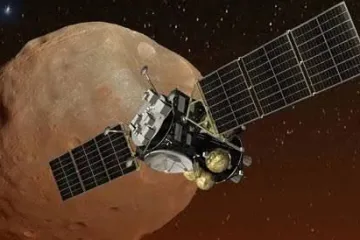
On 3 September something significant happened. The Mercury Transfer Module, which carried the spacecraft across all those years, was separated from the rest of the stack. With that, the last phase of the approach to Mercury formally began, and BepiColombo is now closing in on the planet it was built to study.
The day that matters most is 21 November. That is when the process of letting Mercury’s gravity take hold and draw the spacecraft into orbit begins. In December, the two orbiters that have travelled this far together will part company:
-
The Mercury Planetary Orbiter: built by the European Space Agency.
-
Mio: Japan’s Mercury Magnetospheric Orbiter.
Two spacecraft, looking at the same planet in two different ways.
What we still do not know about Mercury
Mercury looks a good deal like our own Moon: grey, rocky, covered in craters. But this small planet has left scientists with several large puzzles:
-
For all its closeness to the Sun, there are craters near Mercury’s poles that sunlight never reaches — and strong evidence that ice is sitting inside them.
-
A planet this small has a magnetic field of its own. Exactly how a field is still being generated deep inside Mercury, as it is inside Earth, is not fully understood.
-
Its surface carries strange bright hollows, and how they formed is an open question.
-
Scientists want to know how the planet ended up with such an unusually large iron-rich core.
Two orbiters, one laboratory
That is what makes BepiColombo matter. Not one orbiter but two will be watching Mercury at the same time. Europe’s orbiter will study the surface, the interior, the chemistry and the geology of the planet.
Japan’s Mio will concentrate on the magnetic field, the plasma around the planet and the way Mercury meets the solar wind streaming off the Sun. Read together, the two sets of measurements will let scientists treat Mercury as a whole system rather than a surface. Between them the spacecraft carry magnetometers, a laser altimeter, X-ray and infrared spectrometers, and plasma and dust detectors, among many other instruments.
Why Mercury is worth the trouble
Understanding Mercury is not only about one planet. How a rocky world forms so close to the Sun, why its core is so large, how it has changed over billions of years — the answers bear on the birth of every rocky planet in the solar system, Earth included.
Mariner 10 was the first to visit, in 1974–75. MESSENGER followed, mapping the whole planet for the first time between 2011 and 2015. BepiColombo will be only the second mission to enter orbit around Mercury, and its two orbiters the second and third spacecraft ever to circle it.
If everything goes to plan, full science observations begin in April 2027. The eight-year journey is nearly over; the real expedition starts next April. Seen from Earth, Mercury is a small point of light beside the Sun. Two spacecraft built by human hands will soon be going round that point of light — and the history of one of the least known planets in the solar system will start to open up.