Cosmic Inflation: The Big Bang and the Creation of the Universe
The Genesis of the Universe and the Standard Big Bang
For millennia, humanity has pondered the origin of the cosmos. Modern astrophysics has answered this primordial question through the Big Bang theory. Approximately $13.8$ billion years ago, all matter, radiation, and spacetime emerged from an unimaginably hot, dense state: an initial gravitational singularity.
Yet while the classical Big Bang explains the expansion of spacetime and cosmic nucleosynthesis, it left profound foundational anomalies unexplained:
- The Horizon Problem: Why does the Cosmic Microwave Background (CMB) display an almost identical temperature across opposite sides of the observable sky that were never in causal thermal contact?
- The Flatness Problem: Why is the spatial geometry of our universe extraordinarily flat, with critical density parameter $\Omega \approx 1$?
- The Magnetic Monopole Problem: Why do grand unified theories predict abundant stable magnetic monopoles, yet astronomical surveys detect none?
Alan Guth and the Theory of Cosmic Inflation
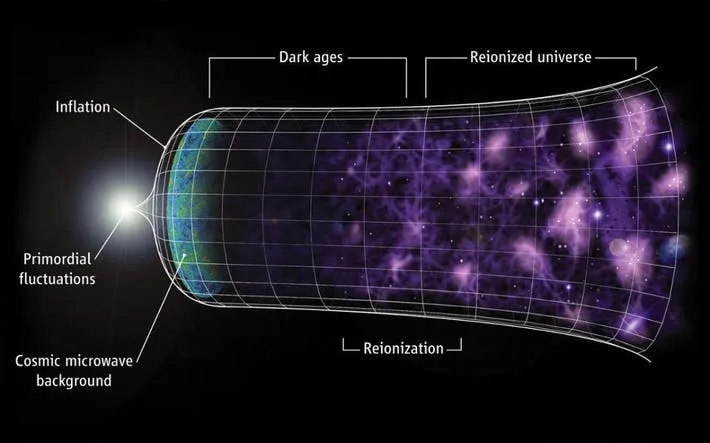
In 1981, American theoretical physicist Alan Guth formulated a revolutionary solution: the theory of cosmic inflation. Guth proposed that between $10^{-36}$ and $10^{-32}$ seconds after the Big Bang, the infant universe underwent a brief phase of exponential, superluminal spatial expansion.
During this fleeting instant, space expanded by a factor of at least $10^{26}$, stretching an infinitesimally microscopic patch into an expanse vastly larger than our entire observable universe today.
The Inflaton Field: Repulsive Gravitational Dynamics
This staggering inflationary expansion was driven by a scalar quantum field known as the inflaton field. In general relativity, an energetic vacuum state with negative pressure produces gravitational repulsion.
Trapped in a temporary high-energy false vacuum state, the inflaton field exerted tremendous outward pressure, acting as repulsive gravity that stretched spacetime flat and diluted any pre-existing relics—such as magnetic monopoles—to imperceptible densities.
Quantum Fluctuations: The Seeds of Galaxies
Perhaps the most profound insight of cosmic inflation is that it connects the subatomic quantum realm with astronomical cosmic structures. Before inflation, sub-microscopic quantum fluctuations constantly rippled across the vacuum.
Exponential inflationary expansion stretched these microscopic quantum fluctuations across macroscopic astronomical scales before they could dissipate. These frozen primordial density variations became the gravitational seeds around which matter later condensed to form gas clouds, galaxies, stars, and planetary systems.
Empirical Verification: The Cosmic Microwave Background
Theoretical inflation predictions have received spectacular empirical corroboration from spaceborne observatories, including NASA’s WMAP and ESA’s Planck satellite. Precision measurements of temperature anisotropies in the CMB revealed a nearly scale-invariant power spectrum ($n_s \approx 0.965$) precisely matching inflationary calculations.
Eternal Inflation and the Multiverse
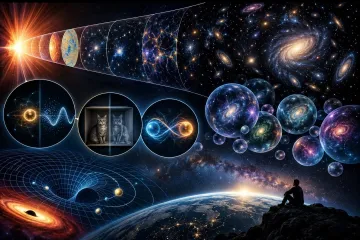
The mathematical physics of cosmic inflation leads to a startling cosmological consequence: eternal inflation. In many models, inflation does not end simultaneously everywhere. While it decayed into hot “pocket universes” (like our own), inflationary expansion continues unabated in surrounding regions, continually spawning an infinite array of bubble universes—the multiverse.
Conclusion
Cosmic inflation remains a cornerstone of modern theoretical cosmology. By harmonizing quantum field theory with Einsteinian relativity, it explains both the majestic uniformity of our cosmos and the primordial quantum seeds that gave rise to stars, planets, and conscious life.