Measuring Astronomical Distances: The History of the Cosmic Ladder
Gazing Into the Unfathomable Depths
Since antiquity, humanity has looked up at the night sky and wondered about the distance to the twinkling points of light. Classical Greek astronomers such as Aristarchus and Hipparchus developed clever geometric methods to estimate distances to the Moon and Sun, yet the true scale of the stars remained inaccessible for thousands of years.
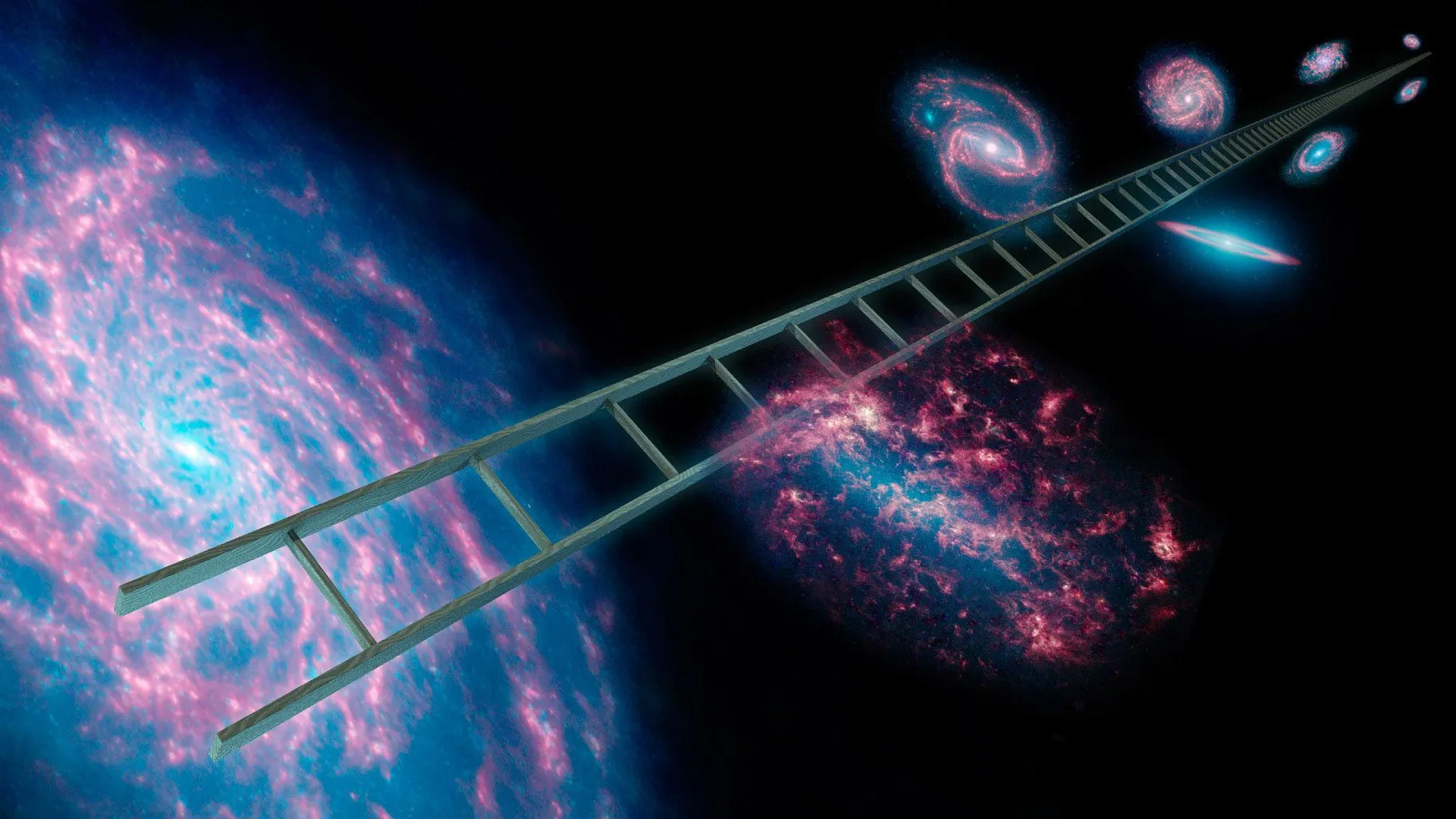
Without physical tape measures or direct probes, astrophysicists constructed the “Cosmic Distance Ladder”—a sequential series of interlocking techniques where each rung provides the calibration baseline for measuring astronomical distances to ever more distant cosmic objects.
Rung 1: Stellar Parallax and Friedrich Bessel
The first foundational breakthrough occurred in 1838 through German astronomer and mathematician Friedrich Bessel. Bessel utilized the principle of trigonometric parallax—the apparent shift in an object’s position against distant background stars when observed from opposite sides of Earth’s orbit around the Sun six months apart.
Measuring an exceedingly tiny angular shift ($0.31$ arcseconds), Bessel calculated the distance to the binary star 61 Cygni at approximately 10.3 light-years, providing the first empirically verified stellar distance measurement in history. Today, space observatories such as ESA’s Gaia mission measure parallaxes with micro-arcsecond precision for over a billion stars across our galaxy.
Rung 2: Henrietta Leavitt and Cepheid Variables
Trigonometric parallax loses precision beyond several thousand light-years. In the early twentieth century, Henrietta Swan Leavitt at the Harvard College Observatory made a discovery that extended humanity’s cosmic reach.
Studying pulsating variable stars in the Small Magellanic Cloud, Leavitt discovered that a Cepheid variable’s pulsation period directly correlates with its intrinsic luminosity (the Period-Luminosity Relation). By measuring a Cepheid’s pulsation cycle, astronomers determine its true brightness, compare it with its apparent brightness from Earth, and calculate its exact distance using the inverse-square law.
Rung 3: Edwin Hubble and Island Galaxies
In 1924, Edwin Hubble identified Cepheid variables inside the Andromeda Nebula (M31) using the 100-inch Hooker Telescope at Mount Wilson. Calculating Andromeda’s distance at over two million light-years, Hubble proved that spiral nebulae are not localized gas clouds within the Milky Way, but independent “island universes”—vast galaxies in their own right.
Rung 4: Type Ia Supernovae as Standard Candles
To measure distances across billions of light-years, astronomers utilize Type Ia supernovae. These violent stellar explosions occur when a white dwarf star accretes matter from a companion until reaching the Chandrasekhar limit ($1.44$ solar masses), triggering thermonuclear collapse.
Because these explosions occur at nearly uniform critical masses, their peak intrinsic luminosities are nearly identical. Acting as cosmic standard candles visible across vast cosmological distances, Type Ia supernovae enabled the 1998 discovery of the accelerating expansion of the universe driven by dark energy.
Rung 5: Redshift and Hubble’s Law
At the farthest cosmological horizons, distances are determined via cosmological redshift ($z$). As space expands, traveling light waves stretch to longer, redder wavelengths. Applying Hubble’s Law ($v = H_0 d$), astronomers determine recessional velocities and cosmic distances across billions of light-years.
Conclusion
From Bessel’s delicate parallax angles to the redshift of distant quasars, the journey of measuring astronomical distances reflects the triumph of scientific curiosity, allowing humanity to map the vast architecture of the cosmos.