Spacetime and the Fourth Dimension: Minkowski's Geometric Universe
Challenging the Three-Dimensional Paradigm
For centuries, human perception conceptualized reality through three spatial dimensions: length, breadth, and height. Classical Newtonian mechanics treated these three spatial axes as an absolute, rigid stage upon which time flowed uniformly and independently like an external river.
The dawn of the twentieth century shattered this classical divide. Through the profound convergence of non-Euclidean geometry, philosophical inquiry, and relativistic physics, theorists recognized that space and time are inextricably interwoven into a single four-dimensional continuum: spacetime and the fourth dimension.
The Concept of Higher Dimensions and Flatland
In the mid-nineteenth century, mathematicians began exploring geometries beyond Euclid’s axioms. If points construct one-dimensional lines, lines sweep into two-dimensional planes, and planes form three-dimensional solids, why should spatial geometry terminate at three?
In 1884, Edwin A. Abbott popularized this idea in his satirical novella Flatland: A Romance of Many Dimensions. Abbott described a two-dimensional world whose flat inhabitants cannot perceive or comprehend a three-dimensional sphere passing through their plane. The sphere appears to them merely as a growing and shrinking two-dimensional circle, prompting philosophers to consider whether humans are similarly blind to higher dimensions.
Hermann Minkowski and the Unification of Space and Time
In 1908, German mathematician Hermann Minkowski—who had taught mathematics to Albert Einstein at ETH Zurich—delivered his celebrated lecture titled “Raum und Zeit” (Space and Time), famously declaring:
“Henceforth space by itself, and time by itself, are doomed to fade away into mere shadows, and only a kind of union of the two will preserve an independent reality.”
Minkowski formalized Einstein’s 1905 special relativity into four-dimensional geometry ($x, y, z, ct$), introducing foundational concepts:
- Events: A specific physical occurrence defined by three spatial coordinates and one temporal coordinate.
- Worldlines: The continuous four-dimensional trajectory traced by a particle through spacetime.
- Spacetime Invariant Interval: The invariant separation between events ($ds^2 = c^2 dt^2 – dx^2 – dy^2 – dz^2$) that remains identical for all observers regardless of relative velocity.
The Light Cone: Past, Present, and Future
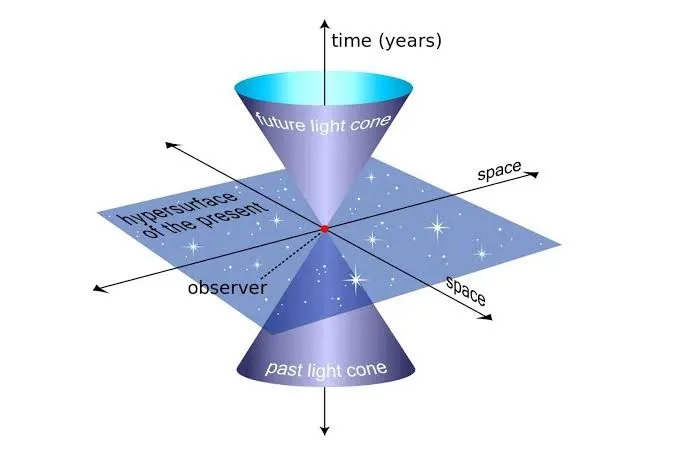
The geometry of Minkowski spacetime is illustrated by the “light cone.” From any given event (“here and now”), light flashes outward at velocity $c$, outlining a future light cone containing all future events that can be causally influenced. Conversely, the past light cone contains all historical events from which light signals could reach the present.
Events lying outside these cones occupy “spacelike” regions, causally disconnected from the present observer by the universal cosmic speed limit of light.
Curved Spacetime and Beyond to String Theory
Minkowski’s four-dimensional continuum provided the essential mathematical canvas for Einstein’s 1915 General Theory of Relativity, in which gravity is reimagined not as an attraction between masses, but as the dynamic curvature of four-dimensional spacetime.
Modern theoretical physics extends far beyond four dimensions. In superstring theory and M-theory, consistent mathematical descriptions of quantum gravity require 10 or 11 dimensions, where unobserved spatial dimensions are tightly compactified at the subatomic Planck scale.
Conclusion
Understanding spacetime and the fourth dimension revolutionized modern physics, revealing that space and time are not passive, disconnected stages, but active geometric fabrics that shape the physical universe.