Global Innovation Index 2025: Bangladesh's Ranking and the Research Crisis
Evaluating National Innovation Capacity
The annual release of the Global Innovation Index (GII) provides an essential diagnostic benchmark evaluating the research, technological infrastructure, and innovation output of economies worldwide. In the Global Innovation Index 2025, published by the World Intellectual Property Organization (WIPO), Bangladesh ranks 106th out of 139 nations surveyed.
While the overall ranking remains unchanged from the previous year, a granular analysis reveals severe structural weaknesses in national research and development (R&D) that jeopardize long-term economic resilience.
The Research Crisis: Human Capital and Academic Underinvestment
The most concerning finding in the 2025 report lies in Human Capital and Research, where Bangladesh ranks near the bottom at 133rd globally. Key structural deficits driving this crisis include:
- R&D Expenditure Deficit: National spending on scientific research remains below 0.33 percent of GDP, lagging far behind regional peers.
- Higher Education Challenges: University curricula focus predominantly on rote credentialism rather than fundamental scientific inquiry, resulting in low patent filing rates and limited publications in international peer-reviewed journals.
- Academic-Industrial Decoupling: Collaboration between university engineering laboratories and domestic commercial manufacturing remains virtually non-existent.
Business Sophistication and Institutional Bottlenecks
In the Business Sophistication pillar, Bangladesh ranks 129th. While domestic manufacturing industries import foreign machinery, indigenous technological adaptation and industrial R&D remain constrained. The information technology sector remains heavily dependent on basic business process outsourcing rather than developing proprietary software architectures.
Furthermore, institutional governance ranks at 109th, reflecting bureaucratic hurdles, fragmented science policy implementation, and funding allocations that frequently overlook meritocratic research excellence.
Youth Entrepreneurship and Creative Output
Encouragingly, the report identifies pockets of resilience. Bangladesh performs comparatively well in Creative Outputs (86th) and Infrastructure adoption (90th), propelled by digital mobile financial services, e-commerce adoption, and grassroots startup initiatives driven by tech-literate youth.
However, without robust institutional science funding, these commercial initiatives cannot substitute for fundamental research in materials science, biotechnology, and renewable energy.
Global Lessons from Innovation Leaders
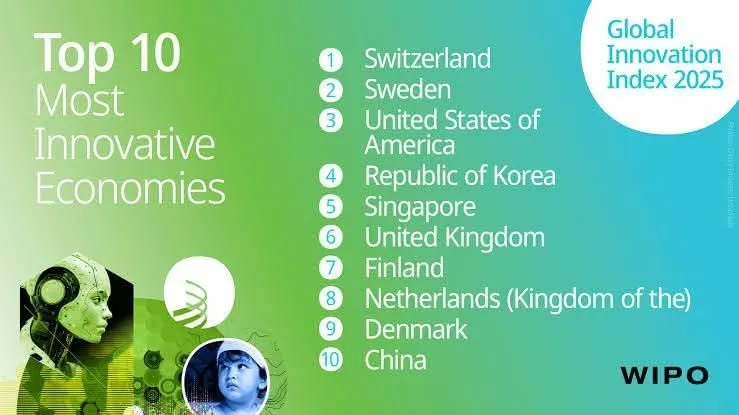
The top ten innovative nations in the Global Innovation Index 2025—led by Switzerland, Sweden, the United States, South Korea, and Singapore—demonstrate that economic prosperity is anchored in sustained investment in higher education, institutional transparency, and strategic research funding. China’s ascension into the global top ten underscores how strategic public R&D investment can transform a developing economy into an industrial and technological powerhouse within a generation.
Conclusion
To break free from low-value-added manufacturing and build a sustainable knowledge-based economy, Bangladesh must treat scientific research, university transformation, and innovation financing as urgent national priorities.