Pluto: Why the Ninth Planet Was Reclassified as a Dwarf Planet
The Discovery of the Ninth Planet
For more than seven decades, children worldwide memorized the nine planets of the solar system in order from the Sun: Mercury, Venus, Earth, Mars, Jupiter, Saturn, Uranus, Neptune, and Pluto. Discovered in 1930 by American astronomer Clyde Tombaugh at Lowell Observatory in Arizona, Pluto was celebrated as the distant, icy guardian of the solar frontier.
However, in August 2006, the International Astronomical Union (IAU) voted to reclassify Pluto, stripping it of its full planetary status and designating it a “dwarf planet.” This historic decision reshaped astronomy textbooks and sparked passionate public debate.
The IAU’s Three Criteria for a Planet
To establish scientific rigor, the IAU defined a planet as a celestial body that satisfies three distinct conditions:
- It must orbit the Sun directly (not be a moon of another planet).
- It must possess sufficient mass for its self-gravity to overcome rigid body forces, assuming a nearly spherical hydrostatic equilibrium shape.
- It must have “cleared the neighborhood” around its orbital path of other competing planetesimals.
Why Pluto Failed the Third Criterion
While Pluto comfortably satisfies the first two conditions—orbiting the Sun and maintaining a spherical shape—it decisively fails the third requirement. Located within the Kuiper Belt—a vast circumstellar disc populated by thousands of icy trans-Neptunian objects—Pluto lacks the gravitational mass to dominate or clear its orbital zone.
Pluto’s physical scale is surprisingly modest:
- Its diameter (2,376 km) is roughly two-thirds that of Earth’s Moon.
- Its mass is only 0.2 percent of Earth’s mass.
- Its surface gravity is merely 6 percent of terrestrial gravity (a 60 kg person weighs less than 4 kg on Pluto).
Furthermore, the 2005 discovery of Eris—a trans-Neptunian object of comparable size and mass—forced astronomers to make a choice: either induct dozens of newly discovered Kuiper Belt objects as planets, or create a distinct category: dwarf planets (which now includes Pluto, Eris, Ceres, Haumea, and Makemake).
The Binary Dance with Charon and New Horizons
Despite its dwarf classification, Pluto hosts an intriguing planetary system with five moons: Charon, Styx, Nix, Kerberos, and Hydra. Its largest moon, Charon, is so massive relative to Pluto (half its diameter) that the pair’s center of mass (barycenter) lies outside Pluto’s surface, causing them to orbit one another as a binary dwarf planet system.
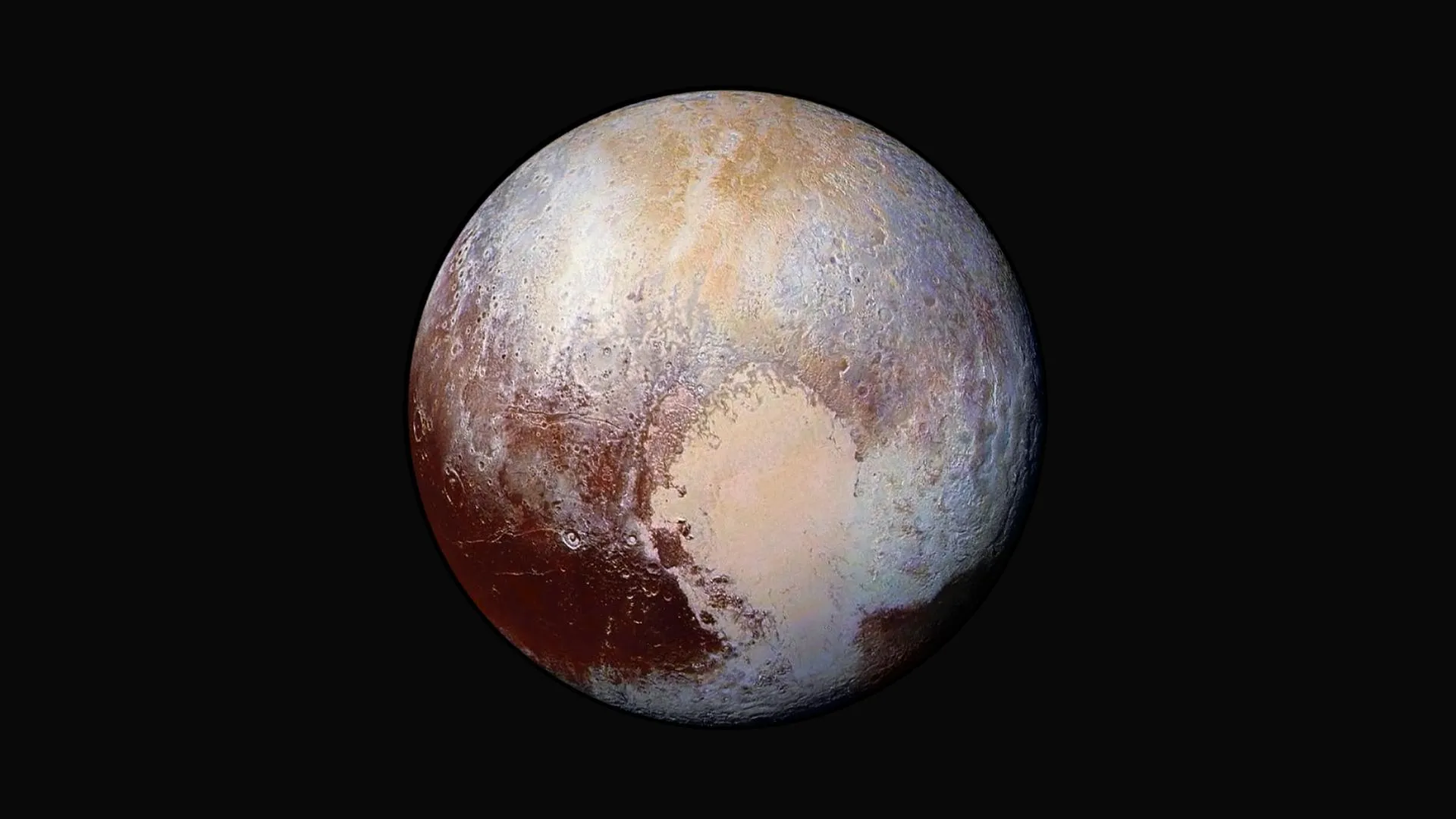
In July 2015, NASA’s New Horizons spacecraft completed a historic flyby after a nine-year, five-billion-kilometer journey. Images revealed towering nitrogen ice mountains, glaciers, a tenuous blue nitrogen atmosphere, and the iconic heart-shaped nitrogen-ice plain known as Tombaugh Regio.
Conclusion
Designating Pluto dwarf planet was not an insult to its grandeur, but an acknowledgment of our evolving understanding of the solar system. Pluto remains an enchanting, complex world that anchors our study of the outer frozen frontier.