A Wide-Angle Eye on the Cosmos
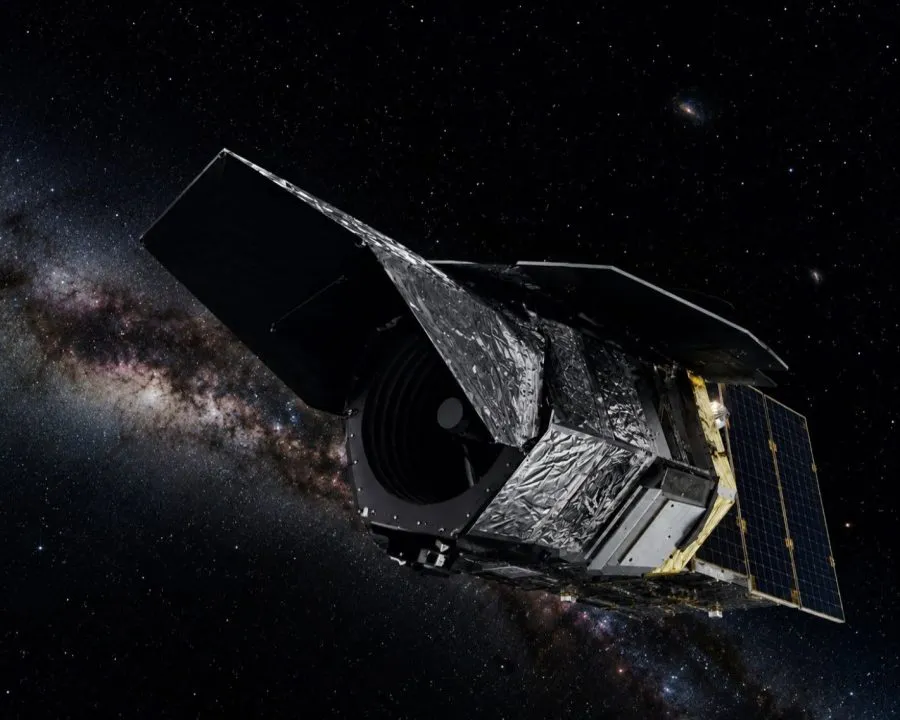
On 30 August 2026, NASA prepares to launch its next flagship astrophysics observatory, the Nancy Grace Roman Space Telescope. Mission preparations are complete, flight clearance has been granted, and a SpaceX Falcon Heavy rocket stands ready at Kennedy Space Center in Florida to deliver the telescope into deep space.
The James Webb Space Telescope has captivated the world by looking deep into the early cosmos. Why then do astronomers need another flagship observatory? Because the Nancy Grace Roman Space Telescope will view the universe through an entirely different optical lens.
A Colossal Field of View
Roman’s primary mirror measures 2.4 metres across – identical in diameter to the legendary Hubble Space Telescope. Yet the similarity ends there.
Roman’s field of view is at least a hundredfold larger than Hubble’s. According to NASA, Roman can survey wide swaths of the sky roughly a thousandfold faster than Hubble while maintaining equivalent optical sharpness.
To put it simply: if Hubble examines the cosmos through a high-magnification telephoto lens, Roman captures the same crisp detail across a panoramic wide-angle vista.
A Billion Galaxies
Roman’s central instrument is the Wide Field Instrument, a sprawling multi-megapixel near-infrared camera designed to repeatedly survey vast swathes of cosmic territory.
Over its nominal five-year mission, Roman is projected to collect light from nearly one billion galaxies. By mapping the precise coordinates, red-shifts, and geometric distributions of such an immense galaxy census, astronomers aim to construct the most comprehensive 3D map of large-scale cosmic structure ever attempted.
Hidden inside that cosmological map lie crucial clues to the greatest puzzles of contemporary physics.
The Invisible Universe
Everything we behold through our eyes or telescopes – stars, gas clouds, planets, and nebulae – constitutes a tiny sliver of the cosmos. The vast majority of the universe is governed by two invisible entities: dark matter and dark energy.
Dark matter emits no light, yet its immense gravitational scaffolding pulls galaxies together. Dark energy, by contrast, is the enigmatic force driving the accelerated expansion of the universe.
By conducting massive surveys of weak gravitational lensing, galaxy clustering, and distant supernovae, Roman will trace the expansion history of the cosmos and provide unprecedented constraints on the physics of the dark universe.
How It Differs from James Webb
Rather than viewing Webb and Roman as competitors, astronomers celebrate them as harmonious scientific partners. Webb’s 6.5-metre segmented mirror is tailored for ultra-deep, narrow-field spectroscopy of ancient, faint objects. Roman’s strength lies in its sweeping survey speed, gathering statistics across millions of galaxies and stellar systems. In short, Webb stares into keyholes, while Roman sweeps across the grand cosmic canvas. Whenever Roman uncovers an intriguing cosmic anomaly, Webb can swivel to inspect it with forensic spectroscopic depth.
Hunting Alien Worlds
Another major objective for Roman is searching for exoplanets beyond our solar system. Using gravitational microlensing – where the gravitational field of a foreground star and planet bends and magnifies the light of a background star – Roman will discover thousands of planets, including worlds situated far from their host stars and free-floating rogue planets.
Roman also carries a cutting-edge experimental Coronagraph Instrument. Designed to block out the blinding glare of parent stars, it will test direct imaging technologies essential for capturing direct portraits of Earth-sized planets around nearby suns in future decades.
Far Beyond Earth
Unlike Hubble in low Earth orbit, Roman will journey approximately 1.5 million kilometres away from Earth to the Sun-Earth Lagrange Point 2 (L2), sharing the stable gravitational haven occupied by the James Webb Space Telescope.
Roman’s baseline science mission spans five years, with substantial fuel reserves allowing for potential mission extensions. Initial instrument calibration will take several months following orbital insertion.
Honouring a Pioneering Astronomer
The observatory honors Dr Nancy Grace Roman, NASA’s first Chief of Astronomy and one of the agency’s earliest female leaders. Widely revered as the “Mother of Hubble”, she was instrumental in turning the vision of an orbital space observatory into engineering reality.
The woman who championed putting Hubble into orbit now has her own name carried across the cosmos to unveil the true scale of the universe.
Hubble revealed how beautiful the cosmos is. James Webb shows how ancient it is. Roman will show us how immense it truly is.