Torrent of Ruin in the Himalayas
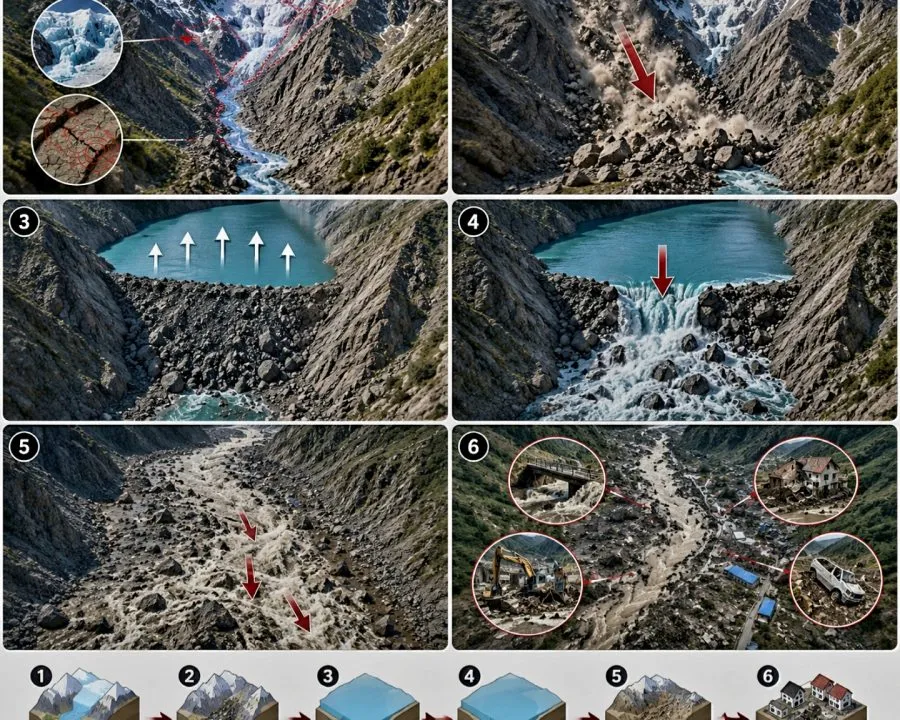
High on a Himalayan mountain flank, a colossal mass of ice and rock abruptly sheared away. The massive avalanche choked a steep river gorge, forming an impromptu natural dam. When that temporary barrier breached under mounting hydrostatic pressure, an immense wall of water, ice, boulders, and slurry surged down the valley. Within moments, vibrant settlements were engulfed and erased.
Experts believe an ice-rock avalanche was the catalyst behind the catastrophic Nepal Tibet flash flood on 26 August. The deluge carved a path of devastation from Tibet’s Gyirong sector down through Nepal’s Rasuwa district, leaving hundreds of people missing in the rubble.
A Sudden Surge
On Wednesday morning, an unprecedented wall of floodwater cascaded from Tibet into Nepal’s Bhote Koshi river system in Rasuwa district. Eyewitness video revealed this was no ordinary seasonal flood. It was a torrential slurry laden with pulverized stone, churning timber, and thick mud screaming through the mountain defile at terrifying velocity. Bridges were snapped from abutments, concrete buildings collapsed, vehicles were tumbled like pebbles, and hydroelectric installations suffered severe damage before the deluge dispersed toward the Trishuli River basin.
Where Did the Water Come From?
Early satellite analysis indicates that high on the Tibetan slopes, a massive detachment of glacier and bedrock cascaded into the Lhende Khola river canyon. This massive avalanche created a temporary dam. As glacial melt and river flow backed up behind the barrier, hydrostatic pressure built up until the fragile dam gave way, releasing stored water and debris in an unstoppable flash flood.
Unlike engineered concrete spillways, natural dams made of loose rock, gravel, and permafrost are structurally unstable. When they fail, the trapped reservoir releases almost instantaneously, sweeping along every loose boulder and tree in its path.
Why Are Debris Flows So Destructive?
Flash floods in high alpine terrain are fundamentally distinct from lowland river flooding. Lowland rivers rise over hours or days. In the Himalayas, extreme vertical gradients convert the gravitational potential energy of water into raw kinetic fury.
When high-density mud and boulders mix with floodwaters, they form a viscous debris flow with immense kinetic mass. Such flows easily crush multi-storey masonry, sweep away heavy steel bridges, and scour roads down to bare bedrock in seconds. That destructive power was on full display in the videos recorded on 26 August.
Hundreds Missing
The full human toll remains difficult to quantify. Official international agency reports indicate at least 494 fatalities, with hundreds more unaccounted for, including foreign trekkers and pilgrims caught along the border passes.
On the Tibetan side, landslides struck the Gyirong crossing, where rescue operations continue amid damaged infrastructure and cut communications.
The Fragile Himalayas
The Himalayas are among the most tectonically active and geologically young mountain ranges on Earth. The Indian tectonic plate continues to push relentlessly northward into the Eurasian plate, predisposing the terrain to earthquakes and rockfalls. Climate warming adds severe stress: retreating glaciers destabilize permafrost slopes and spawn expanding proglacial lakes, heightening the dangers of Glacial Lake Outburst Floods (GLOFs) and debris flows.
The region has seen clear warnings before: in July 2025, a glacial flash flood in Rasuwa Gadhi washed away a crucial bridge connecting Nepal with China.
The Peril Is Not Over
Upstream slopes remain dangerously unstable, with the lingering risk of secondary blockages and subsequent floods. Authorities have evacuated communities in low-lying riparian zones to higher ground.
This catastrophe serves as a sobering reminder: an environmental event high on an uninhabited mountain peak can unleash devastating ruin hundreds of kilometres downstream within minutes.
When ice, rock, water, and gravity converge in the high peaks, even a quiet mountain stream can transform in an instant into an unstoppable torrent of destruction.