Are We Truly Alone in the Universe?
Gazing into the night sky, stars appear as countless pinpricks of light. Yet behind every point shines an incandescent sun, frequently orbited by retinue planets where oceans, atmospheres, and temperate conditions might thrive.
Does biology elsewhere stop at microbial slime, or have technological civilizations emerged to build telescopes, contemplate deep space, and wonder, as we do, whether they are solitary minds in a silent universe?
Science possesses no definitive answer. Yet based on astronomical surveys, primitive life across the cosmos appears plausible, whereas detecting intelligent, technological life presents a vastly more complex puzzle.
Is Earth the Only Habitable World?
For centuries, humanity assumed our solar system was an astronomical anomaly. Today, observational astrophysics has proven that planetary systems are common.
Since the 1990s, astronomers have confirmed thousands of extrasolar worlds. NASA’s Exoplanet Archive catalogues over six thousand confirmed exoplanets, ranging from incandescent gas giants to rocky terrestrial worlds situated within the circumstellar habitable zones of their parent stars.
Habitable zones designate the orbital range where stellar irradiance allows liquid water to persist on a planet with a suitable atmosphere. Yet presence within this zone does not guarantee life; Venus and Mars demonstrate that maintaining habitability requires complex balances of atmosphere, volcanism, magnetic shielding, and stellar stability.
The Cosmic Abundance of Organic Chemistry
Terrestrial life relies on carbon, hydrogen, nitrogen, oxygen, phosphorus, and sulfur—elements forged in stellar furnaces and scattered across nebulae, comets, asteroids, and interstellar clouds. Spectroscopic surveys routinely identify complex organic molecules in interstellar space, demonstrating that the chemical building blocks of biology are widespread.
The unresolved question is how prebiotic compounds self-assemble into self-replicating metabolic systems. Whether abiogenesis represents an inevitable biochemical inevitability or an extraordinarily improbable accident remains unknown.
Lessons from Terrestrial Extremophiles
Biologists once assumed living organisms required mild temperatures, calm waters, and filtered sunlight. Yet Earth’s extremophiles thrive inside hydrothermal vents, acidic hot springs, subglacial Antarctic lakes, hypersaline pools, and high-radiation environments.
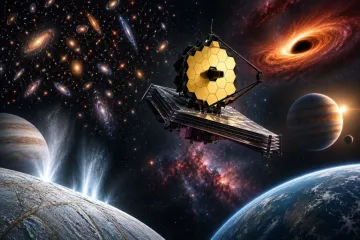
Their resilience expanded astrobiological targets: scientists now investigate the subsurface regolith of Mars, the ice-capped global oceans of Jupiter’s moon Europa, and the hydrothermal plumes erupting from Saturn’s moon Enceladus.
Microbial Life Versus Technological Civilizations
Fostering microbial life and nurturing technological civilizations are profoundly different achievements. Earth is 4.54 billion years old. Microorganisms appeared swiftly, yet single-celled life dominated the biosphere for billions of years before complex multicellularity emerged.
Dinosaurs flourished for roughly 165 million years without building radio transmitters or discovering general relativity. Anatomically modern humans emerged only hundreds of thousands of years ago, and our radio age spans barely a century.
Earth’s history demonstrates that the emergence of life does not guarantee the evolution of abstract reasoning, toolcraft, and technological civilization.
Is Intelligence the Purpose of Evolution?
Biological evolution has no predetermined destination; its sole metric is reproductive fitness within an ecological niche. Bacteria, insects, and sharks thrive without constructing computers. Human-style cognition is a contingent evolutionary adaptation shaped by specific ecological pressures, anatomical pre-adaptations, and historical contingencies.
On other worlds, marine life might exhibit profound cognition without ever developing hands, metallurgy, or electricity. Intelligence may flourish without yielding technological hardware.
The Drake Equation: Structuring the Unknown
In 1961, astronomer Frank Drake formulated his famous equation to structure scientific inquiry into the number of communicating technological civilizations in the Milky Way.
The equation considers the rate of star formation, the fraction of stars with planets, habitable environments, the origin of life, the emergence of intelligence, communication technologies, and civilization longevity.
While modern astronomy has constrained stellar and planetary terms, the biological and sociological parameters remain informed by a single data point: Earth. Extrapolating cosmic statistics from a sample size of one is intrinsically uncertain.
The Critical Factor of Longevity
Suppose thousands of technological civilizations have risen across galactic history. Even so, humanity might never detect them because cosmic expanses isolate cultures in time as well as space. One civilization may have vanished a million years ago; another may emerge a million years hence.
If technological species routinely succumb to ecological collapse, war, or synthetic catastrophes within centuries of industrialization, the likelihood of two civilizations overlapping chronologically becomes vanishingly slim. Longevity remains the Drake equation’s paramount variable.
The Fermi Paradox: Where Is Everybody?
In 1950, physicist Enrico Fermi famously asked: “Where is everybody?” Given the 13-billion-year age of the Milky Way, any civilization with interstellar travel capabilities would have had ample opportunities to explore or colonize the galaxy.
Why do astronomical surveys detect no alien megastructures, radio beacons, or interstellar probes? This tension between high probability and total absence of evidence constitutes the Fermi Paradox.
The Great Filter
One compelling explanation is the Great Filter: an evolutionary barrier along the path from prebiotic chemistry to an interstellar species that almost no species can surpass.
If the filter lies behind us—such as abiogenesis or eukaryotic multicellularity being immensely improbable—humanity is exceptionally fortunate. If the filter lies ahead—such as inevitable self-destruction through runaway technologies—our civilization faces grave perils.
The Scale of Interstellar Communication
Proxima Centauri lies 4.24 light-years distant; an exchange of messages requires nearly nine years at light speed. Across hundreds or thousands of light-years, radio dialogues become generational archives rather than active conversations.
Moreover, advanced civilizations might bypass radio waves entirely, employing directed laser communications, neutrino beams, or digital paradigms indistinguishable from cosmic background noise.
Exoplanet Atmospheres and Biosignatures
The James Webb Space Telescope analyzes transmission spectra of exoplanet atmospheres to detect chemical disequilibrium, such as the simultaneous presence of methane and oxygen, which could signify biological activity.
Astronomers detected methane and carbon dioxide in the atmosphere of K2-18 b, a sub-Neptune exoplanet. While preliminary hints of sulfur compounds excited public imagination, rigorous ongoing analyses caution that non-biological photochemical processes could account for the observations.
A Century of Searching
Decades of SETI observations have detected occasional enigmatic bursts—such as the famous 1977 “Wow!” signal—yet none have repeated or yielded verifiable technological provenance.
To conclude that the universe is empty based on current surveys is like scooping a glass of water from the ocean and concluding the sea contains no fish. Humanity has sampled only a minuscule fraction of cosmic parameters.
The Two Possibilities
Whether the universe teems with silent neighbors or humanity is an isolated anomaly, both possibilities evoke profound awe. If we are not alone, we share the cosmos with other conscious minds. If we are truly alone, terrestrial life is infinitely precious—the sole precinct where matter has awakened to gaze upon the stars and contemplate its own existence.