De Novo DNA Synthesis: Beyond the Central Dogma
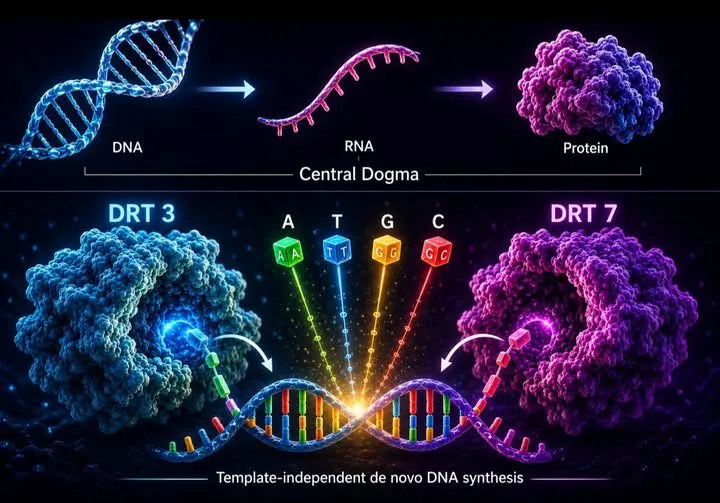
A recent discovery has challenged a foundational tenet of molecular biology known as the “Central Dogma.” Formulated in 1958 by British molecular biologist Francis Crick, its core principle describes the directional flow of genetic information:
DNA → RNA → Protein
Information stored within DNA is transcribed into messenger RNA, which is subsequently translated into proteins. When virologists discovered reverse transcriptase in 1970—an enzyme capable of synthesizing DNA from RNA templates—some believed the dogma had fallen. Yet Crick’s essential postulate held firm: once sequence information reaches protein, it cannot flow back into nucleic acids.
However, embedded within conventional genetics was another implicit rule: synthesizing new DNA requires an existing DNA template.
Nature primarily functions through copying. Enzymes called DNA polymerases read a preexisting strand as a template to build a complementary daughter strand. For decades, synthesizing genetic polymers without a guiding nucleic acid template was thought biologically impossible.
De Novo DNA Synthesis: Writing DNA Without a Template
Here lies the breakthrough. In April 2026, researchers announced the discovery of two novel enzymes: DRT3 and DRT7. These enzymes synthesize brand-new DNA sequences entirely de novo, without relying on a nucleic acid template.
This process—de novo DNA synthesis—represents the creation of genetic sequence information from scratch. Rather than merely copying text, the enzyme composes new biological information, demonstrating extraordinary molecular versatility.
When DRT3 was first characterized, scientists suspected it might represent an isolated evolutionary anomaly. But within weeks, the identification of DRT7 overturned that assumption.
DRT3 and DRT7: Two Distinct Evolutionary Solutions
Remarkably, while both enzymes perform de novo synthesis, their molecular architectures differ fundamentally.
DRT3 utilizes a structured geometric pocket that positions specific nucleotides sequentially. DRT7, by contrast, operates via an open catalytic cleft that stitches nucleotides together with greater flexibility. Nature evolved two independent biochemical solutions to achieve template-free synthesis.
This divergence suggests that template-independent DNA synthesis may have evolved multiple times throughout natural history, carrying profound biological implications.
Origins of Life and the Future of Biotechnology
At the prebiotic dawn of Earth, no preexisting genomic templates existed. Where did the primordial genetic sequences originate?
This discovery sheds fresh light on that ancient puzzle. In prebiotic environments, ancestral enzymes resembling DRT proteins may have written the earliest genetic sentences from scratch.
The biotechnological implications are equally profound. Current synthetic DNA production relies on hazardous chemical synthesis that is costly, intricate, and environmentally demanding. Harnessing DRT-like enzymatic mechanisms could usher in clean, high-fidelity enzymatic “DNA printing.”
This discovery demonstrates that life does not merely replicate inherited code; nature can write entirely new genetic languages from scratch—perhaps one of evolution’s deepest hidden wonders.