Dark Matter: Shadow of a Parallel Universe
One of the greatest conundrums in modern physics is dark matter. Put bluntly, it presents an unsettling dilemma for astrophysicists: they know it exists, but have no idea what it is. Perhaps that is why science affixed the label “dark” to its name.
Why Do We Know It Exists?
Without dark matter, galaxies would have torn themselves apart long ago. Calculating the mass of visible stars, interstellar gas, and cosmic dust reveals insufficient gravity to hold rotating spiral galaxies together. Cosmological measurements indicate that roughly five times more unseen mass exists than all visible matter combined, accounting for approximately 27 percent of the total mass-energy content of the universe.
We call it dark matter. It cannot be seen or touched, yet its gravitational pull acts upon all luminous matter across the cosmos.
What Could It Truly Be?
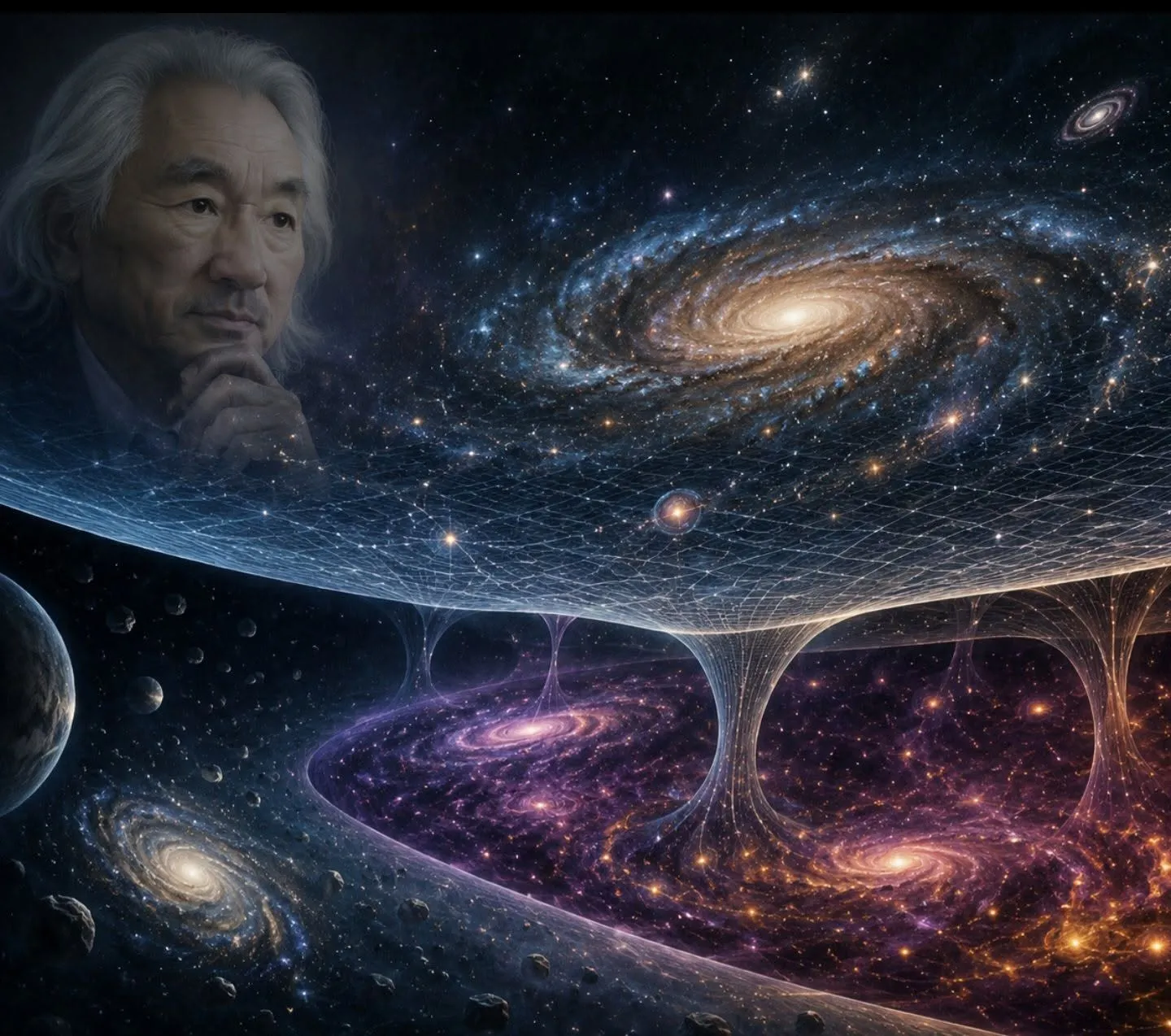
Theoretical explanations abound. Among the most intriguing perspectives is one proposed by theoretical physicist and author Michio Kaku, rooted in string theory. In string theory, our universe is envisioned as a membrane, or “brane,” floating within a vast higher-dimensional space.
This framework offers a novel view of gravity. Among nature’s four fundamental forces, gravity is extraordinarily weak. Why? One theoretical hypothesis suggests that gravity may “leak” across higher dimensions. While electromagnetic and nuclear forces are anchored to our three-dimensional brane, gravitons might roam freely into extra dimensions. If gravitational influence can cross cosmic boundaries, gravity originating in an adjacent parallel universe could exert an effect within our own cosmos.
Michio Kaku’s Hypothesis
If this holds true, what we identify as dark matter might not be exotic matter at all, but rather the gravitational footprint of matter residing in a neighboring parallel universe. We cannot detect that matter directly because it sits outside our visible spatial dimensions, yet its gravitational tug reaches into our world.
Michio Kaku’s proposal sounds like speculative science fiction, but extra-dimensional physics is a serious domain of inquiry. M-theory, an extension of string theory, incorporates eleven spacetime dimensions.
Shadow of Another Universe
The core challenge is experimental verification. Particle colliders like the Large Hadron Collider have yet to produce signals of extra-dimensional gravitons. Decades of searches for dark matter candidate particles, such as WIMPs and axions, have likewise yielded no definitive detections, prompting some physicists to ask: are we searching for the wrong thing?
Perhaps the explanation resides in extra dimensions, or in modifications to our understanding of gravity on cosmological scales. Or perhaps physical reality conceals mechanisms beyond our current imagination.
One reality remains indisputable: whatever dark matter is, it governs the architecture of every galaxy in space. Much of the cosmos visible in our night sky remains deeply mysterious. One day we may discover that dark matter is not an unseen subatomic particle, but the gravitational shadow of another universe. If so, our conception of reality will have to be rewritten from scratch.