Ultramassive Black Hole: The Cosmic Horseshoe and a Cosmic Monster
Monsters in the Deep Cosmos
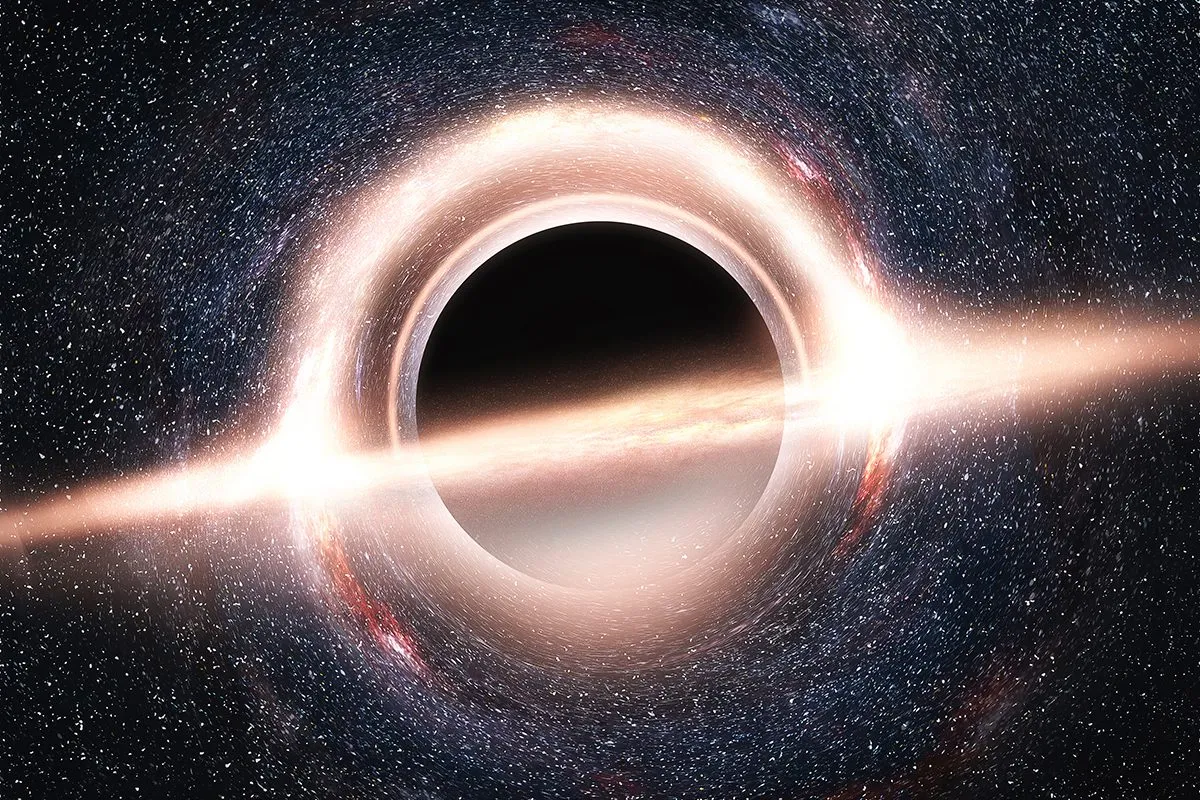
The universe continually challenges the boundaries of astrophysical models. Deep in the extragalactic void, astronomers have confirmed the existence of one of the most gargantuan objects ever cataloged: an ultramassive black hole harboring an astonishing mass of $36$ billion solar masses.
This cosmic titan lies anchored in the central core of an enormous elliptical galaxy known as LRG 3-757. Surrounding this galaxy is one of the most spectacular optical phenomena in observational astronomy: the famous “Cosmic Horseshoe.”
The Cosmic Horseshoe and Strong Gravitational Lensing
The name “Cosmic Horseshoe” reflects its striking geometric appearance. When light emitted by a distant background galaxy traverses spacetime near an intervening massive galaxy, the intense gravitational field of the foreground object bends passing light rays like a massive optical lens.
In the case of LRG 3-757, this gravitational lensing distorts the background light into an almost complete glowing optical arc spanning over $300^\circ$—forming a luminous celestial horseshoe in deep space.
Thirty-Six Billion Suns: Measuring the Titan
Led by Brazilian astrophysicist Carlos Melo-Carneiro and an international consortium of researchers, astronomers utilized spectroscopic data from the European Southern Observatory’s Very Large Telescope (VLT) in Chile alongside high-resolution imagery from the Hubble Space Telescope.
By conducting detailed kinematic modeling of stellar velocity dispersions and analyzing the precise geometry of the Cosmic Horseshoe arc, researchers calculated the central mass required to produce the observed gravitational curvature. The result revealed a central ultramassive black hole weighing approximately $36,000,000,000$ times the mass of our Sun.
Evolutionary Origins: Mergers, Quasars, or Fossil Groups?
While stellar-mass black holes arise from single collapsing hypernovas, how can a black hole grow to tens of billions of solar masses within cosmic history? Astrophysicists propose several mechanisms:
- Successive Hierarchical Mergers: Multiple rounds of major galactic collisions over billions of years, causing supermassive black holes to spiral inward and merge.
- Hyper-Accretion Quasar Phase: An intense early epoch where the proto-galaxy fed an ultra-luminous quasar at or above the Eddington accretion limit.
- Fossil Galaxy Group: LRG 3-757 represents the final evolutionary product of an entire cluster of galaxies that gravitationally cannibalized each other into a single massive elliptical galaxy.
Future Observational Prospects
Uncovering monsters like the ultramassive black hole in LRG 3-757 provides critical empirical constraints on galaxy formation and supermassive black hole co-evolution. Next-generation facilities—including the European Extremely Large Telescope (E-ELT) and the Roman Space Telescope—will reveal whether such behemoths are common throughout cosmic time.