The Higgs Boson: The Origin of Mass and the Standard Model
The Enigma of Mass in the Subatomic Realm
In fundamental physics, an enduring mystery baffled researchers for decades: why do some subatomic particles possess immense mass, while others are featherweight, and still others—like the photon—are completely massless? The resolution to this foundational riddle centers on the most celebrated particle of modern science: the Higgs boson.
Without the mechanism associated with this particle, the physical universe as we know it could never exist. Atoms could not bind together, chemical bonds could not form, and stars, planets, and living beings could never have coalesced.
The Standard Model and Bosons
Over the past half-century, theoretical physicists constructed the Standard Model of particle physics, describing the subatomic building blocks of the universe and their fundamental interactions. The fundamental constituents are organized into:
- Fermions (Quarks and Leptons): Matter particles comprising protons, neutrons, and electrons.
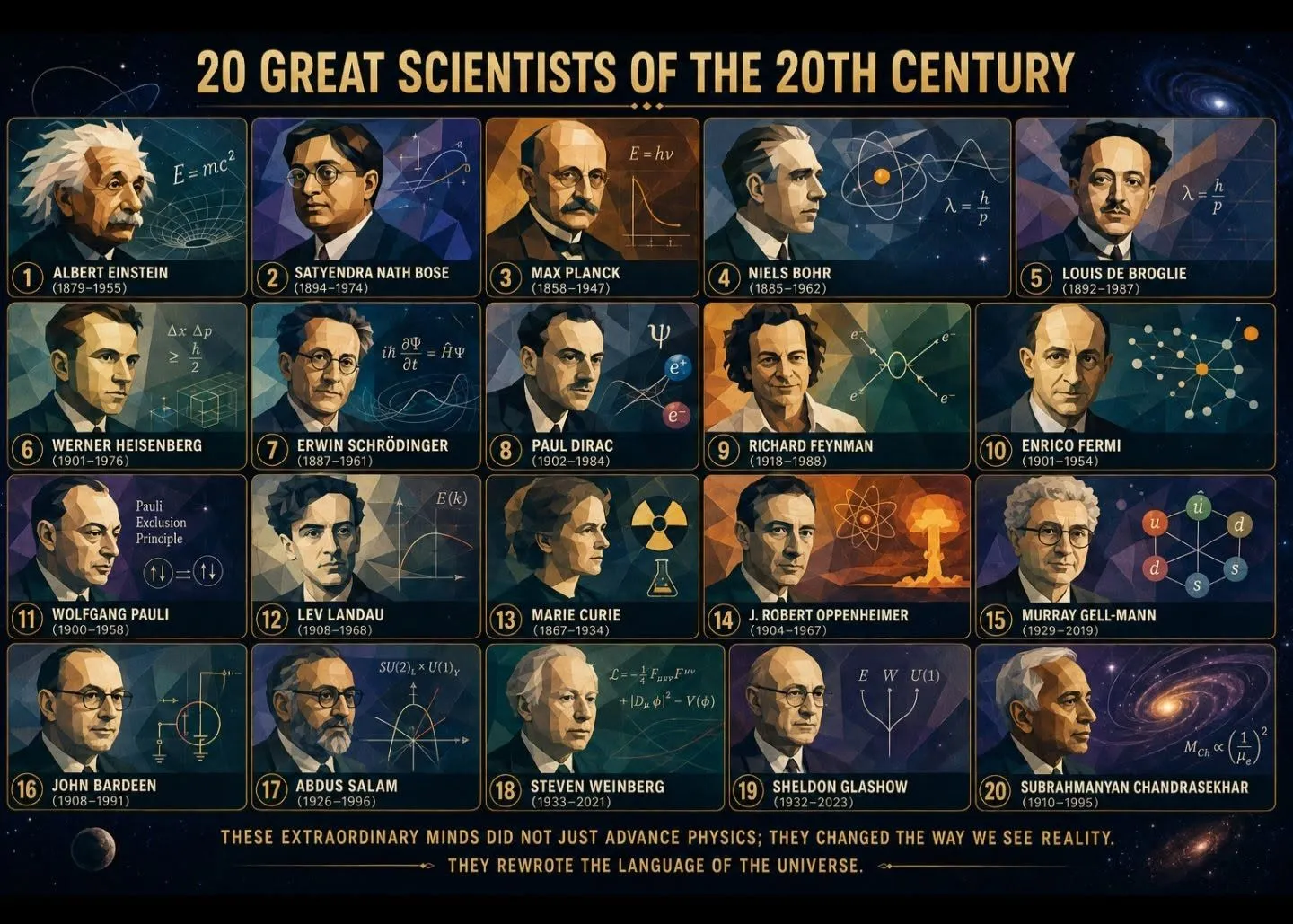
- Gauge Bosons: Force-mediating particles responsible for the electromagnetic, weak nuclear, and strong nuclear forces. The class of force-carrying particles was named “bosons” by Paul Dirac in honor of Indian theoretical physicist Satyendra Nath Bose.
The Higgs Mechanism and the Higgs Field
In the early 1960s, a theoretical crisis emerged: the electroweak theory predicted that the $W$ and $Z$ bosons mediating the weak nuclear force should be massless, yet experimental evidence proved they possessed substantial masses.
In 1964, Scottish physicist Peter Higgs, alongside François Englert and Robert Brout, proposed a brilliant theoretical framework: an invisible, scalar quantum field permeating all space, now known as the Higgs field.
Particles acquire inertial mass through their dynamic interactions with this ubiquitous field. Particles that interact strongly with the Higgs field (such as the top quark) acquire significant mass, while particles that interact weakly (such as electrons) remain light. Particles that do not couple to the field at all (such as photons) travel at the speed of light as massless entities. The Higgs boson is the localized excitation or quantum ripple of this foundational field.
The Large Hadron Collider: The World’s Greatest Experiment
Because the Higgs boson decays within $10^{-22}$ seconds, detecting it required an unprecedented scientific apparatus. The European Organization for Nuclear Research (CERN) constructed the Large Hadron Collider (LHC) beneath the Franco-Swiss border near Geneva.
Operating inside a 27-kilometer circular tunnel cooled to $-271.3^\circ\text{C}$, superconducting magnets accelerate opposing beams of protons to $99.999999\%$ the speed of light, colliding them at energies up to $13\text{ TeV}$ to recreate the extreme energy densities present during the earliest fractions of a second following the Big Bang.
The Historic 2012 Discovery and Nobel Recognition
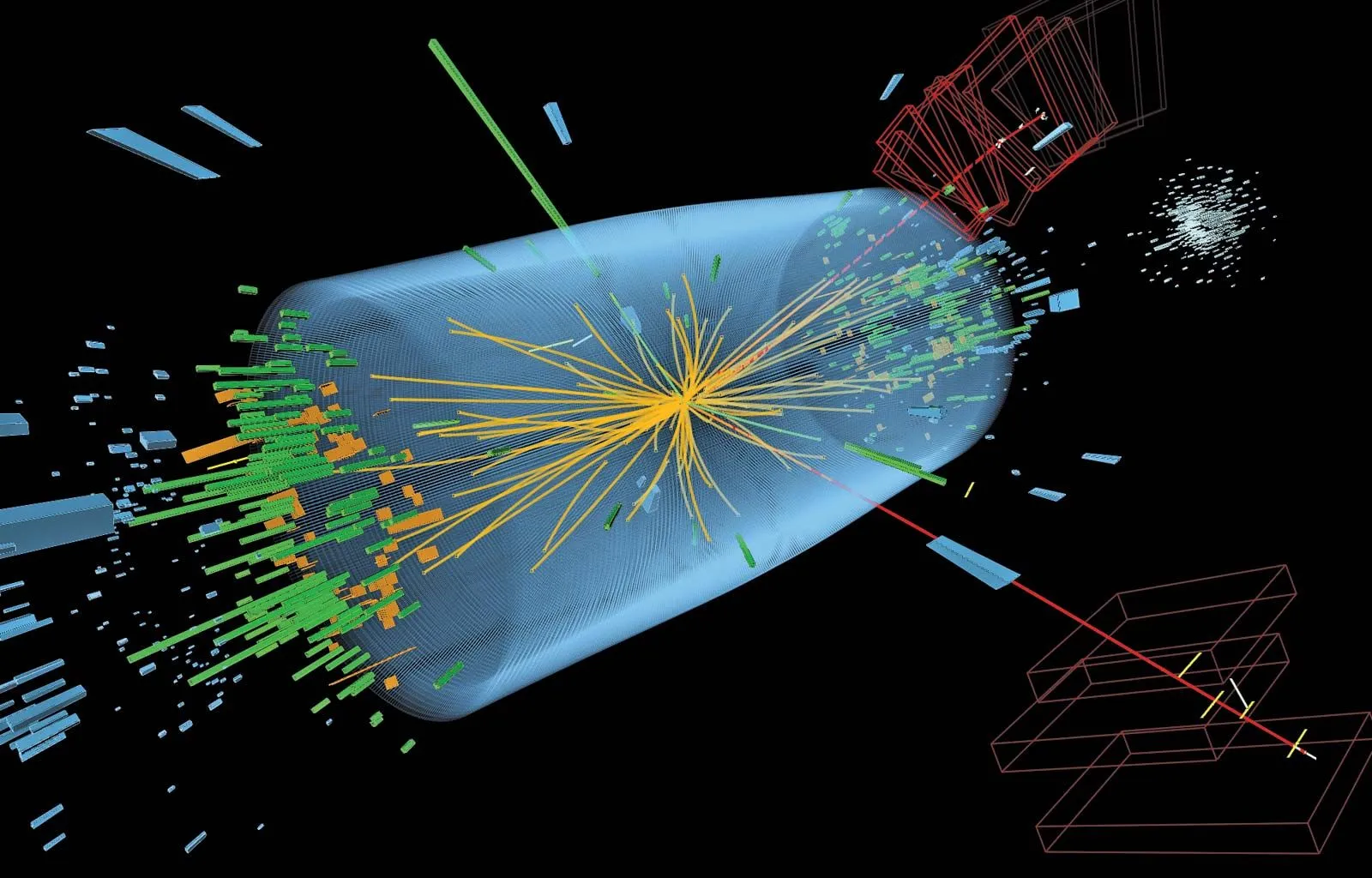
On July 4, 2012, physicists at CERN’s ATLAS and CMS experiments jointly announced the definitive discovery of a new scalar boson with a mass of approximately $125\text{ GeV}$. Comprehensive data analysis confirmed its quantum properties matched the theoretical predictions for the Higgs boson.
This landmark discovery confirmed the final missing piece of the Standard Model, leading to the award of the 2013 Nobel Prize in Physics to Peter Higgs and François Englert.
Future Frontiers in Particle Physics
The discovery of the Higgs boson inaugurated a new era of particle physics. Researchers at CERN’s High-Luminosity LHC continue to measure Higgs coupling constants with extreme precision, probing for subtle deviations that could provide clues to dark matter, supersymmetry, and physics beyond the Standard Model.