Jamal Nazrul Islam: The Visionary Cosmologist Who Calculated the End of Time
Prodigy of Bengal and the Hallways of Cambridge
On February 24, 1939, in the town of Jhenaidah in undivided Bengal, was born Jamal Nazrul Islam (known globally to scientific colleagues as J. N. Islam)—a mathematical prodigy who would become one of South Asia’s most distinguished theoretical physicists and cosmologists.
After graduating with first-class honors in mathematics from St. Xavier’s College in Kolkata, Islam traveled to Trinity College, Cambridge, in the early 1960s to pursue advanced research in applied mathematics and theoretical physics. At Cambridge’s Institute of Theoretical Astronomy, he shared research rooms and formed deep lifelong friendships with icons of modern physics, including Stephen Hawking, Roger Penrose, and Freeman Dyson.
The Ultimate Fate of the Universe
While mainstream cosmology in the 1960s and 1970s was intensely focused on the origins of the cosmos—specifically the Big Bang singularity $13.8$ billion years ago—Dr. Islam directed his analytical mind toward the opposite horizon: What will happen to the universe in the unimaginable, distant future?
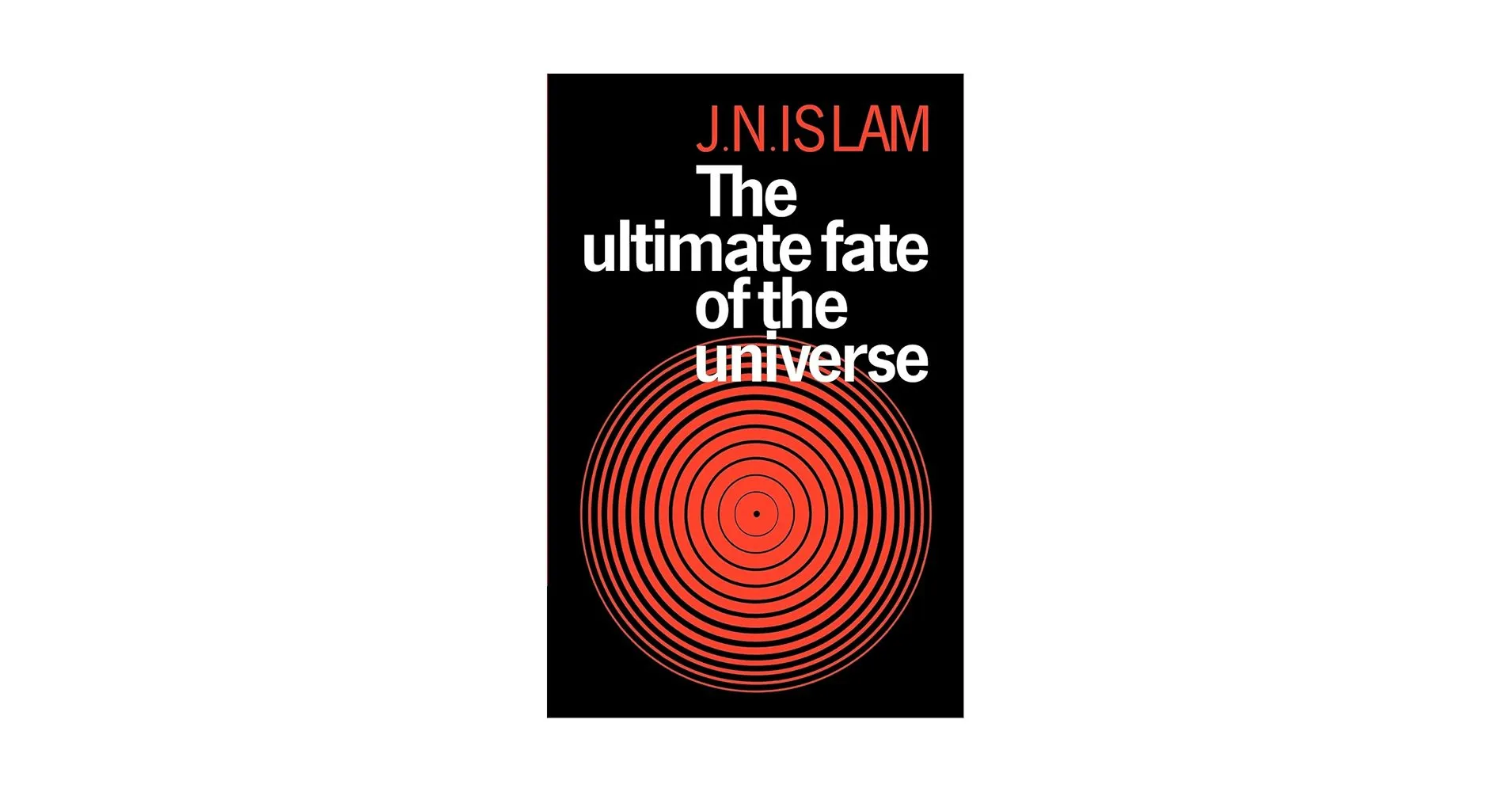
In 1977, Islam published a landmark paper in the Quarterly Journal of the Royal Astronomical Society detailing the ultimate physical evolution of cosmic matter. Building upon this research, he authored the seminal 1983 book “The Ultimate Fate of the Universe”, published by Cambridge University Press.
In this classic monograph, translated into multiple languages, Islam mathematically examined the long-range thermodynamic futures of an open versus closed cosmos:
- The death of stars and the exhaustion of nuclear fuel in galaxies.
- The formation of degenerate stellar remnants—white dwarfs, neutron stars, and stellar-mass black holes.
- The eventual decay of protons, dissolving conventional baryonic matter.
- The evaporation of supermassive black holes via Hawking radiation over googols of years ($10^{100}$ years), leaving a dilute, cold soup of low-energy photons and leptons.
Academic Footprint Across the Globe
Islam’s mathematical versatility extended into general relativity and Einstein’s field equations. He served as a visiting scholar and faculty member at prestigious institutions worldwide, including the California Institute of Technology (Caltech) and the University of Washington. His advanced mathematical textbooks—Rotating Fields in General Relativity (1985) and An Introduction to Mathematical Cosmology (1992)—became standard graduate references across Cambridge, Oxford, Princeton, and Harvard.
A Patriot’s Return to Bangladesh
In 1984, at the height of his international career, Professor Islam made an extraordinary decision. Declining lucrative tenured professorships, affluent living conditions, and premier laboratory access abroad, he resigned from his positions in England and returned permanently to Bangladesh to serve his homeland.
Joining the Department of Mathematics at the University of Chittagong, he established the Research Centre for Mathematical and Physical Sciences (RCMPS). Working tirelessly with personal funds and modest resources, he built an advanced research institute that trained generations of Bangladeshi mathematicians and physicists.
A Renaissance Mind and Lasting Legacy
A passionate advocate for vernacular science education, Professor Islam authored popular books in Bengali, including Krishnobibor (“Black Holes”) published by Bangla Academy, and Matribhasha O Biggan Charcha (“Mother Tongue and the Practice of Science”). In recognition of his monumental contributions, he was named Professor Emeritus by Chittagong University and awarded Bangladesh’s prestigious Ekushey Padak.
Passing away in 2013, Professor Jamal Nazrul Islam remains an indelible inspiration—a world-class scientist who mapped the end of cosmic time while remaining profoundly rooted in the soil of his motherland.