Roger Penrose: Pioneer of Cosmic Mysteries
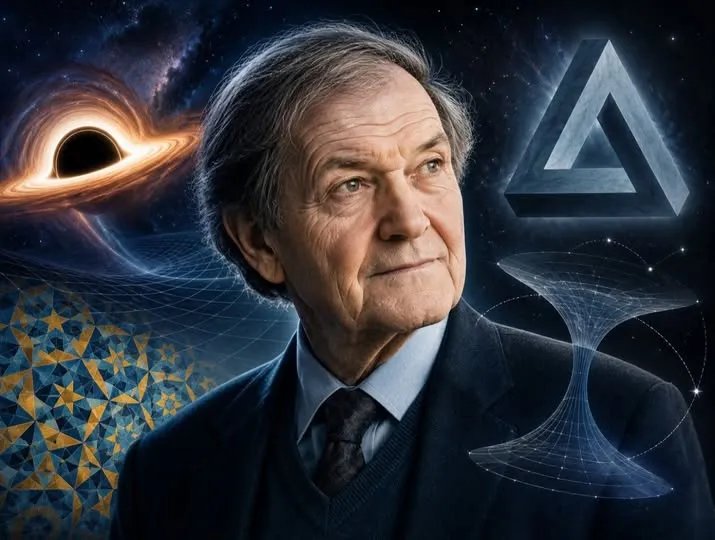
Born on 8 August 1931 in Colchester, England, Sir Roger Penrose stands among the most brilliant mathematicians and theoretical physicists of the modern era.
From black holes and the origin of the cosmos to the fabric of space and human consciousness, Penrose has fearlessly tackled the deepest questions in science. Alongside Albert Einstein and Stephen Hawking, his mathematical insights have fundamentally reshaped our understanding of reality.
The Reality of Black Holes
For decades, many leading physicists dismissed black holes as mathematical curiosities that could never form in nature.
In 1965, Penrose shattered that scepticism. Using topological methods, he proved that if Einstein’s general theory of relativity holds, gravitational collapse inevitably culminates in a gravitational singularity. Black holes were not hypothetical abstractions, but inevitable cosmic realities.
Later, collaborating with Stephen Hawking, he demonstrated that the entire universe must likewise have originated from an initial singularity.
The Wonder of Two Tiles
In 1974, Penrose discovered a pair of simple geometric tiles capable of paving an infinite plane without ever repeating the same pattern periodically. This remarkable non-periodic tiling later laid the theoretical foundation for the discovery of quasicrystals in physical chemistry.
The Origins of Human Consciousness
Penrose also proposed that human cognition cannot arise purely from algorithmic neural firing. Together with Stuart Hameroff, he formulated the Orchestrated Objective Reduction theory, suggesting quantum gravitational effects within neuronal microtubules give rise to conscious awareness.
While contested by mainstream neuroscientists, the hypothesis remains an audacious attempt to link quantum physics with the inner workings of the mind.
Does the Universe Ever Die?
According to Penrose’s Conformal Cyclic Cosmology (CCC), the demise of one cosmos seeds the dawn of the next.
Under this model, the universe does not terminate after a single Big Bang; rather, an infinite succession of aeons unfolds, with creation and dissipation repeating in an eternal cosmic rhythm.
The Nobel Prize
In 2020, Roger Penrose was awarded the Nobel Prize in Physics for his foundational proof that black hole formation is a robust prediction of general relativity.
On his 95th birthday, we celebrate a visionary whose courage to pursue profound questions continues to illuminate the mysteries of our universe.