Har Gobind Khorana: Deciphering the Genetic Code and the Birth of Synthetic Biology
From a Mud Village to Global Biochemistry
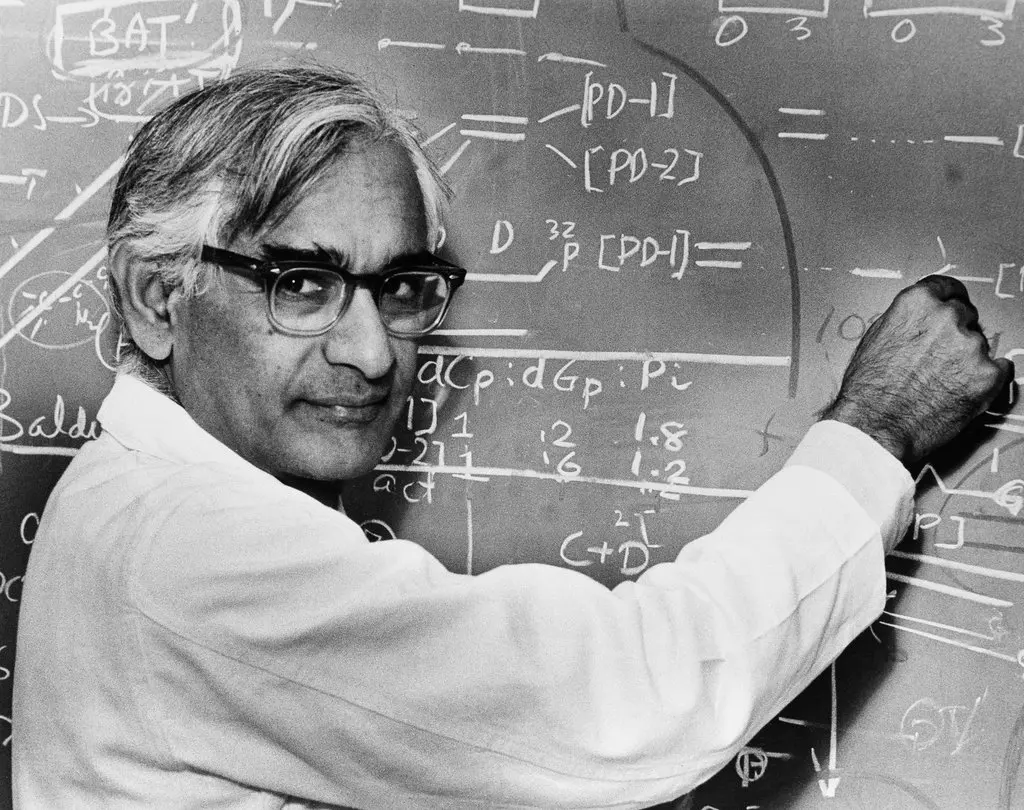
Born in 1922 in the impoverished village of Raipur in rural Punjab (now Pakistan), Har Gobind Khorana grew up in a humble home without electricity. His father, a modest village clerk, was deeply committed to his children’s education, ensuring they attended school even when classes were held under the shade of banyan trees.
Har Gobind’s extraordinary aptitude for chemistry carried him to the University of the Punjab in Lahore and subsequently to the University of Liverpool on a government scholarship, where he earned his doctorate in organic chemistry in 1948. When post-partition turmoil left him without academic prospects in his native region, Khorana emigrated to the West, ultimately joining the University of British Columbia in Vancouver and later the University of Wisconsin-Madison.
Cracking the Genetic Code
Following the 1953 discovery of the DNA double-helical structure by Watson and Crick, the central mystery of molecular biology shifted to the genetic code: How does a four-letter chemical alphabet of nitrogenous bases—Adenine (A), Thymine (T), Guanine (G), and Cytosine (C)—instruct living cells to assemble twenty different amino acids into functional proteins?
Biochemists hypothesized that the code operated via triplets of nucleotides called codons. With four bases grouped into groups of three, there are $4^3 = 64$ possible codon combinations. In 1961, Marshall Nirenberg deciphered the first codon (UUU for phenylalanine). However, deciphering all sixty-four codons demanded sophisticated chemical synthesis that existing laboratories could not achieve.
Khorana pioneered masterful methods of chemical and enzymatic RNA synthesis. By constructing defined synthetic RNA repeating sequences—such as repeating copolymers (UCUCUC…) and repeating triplets (AAGAAGAAG…)—Khorana systematically demonstrated precisely which amino acid was synthesized by each triplet sequence. By the mid-1960s, Khorana’s team had rigorously verified and completed the entire sixty-four-codon genetic dictionary.
The 1968 Nobel Prize and Synthetic Biology
For their monumental deciphering of the genetic code and its function in protein synthesis, Har Gobind Khorana, Marshall Nirenberg, and Robert Holley were jointly awarded the 1968 Nobel Prize in Physiology or Medicine.
Yet Khorana was already setting his sights on an even bolder frontier: synthesizing a complete, functional gene from scratch. In the 1970s, at the Massachusetts Institute of Technology (MIT), Khorana achieved the world’s first total chemical synthesis of an artificial gene—the transfer RNA gene of yeast. This landmark triumph marked the true dawn of synthetic biology and recombinant DNA engineering.
Furthermore, Khorana’s pioneering 1970s investigations into using synthetic oligonucleotides to replicate target DNA sequences laid the essential conceptual foundations for Kary Mullis’s later invention of the Polymerase Chain Reaction (PCR).
An Enduring Scientific Pioneer
Throughout his prolific career, Khorana remained an extraordinarily modest and self-effacing researcher. His seminal discoveries bridged organic chemistry and genetics, establishing the molecular vocabulary of life and providing the bedrock upon which modern biotechnology, gene therapy, and synthetic genomics flourish today.