The Future of Space Colonization: From Moon Bases to Proxima b
The Existential Need to Branch Beyond Earth
In 2005, former NASA Administrator Michael Griffin stated that the ultimate goal of long-term human spaceflight is to establish permanent human habitats beyond Earth, warning that remaining on a single planet jeopardizes the long-term survival of civilization. Renowned cosmologist Stephen Hawking voiced similar urgency, noting that climate change, nuclear proliferation, asteroid impacts, and ecological collapse make space colonization an evolutionary imperative.
To ensure humanity’s continuity, space agencies and private aerospace companies are systematically preparing the path toward multiplanetary life.
The Moon: Earth’s Orbital Staging Ground
While human astronauts have only set foot upon Earth’s Moon, lunar settlement represents the indispensable stepping stone for deep space exploration. Under NASA’s Artemis program, international partnerships are developing sustainable lunar infrastructure, including the Lunar Gateway orbital station and permanent surface outposts at the lunar South Pole.
Because the Moon possesses only one-sixth of Earth’s gravity and no atmosphere, launching spacecraft from the lunar surface requires substantially less fuel than Earth departures. Launching missions to Mars from lunar outposts could reduce transit times to approximately 130 days, serving as an ideal proving ground for closed-loop life-support systems and in-situ resource utilization (ISRU).
Colonizing Mars: NASA and SpaceX
Mars is the most habitable planet in our solar system aside from Earth. However, settling Mars presents formidable engineering obstacles: the Martian atmosphere is less than one percent as dense as Earth’s, consisting primarily of carbon dioxide, with sub-zero average temperatures and severe cosmic radiation.
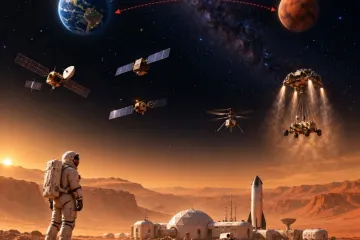
Establishing human colonies on Mars entails several crucial phases:
- Pressurized Biospheres: Subsurface or radiation-shielded habitats maintaining regulated oxygen, temperature, and atmospheric pressure.
- Water Extraction: Mining abundant subsurface water ice deposits located at Martian polar and mid-latitude regions to produce drinking water, oxygen, and liquid methane propellant.
- Hydroponic Farming: Cultivating crops in enclosed, nutrient-rich vertical hydroponic systems to establish local food autonomy.
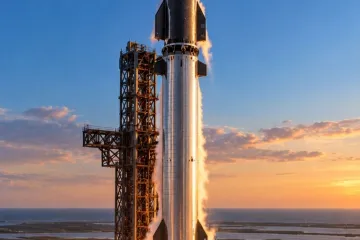
While NASA projects crewed Martian missions in the 2030s, SpaceX founder Elon Musk envisions accelerated timelines utilizing the reusable Starship rocket architecture to establish self-sustaining Martian cities.
Outer Moons and the Interstellar Frontier
Beyond Mars, robotic exploration highlights intriguing possibilities within the outer solar system. Jupiter’s moon Europa harbors a vast subsurface liquid ocean beneath its icy crust, while Saturn’s moon Titan boasts a dense nitrogen atmosphere and rivers of liquid hydrocarbons, offering unique environments for distant future outposts.
Beyond our solar system lies the interstellar frontier. Orbiting Proxima Centauri at a distance of $4.25$ light-years is Proxima b, a terrestrial exoplanet within its star’s habitable zone. With conventional chemical propulsion, Voyager 2 would require more than $70,000$ years to reach Proxima b.
To bridge this interstellar chasm, the Breakthrough Starshot initiative envisions deploying gram-scale nanocrafts (“Star Chips”) propelled by gigawatt-scale ground-based laser arrays. Traveling at twenty percent the speed of light ($60,000$ km/s), these nanocrafts could reach Proxima b in just over twenty years, transmitting the first close-up images of an exoplanet back to Earth within our lifetime.