Where Is Life in the Solar System? Key Habitats Beyond Earth
Searching Beyond Earth for Habitable Niches
Earth is currently the only confirmed abode of life in the universe. Yet astrobiologists increasingly recognize that several destinations across our solar neighborhood possess the three prerequisites for biological habitability: liquid solvents, organic building blocks, and an energy gradient. Where might extraterrestrial life exist, or have once existed, within our cosmic backyard?
Mars: Ancient Riverbeds and Subsurface Aquifers
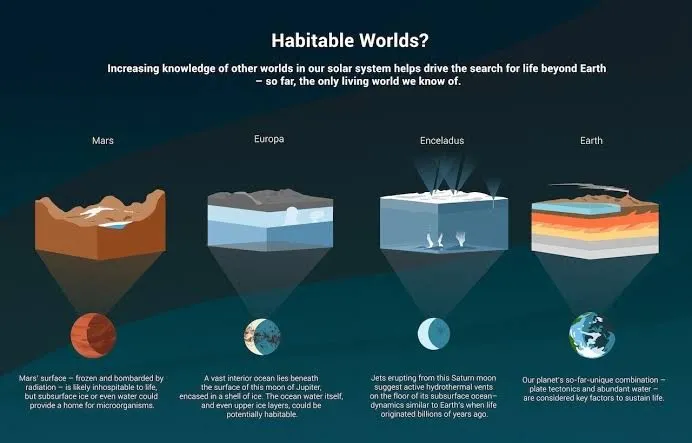
Mars remains at the forefront of astrobiological exploration. Dry river valleys, lake deltas, and sedimentary strata confirm that liquid water once flowed freely across the ancient Noachian Martian surface. Robotic explorers like NASA’s Curiosity and Perseverance rovers have detected complex organic molecules and seasonal plumes of methane in the Martian atmosphere. Deep underground aquifers, shielded from solar radiation and cosmic rays, could shelter psychrophilic microbial life today.
Europa: The Subsurface Ocean of Jupiter’s Moon
Jupiter’s moon Europa represents one of the most compelling astrobiological targets. Beneath a thick crust of fractured ice lies a global liquid water ocean containing more water than all of Earth’s oceans combined. Tidally flexed by Jupiter’s massive gravity, Europa’s rocky mantle likely hosts hydrothermal vents, mirroring deep-sea geothermal vents on Earth where chemotrophic ecosystems thrive in absolute darkness. NASA’s Europa Clipper mission is designed to analyze plumes and scout for habitable conditions.
Enceladus: Geysers Over a Saline Sea
Saturn’s small icy moon Enceladus shoots spectacular geysers of water vapor, ice grains, and organic molecules into space from fractures nicknamed “tiger stripes” near its south pole. Data from NASA’s Cassini spacecraft confirmed the presence of salts, methane, carbon monoxide, and molecular hydrogen—a metabolic energy source capable of sustaining methanogenic microbes in a warm, alkaline subsurface ocean.
Titan: Prebiotic Chemistry in Methane Seas
Saturn’s giant moon Titan presents an alternative biochemical scenario. Shrouded in a dense nitrogen atmosphere, Titan boasts rivers, lakes, and seas filled with liquid hydrocarbons like methane and ethane. NASA’s upcoming Dragonfly octocopter mission will explore Titan’s organic sand dunes and prebiotic chemistry, searching for non-water-based exotic life.
Other Habitable Candidates: Ganymede, Venus, and Triton
ESA’s JUICE mission will investigate Jupiter’s largest moon Ganymede, which harbors internal salt water. Even Venus’s temperate cloud decks—where controversial traces of phosphine were detected—and Neptune’s moon Triton remain intrigue-filled candidates. The discovery of microbial life anywhere in our solar system would prove that biology is a cosmic imperative rather than a terrestrial anomaly.