Warp Drive: Faster-Than-Light Space Travel Explained
Memories of Star Trek and Sci-Fi Dreams
Growing up, television offered few channels, and evening broadcasts brought legendary science fiction directly into our living rooms. Among them was the iconic series Star Trek. Aboard the starship USS Enterprise, astronauts journeyed across immense galactic distances, discovering strange new worlds and outwitting cosmic hazards. Most intriguing was their propulsion system: the ship could travel many times faster than the speed of light, leaping across interstellar expanses in mere moments. The fictional technology enabling this was the warp drive. While Star Trek was pure fantasy, it sparks a profound scientific question: is superluminal travel—traveling faster than light—truly impossible in the real world?
Einstein’s Relativity and the Cosmic Speed Limit
According to Albert Einstein’s special theory of relativity, the speed of light in a vacuum—approximately 299,792 kilometers per second—is the ultimate cosmic speed limit. No material object possessing mass can ever accelerate to, or exceed, this boundary. As an object approaches light speed, its relativistic mass increases toward infinity, requiring an infinite amount of energy to accelerate further, while its length contracts to zero and time grinds to a halt. Our fastest spacecraft operate at only a tiny fraction of this universal threshold.
Voyager 2 and the Immensity of Interstellar Space
Launched by NASA in 1977, the spacecraft Voyager 2 has crossed the outer heliosphere into interstellar space. Traveling at roughly 15.4 kilometers per second, its velocity corresponds to a meager 0.005 percent of the speed of light. At this rate, reaching Proxima Centauri, the Sun’s nearest stellar neighbor 4.24 light-years away, would take over 70,000 years. If we could travel at the speed of light, that journey would take barely over four years.
The Grand Barrier to Interstellar Exploration
The primary barrier to interstellar voyages is the staggering distance separating the stars. Celestial bodies and neighboring galaxies span millions to billions of light-years. Humanity currently lacks any propulsion technology capable of bridging these chasms within a human lifetime, motivating physicists to explore whether theoretical loopholes exist within general relativity.
Miguel Alcubierre and the Warp Drive Concept
In 1994, Mexican theoretical physicist Miguel Alcubierre published a seminal paper proposing an ingenious mechanism for superluminal travel that does not violate Einstein’s local laws: the Alcubierre warp drive. Inspired directly by Star Trek, Alcubierre derived an exact solution to the Einstein field equations, now known as the Alcubierre metric, demonstrating that spacetime itself can be manipulated.
The Fabric of Spacetime
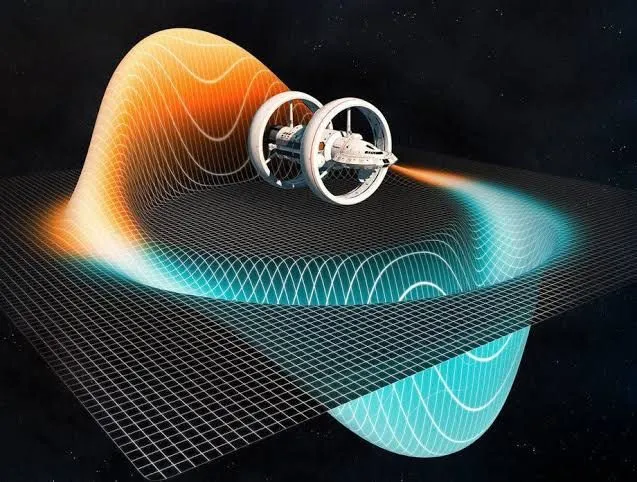
In general relativity, space and time are fundamentally interwoven into a four-dimensional continuum known as spacetime. Physicists often visualize spacetime as a flexible rubber membrane. Massive objects curve this fabric, and that curvature is what we perceive as gravity. The greater the mass, the deeper the gravitational well. Gravity, in Einstein’s view, is purely geometric curvature.
Negative Energy and Quantum Mechanics
To produce the geometric warping required for his drive, Alcubierre’s solution required an exotic substance possessing negative energy density. While classical physics forbids negative energy, quantum field theory permits local negative energy states through quantum vacuum fluctuations. A classic empirical demonstration is the Casimir effect, where uncharged parallel conducting plates experience an attractive force in a vacuum due to restricted quantum zero-point modes. However, generating large macroscopic quantities of negative energy remains entirely beyond existing technology.
How a Warp Bubble Functions
Alcubierre demonstrated mathematically that a ring of negative energy could contract the fabric of spacetime in front of a spacecraft while expanding spacetime behind it. This creates a localized distortion termed a “warp bubble”. The spacecraft sits inside a flat, uncurved region of spacetime inside the bubble. To observers within the bubble, the vessel experiences no crushing acceleration forces or extreme relativistic time dilation, yet the bubble itself sweeps across space at an apparent velocity exceeding light.
Shortcutting Cosmic Distances
Locally, the starship never moves faster than light relative to the space immediately surrounding it; instead, spacetime itself contracts ahead and expands behind. This is the ultimate cosmic shortcut. It complies fully with general relativity because the universal speed limit strictly governs matter moving through space, not the expansion or contraction of space itself. During the early universe’s inflationary epoch, space expanded far faster than the speed of light.
The Analogy of the Carpet and the Cup
Consider a simple analogy: imagine a teacup placed on the opposite side of a large living room carpet. To reach the cup, you can walk all the way across the carpet. Alternatively, you can stay where you are and pull the carpet toward you, gathering up folds until the cup arrives directly at your feet. Alcubierre’s warp drive employs this second principle: rather than racing across billions of kilometers, it compresses the spacetime fabric in front of you.
Theoretical Elegance versus Engineering Hurdles
Although mathematically consistent within general relativity, the Alcubierre warp drive faces immense practical challenges. Early calculations suggested that powering a warp bubble would require more negative energy than the entire mass-energy content of the observable universe.
Searching for Exotic Energy Solutions
Subsequent refinements by physicists dramatically reduced the calculated energy requirement down to stellar or planetary mass equivalents. However, the fundamental barrier remains: no known method exists to generate, stabilize, or manipulate macroscopic quantities of negative energy.
Positive-Energy Warp Drives and Modern Research
In March 2021, physicists Alexey Bobrick and Gianni Martire published a groundbreaking study in Classical and Quantum Gravity presenting a class of physical warp drives powered entirely by positive energy. While these positive-energy solutions currently operate at subluminal speeds (slower than light) and require immense masses on planetary scales, they eliminated the theoretical requirement for negative energy. Organizations like Applied Physics have since initiated active research modeling constant-velocity warp geometries.
From Science Fiction toward Scientific Reality
Many revolutionary technologies began as audacious dreams in science fiction before solidifying into hard science. While a functional interstellar warp drive remains decades or centuries away, foundational research into spacetime engineering continues to deepen our grasp of relativity and quantum field theory.