Golden Age of Muslim Science: History and Pioneers
Historical Context of the Golden Age
One of the most luminous chapters in human civilization was the Golden Age of the Muslim world, spanning from the eighth to the thirteenth centuries. During this era, Islamic civilization reached the zenith of scientific, economic, and cultural achievement. While Europe was traversing what historians often refer to as the Dark Ages, metropolitan centers such as Baghdad flourished as vibrant epicenters of scholarship, inquiry, and innovation.
The House of Wisdom and the Intellectual Revolution
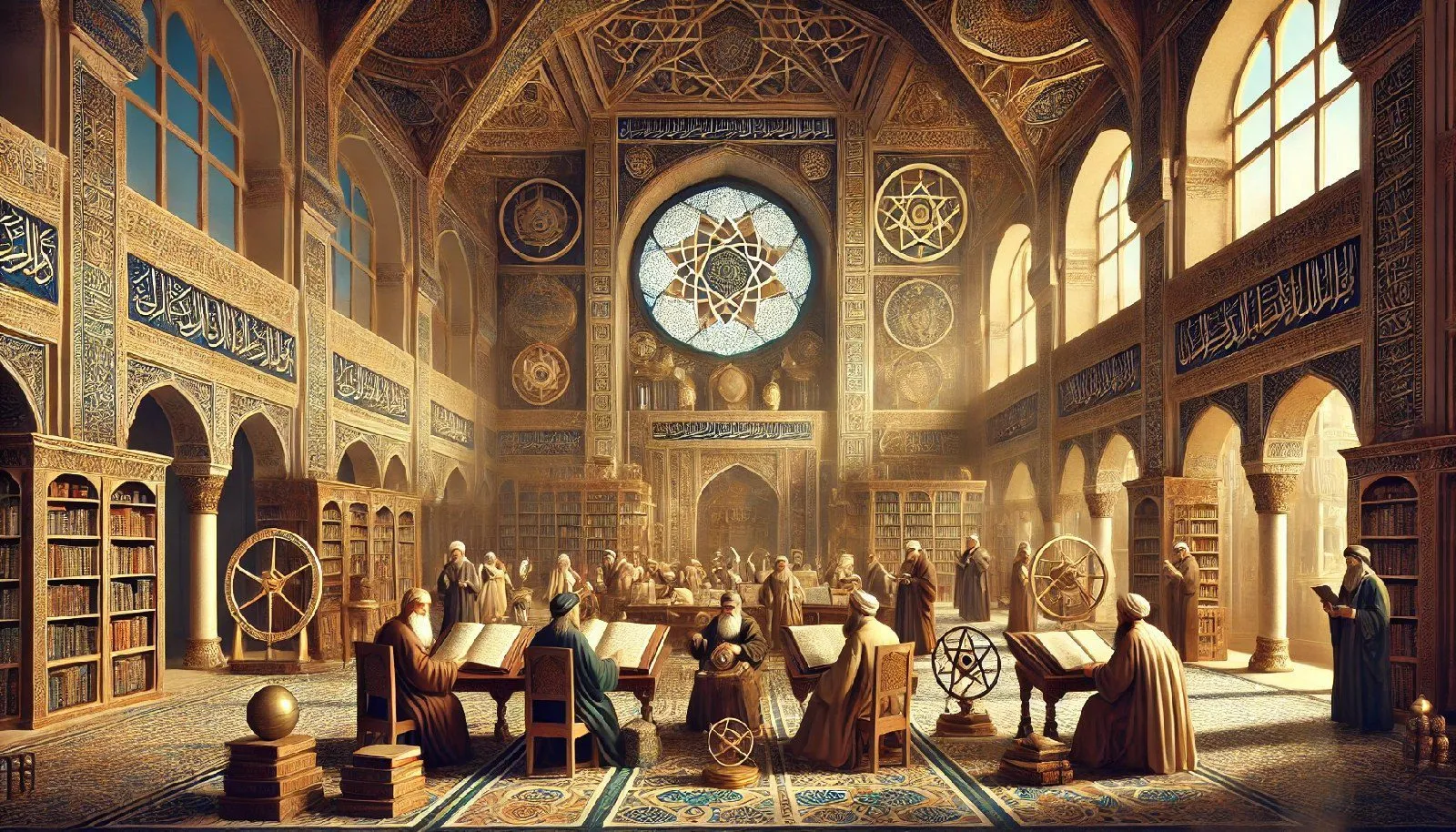
This renaissance was catalyzed by the founding of the legendary House of Wisdom (Bayt al-Hikma) in Baghdad by the Abbasid caliph Harun al-Rashid and expanded under his successor Al-Ma’mun. It was far more than an immense library; it served as a collaborative sanctuary where scholars of diverse faiths, ethnicities, and origins gathered in an ethos of open inquiry. Day and night, scribes and thinkers translated classical Greek, Persian, Roman, and Indian manuscripts into Arabic. This vibrant intellectual ecosystem gave rise to visionary polymaths, physicians, engineers, and inventors whose legacies remain woven into modern civilization. Here are the remarkable stories of several key figures:
Al-Khwarizmi: The Father of Algebra
Within the illuminated halls of the House of Wisdom worked a brilliant young mathematician named Muhammad ibn Musa al-Khwarizmi. He established algebra as an independent mathematical discipline, introducing systemic methods for balancing equations and utilizing symbols to represent unknown values. His seminal treatise, Al-Kitab al-mukhtasar fi hisab al-jabr wal-muqabala, became the foundational textbook of algebra, later translated into Latin and revolutionizing European mathematics. In fact, our modern word “algorithm” derives directly from his name. Al-Khwarizmi also popularized the Hindu-Arabic decimal positional system and the foundational mathematical concept of zero.
Omar Khayyam’s Precise Calendar
Another brilliant luminary of the era was Omar Khayyam. Celebrated worldwide as a philosopher and poet, he was equally an accomplished mathematician and astronomer. He devised geometric solutions for complex cubic equations and, under the patronage of Sultan Malik-Shah, developed an exceptionally precise solar calendar known as the Jalali calendar. Khayyam’s calendar was so accurate that it drifted by only one day in 3,770 years—surpassing even the modern Gregorian calendar in astronomical precision.
Astronomical Advances by Al-Battani and Al-Farghani
Numerous Muslim astronomers spearheaded the exploration of the cosmos. Al-Battani (known in the West as Albatenius) calculated the positions of planets and stars with unprecedented precision and pioneered fundamental trigonometric formulas. His observations directly influenced later astronomers, including Nicolaus Copernicus. In the ninth century, astronomer Al-Farghani (Alfraganus) authored a monumental work that was translated into Latin as Elements of Astronomy, serving as a standard university textbook across Europe for centuries, while also providing remarkably accurate estimates of Earth’s circumference.
The Polymath Abu Rayhan Al-Biruni
Abu Rayhan al-Biruni was another towering figure of this intellectual epoch, celebrated for his uncompromising scientific rigor and originality. A true polymath, he excelled in mathematics, astronomy, chemistry, geology, and anthropology. Al-Biruni lived in India for over a decade, studying Sanskrit texts and producing the monumental anthropological encyclopedia Kitab al-Tarikh al-Hind. Utilizing ingenious trigonometric measurements from a mountain peak, he calculated the radius and circumference of the Earth with remarkable precision, missing the modern value by less than one percent.
Maryam al-Asturlabi: Master Instrument Maker
Women scholars also made vital contributions to medieval science. In tenth-century Aleppo, Syria, a woman named Maryam al-Ijliya (popularly known as Maryam al-Asturlabi) learned the intricate art of making astrolabes from her father. She mastered the mathematical precision required to construct these essential astronomical and navigational devices. Astrolabes served as analog calculators for determining the positions of the Sun and stars, telling time, and guiding mariners across uncharted seas. Her exquisitely calibrated instruments became invaluable guides for navigators and astronomers throughout the region.
Abu Bakr al-Razi and Clinical Medicine
Medicine reached remarkable sophistication during the Golden Age, led by pioneers like Abu Bakr Muhammad ibn Zakariya al-Razi (Rhazes). Serving as chief physician of the major hospital in Baghdad, al-Razi championed empirical observation and clinical methodology. He was the first physician to clinically differentiate measles from smallpox based on precise diagnostic criteria. Revered as a pioneer in pediatrics, obstetrics, and ophthalmology, his extensive medical treatises were translated into Latin and became core curricula in European medical schools for centuries.
Ibn Sina: The Prince of Physicians
The next generation produced Ibn Sina (Avicenna), who achieved mastery over medical theory by the age of eighteen. He authored the monumental The Canon of Medicine (Al-Qanun fi al-Tibb), a five-volume encyclopedia that synthesized Greco-Roman and Islamic medical knowledge and served as the authoritative standard in European and Asian universities until the seventeenth century. Ibn Sina identified the contagious nature of infectious diseases, documented the symptoms of meningitis, and introduced quarantine protocols to contain epidemics, earning the enduring title “Prince of Physicians”.
Al-Zahrawi: The Father of Modern Surgery
In Muslim Spain (Al-Andalus), Abu al-Qasim al-Zahrawi (Albucasis) laid the foundations of operative surgery. He compiled a comprehensive thirty-volume medical encyclopedia titled Kitab al-Tasrif, whose surgical section became the bedrock of European surgical education for five centuries. Al-Zahrawi invented and illustrated over two hundred surgical instruments, including scalpels, forceps, surgical needles, and catgut sutures for internal stitching that dissolve naturally. He was also the first physician to accurately document hemophilia as an inherited condition and describe ectopic pregnancy.
Ibn al-Nafis and Pulmonary Circulation
In the thirteenth century, Syrian physician Ibn al-Nafis made a groundbreaking physiological discovery. The ancient Greek physician Galen had claimed that blood passed between the cardiac ventricles through invisible pores in the interventricular septum. Ibn al-Nafis rejected this dogma, demonstrating that no such pores exist and describing how deoxygenated blood travels from the right ventricle through the pulmonary artery into the lungs to mix with air before returning to the left atrium. This was the first correct description of pulmonary circulation, formulated nearly three centuries before William Harvey and Michael Servetus.
Jabir ibn Hayyan: The Father of Chemistry
In chemical sciences, Muslim researchers transformed speculative alchemy into an experimental science. Jabir ibn Hayyan (Geber) is widely revered as the father of early chemistry. He emphasized systematic experimentation, distillation, crystallization, calcination, and evaporation. Jabir was the first to synthesize and purify mineral acids, including hydrochloric, nitric, and sulfuric acids, and invented the alembic still for distillation. Translated into Latin under the name Geber, his extensive laboratory notes formed the cornerstone of European chemical theory.
Ibn al-Haytham: The Pioneer of Modern Optics
Hasan Ibn al-Haytham (Alhazen), born in Basra, revolutionized optics and established the modern scientific method. In his masterpiece Kitab al-Manazir (Book of Optics), he refuted the ancient intromission and emission theories of Euclid and Ptolemy, proving experimentally that vision occurs when rays of light reflect off external objects and enter the eye. He formulated the laws of reflection and refraction, investigated spherical aberration, and designed the camera obscura, anticipating the fundamental physics behind modern photography and telescopes.
The Banu Musa Brothers and Automated Engineering
Mechanical innovation flourished through the Banu Musa brothers—three ninth-century siblings named Muhammad, Ahmad, and Hasan. In their celebrated work Kitab al-Hiyal (Book of Ingenious Devices), they detailed more than one hundred automated mechanical devices. Their designs featured feedback controllers, self-filling vessels, fail-safe valves, and an automated flute player powered by steam or water, recognized by modern historians as one of the world’s earliest programmable machines.
Abbas ibn Firnas and the Dream of Flight
In ninth-century Córdoba, Andalusian inventor and polymath Abbas ibn Firnas dared to conquer the skies. After studying avian mechanics, he constructed a lightweight glider framed with wood and silk and covered in feathers. Launching himself from an elevated tower, he glided through the air for several moments before sustaining a hard landing due to the lack of an artificial tail to control descent. Centuries before Leonardo da Vinci or the Wright brothers, Ibn Firnas demonstrated controlled heavier-than-air gliding and inspired subsequent generations of aeronautical thinkers.
Ismail al-Jazari and Programmable Robotics
In the twelfth century, Mesopotamian polymath Ismail al-Jazari revolutionized mechanical automation. In 1206, he authored The Book of Knowledge of Ingenious Mechanical Devices, illustrating fifty complex automata, water clocks, and automated water-raising pumps. Al-Jazari’s invention of the crankshaft and connecting rod converted rotary motion into linear motion, an innovation indispensable to modern internal combustion engines and machinery. His elaborate castle clock, incorporating programmable musical automata, is celebrated today as an early analog computer.
The Decline of the Golden Age
After five centuries of intellectual and scientific brilliance, the golden era suffered severe geopolitical catastrophes. In 1258, Mongol armies led by Hulagu Khan sacked Baghdad, destroying the House of Wisdom and casting countless irreplaceable manuscripts into the Tigris River. The loss was profound. Subsequent political fragmentation, foreign invasions, inward-looking dogmatism, and the eventual fall of Granada in 1492 steadily curtailed independent scientific patronages. In modern times, the 57 OIC member nations contribute approximately 1.17 percent of global scientific publications, highlighting how far the contemporary Islamic world drifted from its illustrious scientific heritage.
Lessons for a Modern Renaissance
Yet the history of the Golden Age demonstrates that whenever a society fosters open inquiry, embraces intellectual diversity, and invests in rigorous scholarship, extraordinary progress is possible. Scholars in Baghdad, Cairo, and Córdoba translated universal knowledge without sectarian bias, laying the bedrock for the modern scientific revolution. Embracing that spirit of curiosity and scientific pursuit offers a clear blueprint for revitalizing research and education today.