Voyager 2: NASA's Journey into Interstellar Space
The Grand Tour of the Outer Solar System
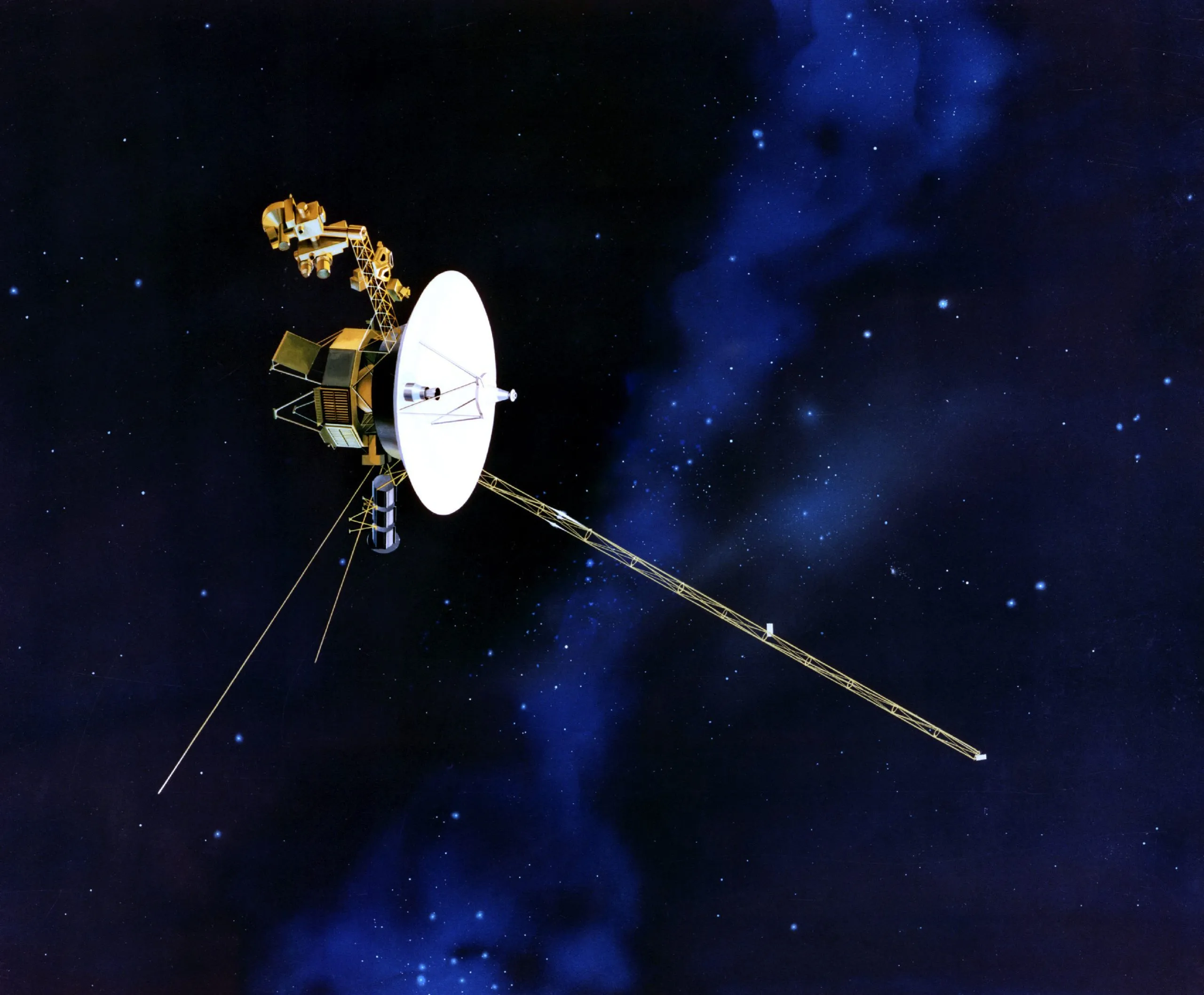
On August 20, 1977, NASA launched Voyager 2 from Cape Canaveral, Florida, on an extraordinary expedition designed to capitalize on a rare geometric alignment of the outer gas giants that occurs only once every 175 years. While its twin, Voyager 1, was dispatched on a faster trajectory past Jupiter and Saturn, Voyager 2 embarked on humanity’s legendary “Grand Tour,” becoming the only robotic spacecraft to perform close flybys of all four giant outer planets: Jupiter, Saturn, Uranus, and Neptune.
Planetary Discoveries Across the Outer Realm
During its decades-long planetary tour, Voyager 2 fundamentally reshaped planetary science:
- Jupiter (1979): Captured stunning high-resolution imagery of the Great Red Spot and discovered a faint planetary ring system alongside multiple Jovian moons.
- Saturn (1981): Probed the intricate ring dynamics, braided shepherd moons, and atmospheric temperature gradients of the ringed planet.
- Uranus (1986): Provided humankind’s first and only close-up exploration of the tilted ice giant, discovering 10 new moons, two new rings, and an anomalous tilted magnetic field.
- Neptune (1989): Documented the roaring Great Dark Spot, supersonic atmospheric winds, and active nitrogen ice geysers erupting from the frozen surface of moon Triton.
Crossing the Heliopause into Interstellar Space
In November 2018, more than four decades after launch, Voyager 2 crossed the heliopause—the boundary where the solar wind is arrested by the interstellar medium—officially entering pristine interstellar space at a distance of approximately 18 billion kilometers from Earth. Traveling at roughly 15.4 kilometers per second (over 55,000 km/h), the probe transmits unprecedented real-time measurements of interstellar magnetic fields, plasma density, and galactic cosmic rays.
Communicating Across Billions of Kilometers
Maintaining communication with a robotic spacecraft billions of kilometers away requires extreme technological prowess. Flight controllers communicate with Voyager 2 exclusively via the 70-meter Deep Space Station 43 (DSS-43) radio dish located at NASA’s Deep Space Network complex in Canberra, Australia. Radio signals traveling at the speed of light require approximately 16 hours to reach the distant probe, and an additional 16 hours for telemetry to return, making each two-way command cycle exceed 32 hours.
Power Management and the Long Farewell
Powered by radioisotope thermoelectric generators (RTGs) converting plutonium-238 decay heat into electrical current, Voyager 2’s available power diminishes by roughly 4 watts annually. NASA engineers systematically manage power by powering down auxiliary heaters and non-essential systems, allowing essential scientific instruments to gather cosmic data for as long as possible. Long after its nuclear heart grows quiet, Voyager 2 will drift silently through the Milky Way for eons, carrying humanity’s Golden Record as a timeless cosmic message in a bottle.