Van Gogh's Starry Night: Quantum Physics Hidden Behind Art
Artistic Vision Meets Scientific Truth
Vincent van Gogh’s masterwork The Starry Night, painted in 1889 from the Saint-Paul-de-Mausole asylum in Saint-Rémy-de-Provence, has mesmerized art lovers for well over a century. Its tempestuous cobalt skies, luminous crescent moon, and swirling golden eddies suggest a realm of pure emotional expression and imaginative brilliance.
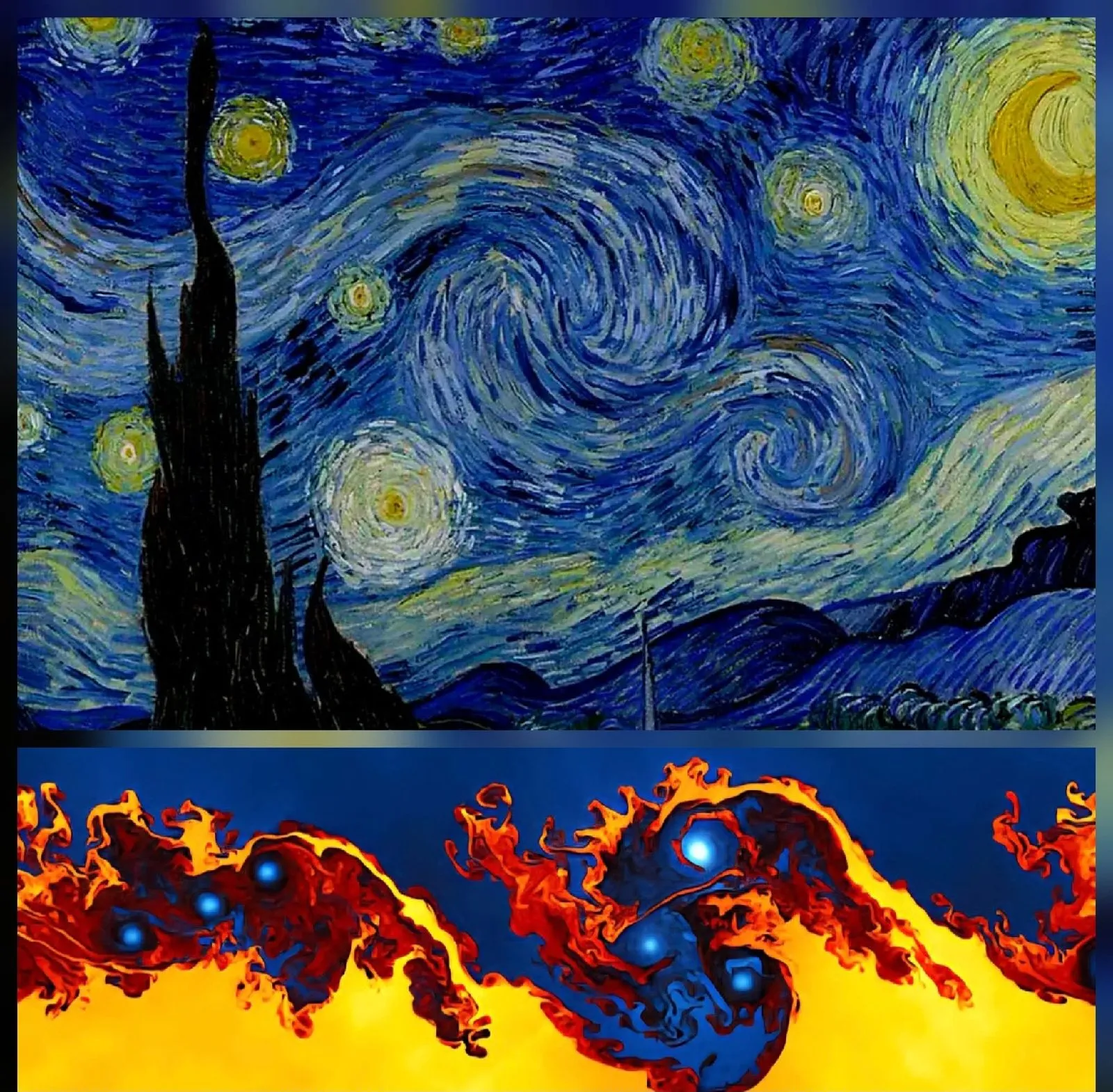
Yet modern hydrodynamic analysis and quantum laboratory experiments demonstrate that the swirling atmospheric eddies in Van Gogh’s Starry Night are not merely artistic license. Astoundingly, they reflect the rigorous mathematical physics governing fluid turbulence and quantum vortices.
Kelvin-Helmholtz Instability and Turbulent Cascades
In classical fluid dynamics, the shearing interaction between two fluid or gas layers moving at different velocities generates hydrodynamic instability known as the Kelvin-Helmholtz instability (KHI). Common manifestations include rolling atmospheric wave clouds, breaking ocean billows whipped by coastal gales, and the churning bands of Jupiter’s atmosphere.
In 2008, physicists discovered that Van Gogh’s brushstrokes across The Starry Night conform meticulously to Kolmogorov’s statistical scaling law of turbulent energy cascades. But what happens when hydrodynamic turbulence is manifested inside an ultra-cold quantum fluid where conventional viscosity vanishes?
Bose-Einstein Condensates: The Quantum Testing Ground
An international team of quantum physicists from Japan and South Korea investigated this phenomenon by cooling lithium atomic gas to within nanokelvins above absolute zero, synthesizing a Bose-Einstein Condensate (BEC).
Predicted conceptually in the 1920s by Satyendra Nath Bose and Albert Einstein, a Bose-Einstein condensate represents the fifth state of matter. At near-zero temperatures, individual atomic de Broglie wavelengths expand and overlap, causing millions of discrete atoms to coalesce into a single macroscopic quantum wave packet governed by one unified wave function.
Laboratory Vortices and Fractional Skyrmions
In their ultra-low-temperature apparatus, the researchers engineered two separate components of the condensate traveling at distinct velocities to trigger a quantum Kelvin-Helmholtz instability. The resulting shear boundary produced miniature quantum eddies that rapidly organized into exotic topological textures known as eccentric fractional skyrmions.
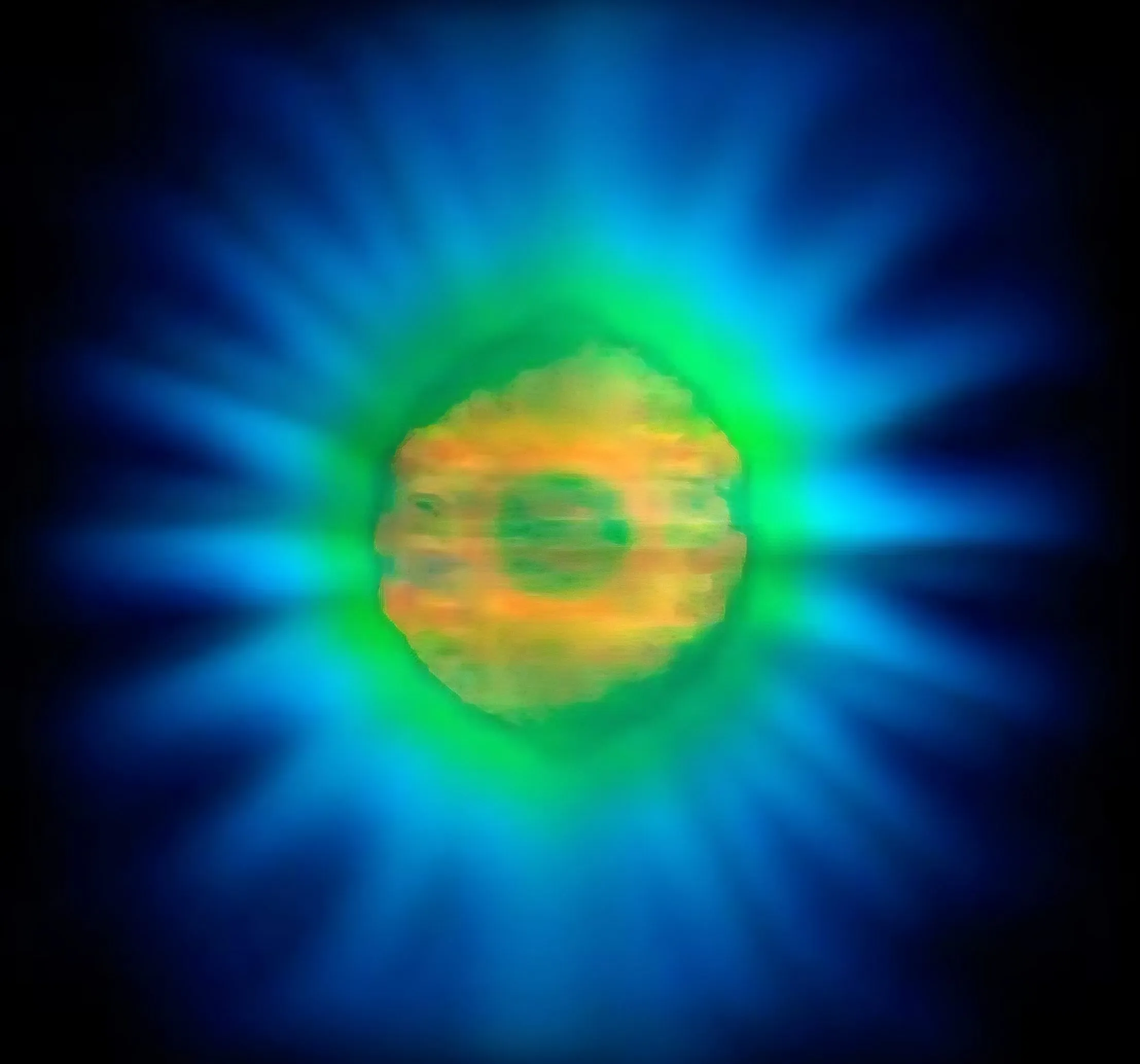
These crescent-shaped quantum vortices exhibit fractional topological charges, defying the integer topological invariants typical of standard quantum systems. High-resolution optical imaging revealed that the spatial distribution and rotation of these fractional skyrmion vortices closely mirror the luminous swirling halos and crescent structures depicted in Van Gogh’s Starry Night.
Technological Horizons: Spintronics and Quantum Information
This remarkable convergence of post-impressionist art and quantum mechanics carries tangible technological consequences. Skyrmions and fractional topological excitations are central candidates in the field of spintronics, which manipulates electron spin rather than electronic charge to store and process data.
Because fractional topological states possess inherent topological protection against thermal noise and decoherence, understanding their hydrodynamic generation could enable ultra-high-density non-volatile magnetic memory architectures and robust quantum computation registers.
Conclusion
More than a century ago, Vincent van Gogh captured the turbulent rhythm of the night sky through intuitive artistic observation. Today, ultra-cold quantum physics reveals that the artist’s brushstrokes resonate with the deepest laws of nature, demonstrating the timeless unity between creative insight and the mathematical elegance of the cosmos.