Chiral Quantum State Discovered by M. Zahid Hasan
A New Frontier in Topological Physics
In the frontier of quantum condensed matter physics, Bangladeshi-American physicist Dr. M. Zahid Hasan is internationally renowned. As the Eugene Higgins Professor of Physics at Princeton University, Hasan has spearheaded transformative discoveries in topological quantum matter and novel states of matter. Recently, an international research team led by Hasan unveiled a groundbreaking phenomenon that has captivated the physics community: a newly observed chiral quantum state.
Understanding Chirality in the Quantum Domain
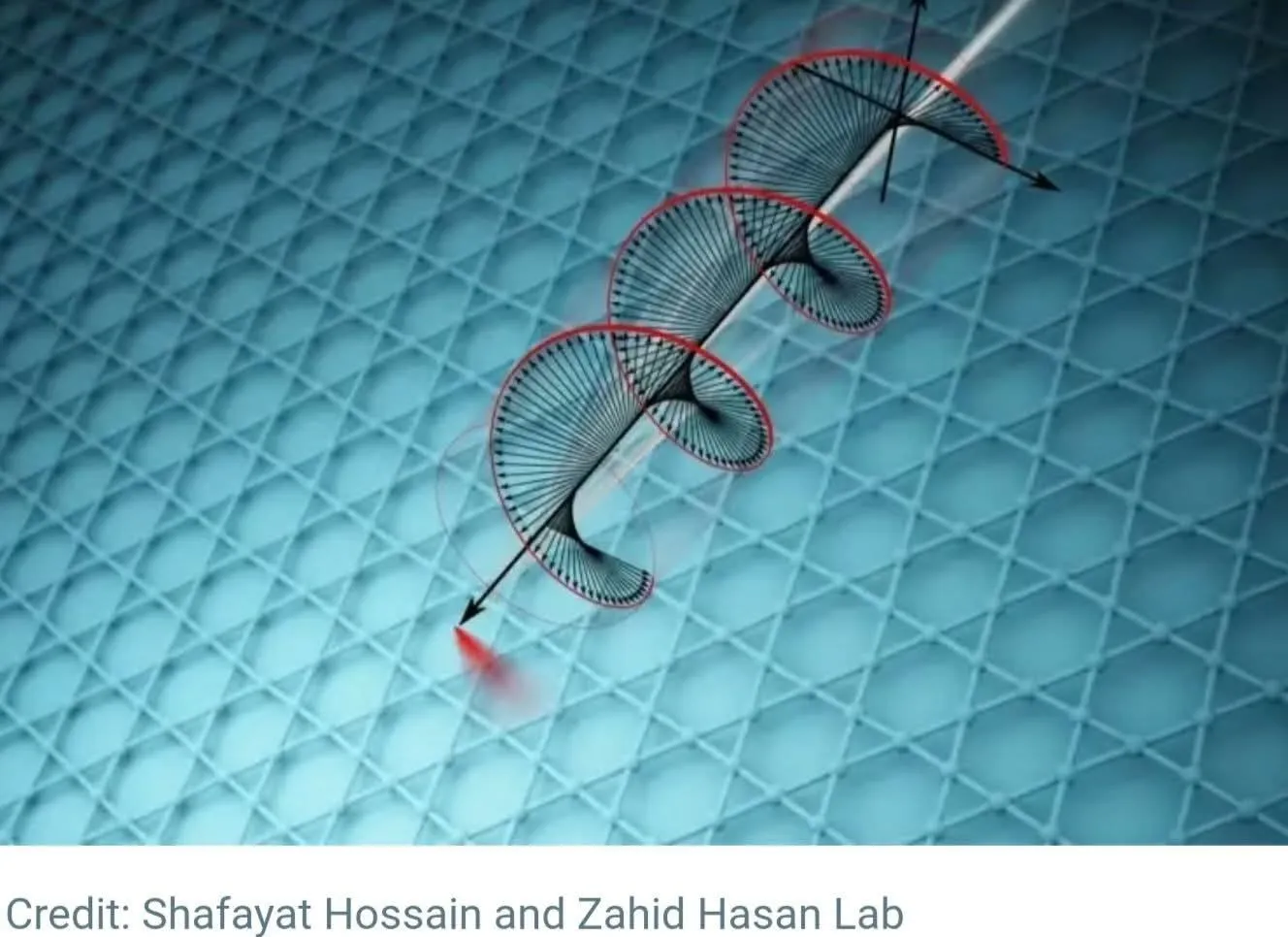
In geometry and physics, chirality refers to an intrinsic asymmetry where an object cannot be superimposed upon its mirror image, much like our left and right hands. In the subatomic world, chirality describes particles whose quantum spin and momentum align in a fixed handedness—preferentially rotating clockwise or counterclockwise along their trajectory.
Kagome Lattices and Spontaneous Chiral Magnetism
Hasan’s research group focused on a remarkable class of materials known as Kagome lattices, named after a traditional Japanese woven basket pattern of interlaced triangles. Investigating exotic Kagome magnets subjected to high magnetic fields and near absolute-zero temperatures, the researchers observed a startling quantum effect: electrons spontaneously organized into unidirectional circulating loops without external guidance. This collective, perpetual unidirectional motion represents an emergent chiral quantum state of matter.
Pioneering Energy-Efficient Quantum Technologies
Why does this discovery carry profound technological implications? In conventional conductors, moving electrons collide with atomic lattices, dissipating substantial energy as waste heat. Within a topologically protected chiral state, electrons travel along dissipationless, one-way quantum highways immune to scattering defects. This behavior could pave the way for ultrafast, energy-efficient spintronic devices, virtually heatless computer chips, and fault-tolerant platforms for quantum computers.
Global Scientific Acclaim
Professor M. Zahid Hasan previously gained worldwide acclaim for his experimental discovery of Weyl semimetals, positioning him as a leading candidate for future Nobel consideration in physics. The realization of this chiral quantum state in Kagome materials reinforces his laboratory’s legacy of pioneering discoveries, providing profound insights into quantum reality while elevating the global stature of Bangladeshi scientists.