A Wandering Black Hole Caught Shredding a Distant Star
A Cataclysmic Stellar Feast
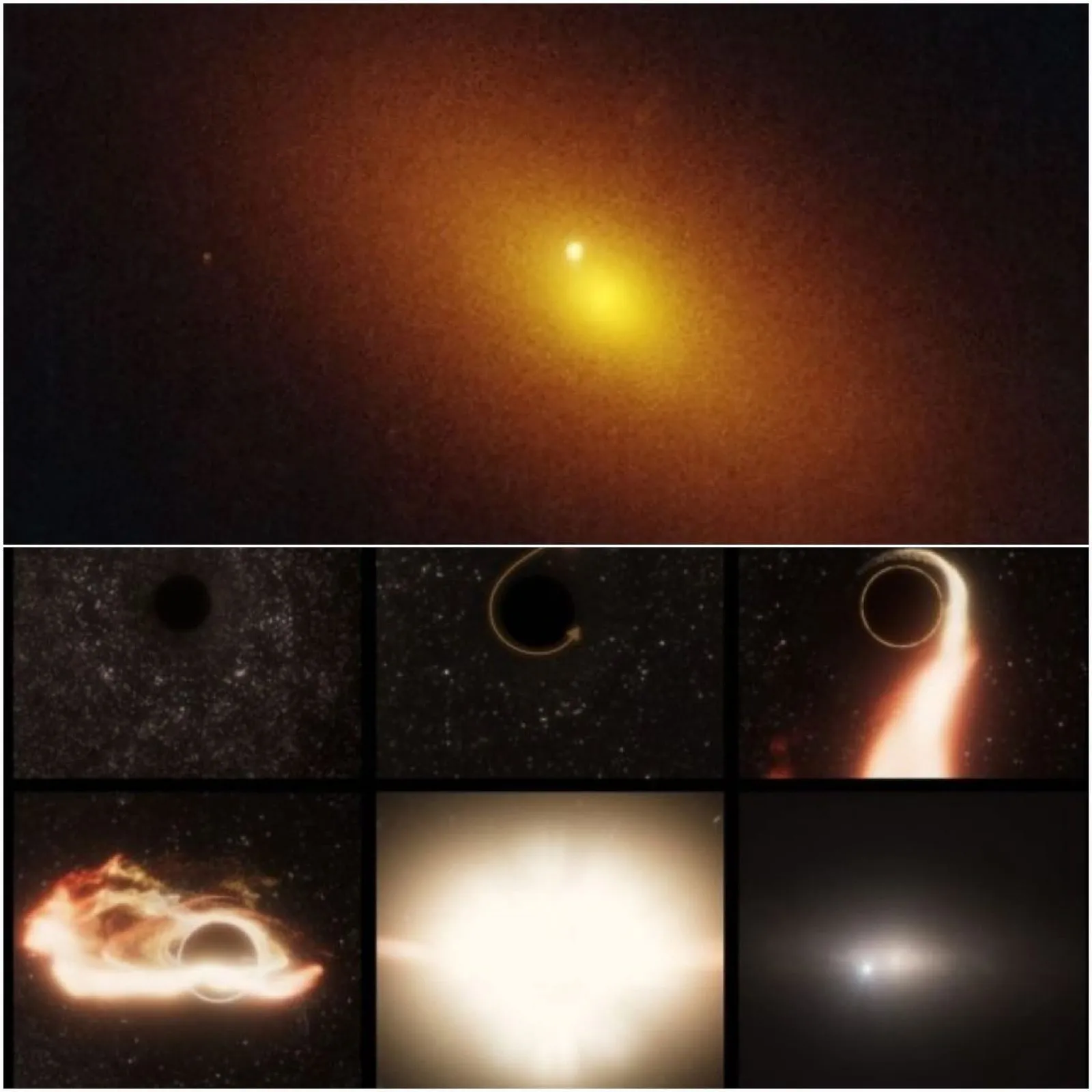
Roughly 600 million light-years from Earth, a dramatic cosmic disaster unfolded across deep space. An enormous black hole snared an unsuspecting star in its gravitational web, tearing it apart and devouring its stellar material. Astrophysicists refer to this violent cosmic execution as a Tidal Disruption Event (TDE). Recently captured by NASA’s Hubble Space Telescope, this spectacular flare has been officially cataloged as AT2024tvd.
The Terrible Agony of Spaghettification
The cosmic drama came to light in August 2024, when astronomers monitoring the Zwicky Transient Facility in California detected an unexpected burst of brilliant light. The flare originated from an unlucky star being stretched and shredded into elongated streams of superheated gas by a black hole’s extreme gravitational gradient. Astrophysicists call this extreme elongation spaghettification—the process where gravitational tidal forces stretch an object vertically and compress it horizontally into ribbon-like strands.
An Anomalous Off-Center Location
Following initial detection, a global armada of observatories—including the Hubble Space Telescope, Chandra X-ray Observatory, and the Very Large Array—swung toward AT2024tvd. Their observations revealed something extraordinary: the event was not unfolding at the center of the galaxy where supermassive black holes typically lurk. Instead, this TDE erupted approximately 2,600 light-years away from the galactic nucleus, positioned out toward the galactic periphery.
The Odyssey of a Rogue Cosmic Wanderer
Astrophysicists conclude that this object is a wandering black hole. It likely once occupied the core of a smaller galaxy that collided and merged with a larger one. During the chaotic gravitational dance of the merger, gravitational recoil kicked the black hole out of its central home, sending it wandering through the outskirts of the merged galaxy. While theoretical models have long predicted rogue black holes, directly catching one in the act of feeding at such distances is unprecedented.
Coexistence of Dual Black Holes
The rogue wanderer is estimated to possess a mass roughly one million times that of our Sun. Meanwhile, the host galaxy’s true central core harbors a separate supermassive monster weighing around 100 million solar masses. Detecting two colossal black holes coexisting within the same galaxy—with one exiled to wander through stellar fields—offers a rare glimpse into post-merger galactic dynamics.
Illuminating Hidden Black Hole Populations
Tidal disruption events provide astronomers with unique illumination to uncover dormant or hidden black holes. Events like AT2024tvd demonstrate that black holes do not exclusively reside in galactic cores; countless wanderers may drift unseen through interstellar space, revealing themselves only when an unfortunate star wanders too close to their event horizon.