Carbon Dating: Unlocking Time with Nature's Invisible Clock
Nature’s Hidden Chronometer
If someone asks your age, the answer is straightforward—you simply calculate the years from your birth. But how do archaeologists determine the age of an ancient Egyptian mummy, a prehistoric campfire hearth, or a petrified bone discovered deep underground? To answer these fundamental chronological mysteries, twentieth-century scientists unveiled an extraordinary natural chronometer: carbon dating.
Radiocarbon dating provides an objective, empirical yardstick that illuminates thousands of years of human prehistory and paleontology, transforming speculative antiquity into precise historical milestones.
The Chemistry of Carbon-12 and Carbon-14
Carbon represents the foundational building block for all organic life on Earth. In the terrestrial biosphere, carbon occurs predominantly in two distinct isotopic configurations:
- Carbon-12 ($^{12}\text{C}$): The overwhelmingly abundant and completely stable isotope, possessing 6 protons and 6 neutrons within its atomic nucleus. It does not undergo radioactive decay.
- Carbon-14 ($^{14}\text{C}$): An unstable, radioactive cosmogenic isotope containing 6 protons and 8 neutrons. Over time, it decays spontaneously at a mathematically predictable rate.
The Genesis and Biospheric Cycling of Carbon-14
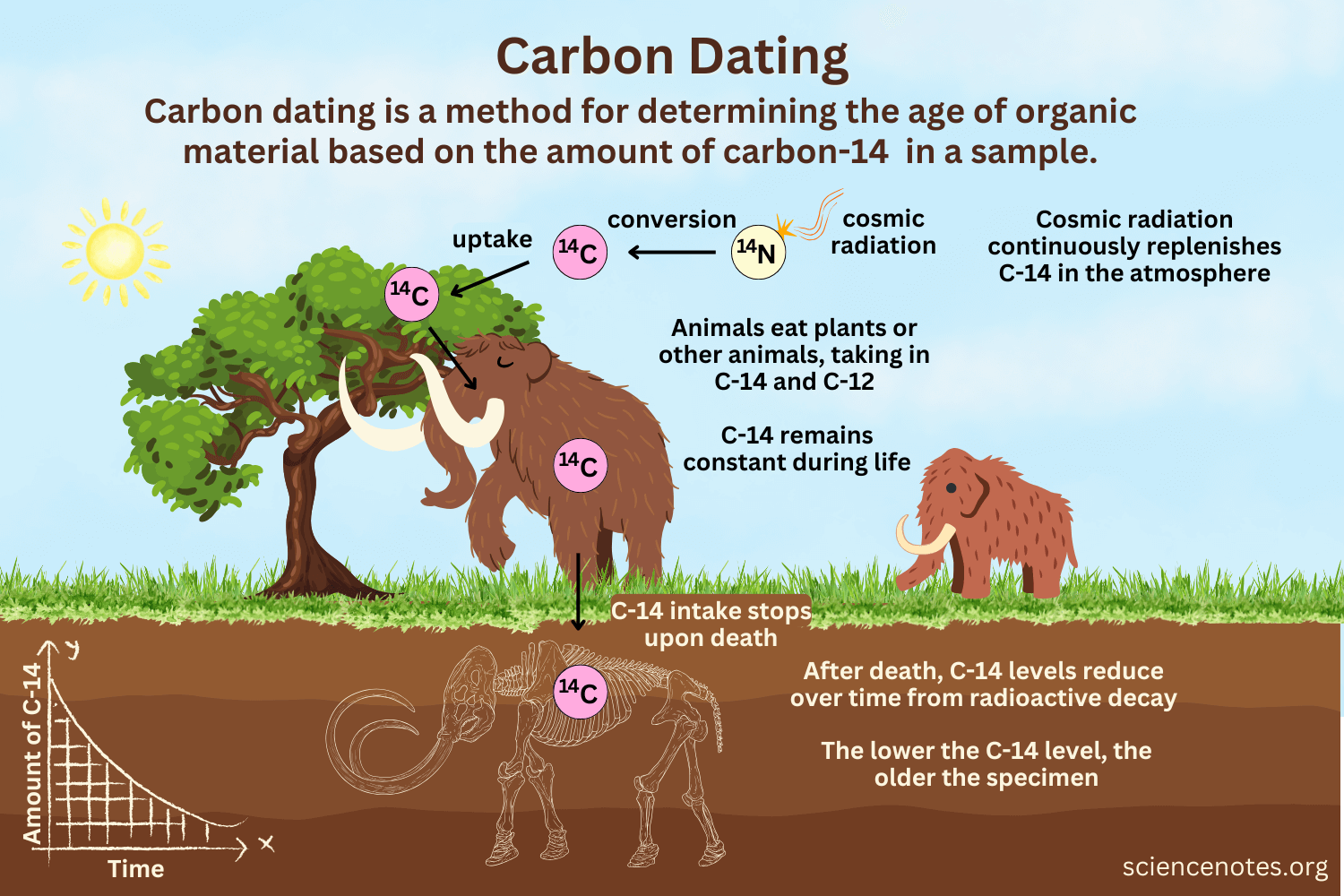
Radioactive carbon-14 is continuously forged in Earth’s upper atmosphere. High-energy cosmic rays collide with atmospheric atoms, generating energetic thermal neutrons. When these neutrons strike abundant Nitrogen-14 ($^{14}\text{N}$) nuclei, a neutron displaces a proton, transmuting nitrogen into radioactive Carbon-14.
Once formed, $^{14}\text{C}$ rapidly oxidizes into radioactive carbon dioxide ($^{14}\text{CO}_2$). Terrestrial plants assimilate this atmospheric carbon through photosynthesis, integrating trace amounts of $^{14}\text{C}$ into their cellular tissues. Herbivores and apex carnivores then ingest this carbon along the trophic food web, ensuring that all living organisms maintain a constant proportion of carbon-14 relative to stable carbon-12.
The Clock Starts at Death
During an organism’s lifespan, continuous metabolic respiration and ingestion maintain an isotopic equilibrium matching atmospheric concentrations—roughly one $^{14}\text{C}$ atom for every trillion ($10^{12}$) $^{12}\text{C}$ atoms.
However, the moment an organism dies, metabolic intake ceases immediately. No fresh carbon-14 enters the biological tissues. Instead, the trapped $^{14}\text{C}$ atoms steadily disintegrate through beta decay, emitting an electron and an antineutrino to transform back into stable $^{14}\text{N}$. Concurrently, stable carbon-12 remains constant. By measuring the diminishing ratio of $^{14}\text{C}$ to $^{12}\text{C}$ using accelerator mass spectrometry, researchers calculate precisely when the organism died.
Radioactive Half-Life
The radioactive decay of $^{14}\text{C}$ follows an invariant exponential rate defined by its half-life: approximately $5,730$ years. This predictable countdown proceeds methodically:
- After $5,730$ years, half of the original $^{14}\text{C}$ remains.
- After $11,460$ years, one-quarter remains.
- After $17,190$ years, one-eighth remains.
By measuring the residual radioactivity or counting individual atoms, geochronologists accurately date ancient biological materials.
Willard Libby and the Nobel Prize
American chemist Willard Frank Libby developed radiocarbon dating at the University of Chicago during the late 1940s. His technique provided archaeological science with its first universal chronometer, resolving longstanding chronological disputes across global prehistory. In recognition of this monumental breakthrough, Libby received the 1960 Nobel Prize in Chemistry.
Analytical Boundaries and Deep-Time Methods
Despite its revolutionary utility, carbon dating possesses practical limitations. After approximately $50,000$ to $60,000$ years (roughly ten half-lives), residual $^{14}\text{C}$ drops below detectable laboratory thresholds, rendering older samples indistinguishable from background noise.
To date geological strata and hominid fossils spanning millions to billions of years, geochemists rely on alternative radiometric systems with substantially longer half-lives:
- Potassium-Argon ($^{40}\text{K}/^{40}\text{Ar}$) Dating: Half-life of $1.25$ billion years, ideal for volcanic tuffs.
- Uranium-Lead ($^{238}\text{U}/^{206}\text{Pb}$) Dating: Half-life of $4.47$ billion years, used to date the oldest terrestrial zircon crystals.
- Uranium-Thorium Dating: Effective for dating speleothems and corals spanning hundreds of thousands of years.
Conclusion
Through the physics of atomic decay, science has illuminated deep human history. The radiocarbon clock decodes ancient human migrations, prehistoric environmental adaptations, and lost archaeological civilizations, bridging the atomic realm with our collective cultural memory.