Solar and Lunar Eclipses: Why Don't They Happen Every Month?
The Celestial Geometry of Eclipses
From elementary astronomy, we learn the basic mechanics of eclipses: a lunar eclipse occurs during a full moon when Earth passes between the Sun and the Moon, while a solar eclipse occurs during a new moon when the Moon passes between Earth and the Sun. Since every month features both a full moon and a new moon, why do we not witness solar and lunar eclipses every month?
The answer lies in three-dimensional orbital geometry. The celestial bodies of our solar system do not orbit in a single, identical flat plane.
Orbital Inclination and Nodes
Earth orbits the Sun in a planar path known as the ecliptic plane. Concurrently, the Moon orbits Earth. However, the Moon’s orbital plane is tilted by approximately $5.14^\circ$ relative to the ecliptic plane.
Because of this $5.14^\circ$ tilt, the two orbital planes intersect at only two points in space, known as orbital nodes (the ascending node and descending node). An eclipse can occur only when two specific conditions are met simultaneously:
- The Sun, Earth, and Moon must align in syzygy (a straight line).
- The Moon must be situated near one of the two orbital nodes.
Full Moon and the Mechanics of Lunar Eclipses
During a full moon, Earth sits between the Sun and the Moon. However, in most months, the Moon passes several thousand kilometers above or below Earth’s orbital plane.
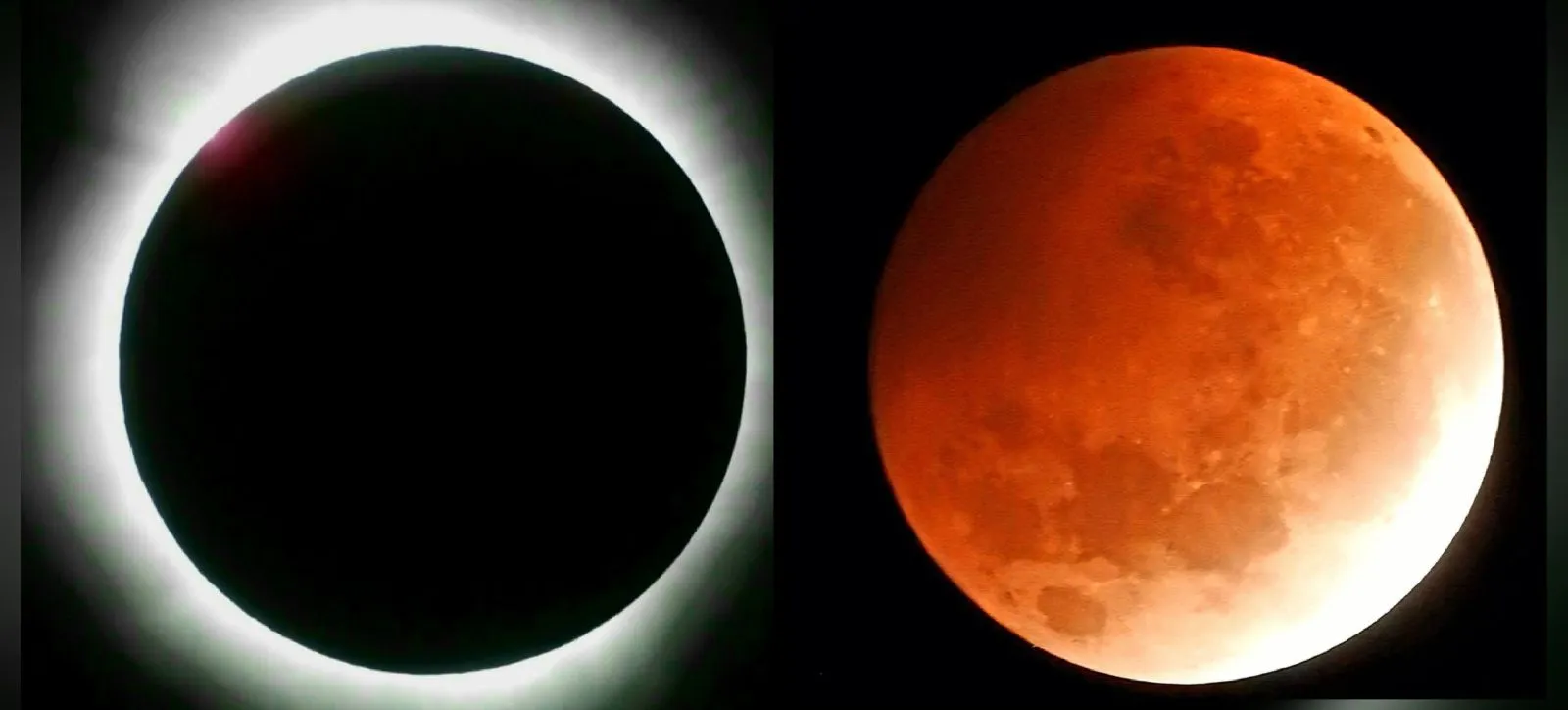
Consequently, Earth’s shadow—comprising the central umbra and outer penumbra—sweeps harmlessly through empty space without striking the lunar surface. A lunar eclipse occurs only when the full moon coincides closely with an orbital node, casting Earth’s shadow across the lunar terrain.
New Moon and the Precision of Solar Eclipses
The same orbital constraint governs solar eclipses during a new moon. In most months, the Moon’s shadow cone points above or below Earth’s disk, missing our planet entirely.
Only when a new moon occurs near an orbital node does the Moon’s shadow touch Earth’s surface. In those rare geometric moments, observers within the path of totality witness the Moon completely blocking the solar photosphere, revealing the ethereal solar corona.
Eclipse Seasons: A Cosmic Cadence
Because the Moon’s orbital nodes slowly precess westward over an $18.6$-year cycle, eclipses do not occur at fixed calendar dates. Instead, they recur during two distinct windows each year known as “eclipse seasons,” spaced approximately six months apart.
Each eclipse season lasts about 34 days, guaranteeing a minimum of two and a maximum of seven solar and lunar eclipses worldwide in any given calendar year. If the Moon’s orbit were perfectly aligned with the ecliptic without its five-degree tilt, every full moon would bring a lunar eclipse, and every new moon would deliver a solar eclipse.
Visibility: Umbra Versus Penumbra
While total lunar eclipses are visible from across entire night hemispheres and relatively easy to observe, total solar eclipses trace only a narrow umbral track across Earth’s surface. Standing within that narrow path of totality to witness a total solar eclipse remains one of nature’s rarest and most awe-inspiring astronomical spectacles.