The Shape of a Photon: Seeing the Quantum Lemon Geometry
Beyond the Mathematical Abstraction
Light is omnipresent: it streams through our windows, illuminates cities, and carries high-speed internet data across fiber-optic cables. Yet for centuries, the fundamental particle of light—the photon—existed primarily as an abstract mathematical entity: a discrete energy quantum ((E = h
u)) represented by wavy lines and Feynman diagrams. Because photons are massless, travel at the speed of light, and interact instantaneously, imaging their physical spatial distribution was long deemed impossible.
Imaging the Electromagnetic Wavepacket
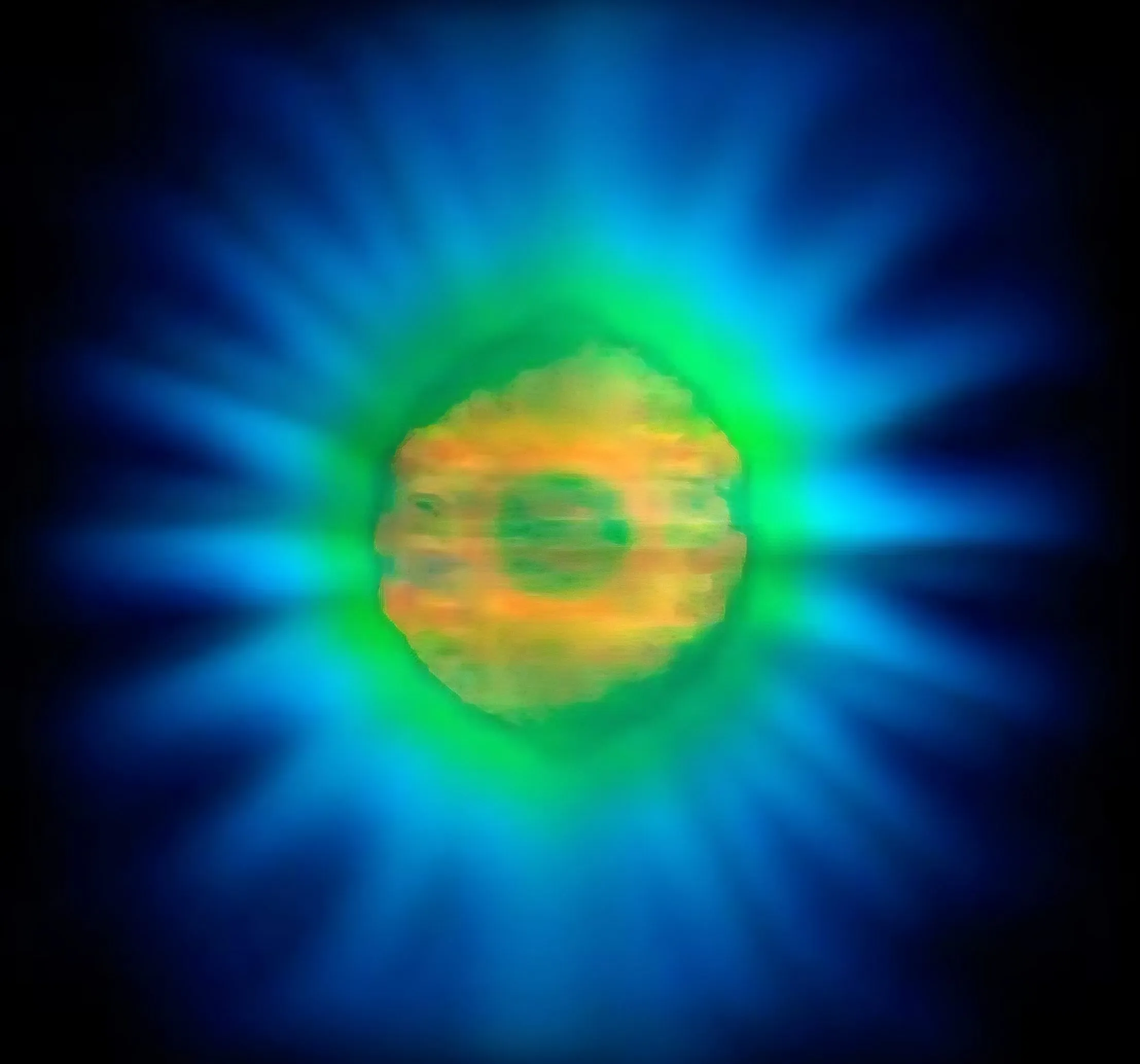
A research team from the University of Birmingham broke through this barrier, successfully reconstructing the continuous spatial profile and electromagnetic energy distribution of a single isolated photon. While not a conventional optical photograph, this breakthrough provides a precise visual map of the localized electromagnetic field configuration that defines a propagating light quantum.
The “Lemon” Geometry of Light
The resulting visual topography yielded a fascinating surprise: a photon is neither a hard spherical billiard ball nor a uniform planar wave. Instead, its localized electromagnetic field exhibits an elongated, tapered geometry resembling a lemon. The wavepacket swells prominently along its equatorial midsection and tapers symmetrically at both ends along its longitudinal axis of propagation.
Why Does a Photon Have This Shape?
In quantum electrodynamics (QED), a photon is fundamentally a localized excitation within the universal electromagnetic field. When an excited atom or quantum dot relaxes and emits a photon, the radiative boundary conditions dictate how electromagnetic energy disperses. The asymmetric spatial distribution of electric and magnetic vectors dictates that field density is concentrated along preferential directional modes, sculpting the characteristic elongated prolate profile.
Implications for Quantum Information Technologies
Resolving the precise spatial morphology of individual photons is far more than a conceptual curiosity; it unlocks major engineering advantages across emerging quantum technologies:
- Quantum Computing: Enabling photonic qubits to couple into nanophotonic circuits and quantum logic gates with minimal insertion loss and near-zero decoherence.
- Quantum Cryptography: Perfecting single-photon emitters for unhackable quantum key distribution (QKD) over terrestrial fiber networks and satellite links.
- Ultra-Sensitive Quantum Metrology: Harnessing structured light modes to perform non-destructive, sub-diffraction-limit measurements in biological cells.
From Newton’s corpuscles to Maxwell’s classical waves and Einstein’s light quanta, our perception of light has undergone repeated revolutions. Seeing the geometric silhouette of an individual photon marks another exhilarating leap into the heart of quantum reality.