Stephen Hawking: The Life and Legacy of a Theoretical Genius
An Exceptional Mind at Oxford and Cambridge
Born on January 8, 1942, in Oxford, England, Stephen Hawking blossomed into one of the most brilliant theoretical physicists since Albert Einstein. Demonstrating extraordinary mathematical aptitude from an early age, he entered University College, Oxford, at just seventeen years old. After completing his undergraduate degree in natural sciences, he moved to Trinity Hall, Cambridge, in 1962 to pursue a doctorate in applied mathematics and theoretical physics, focusing on cosmology and general relativity under the mentorship of Dennis Sciama.
Defying Amyotrophic Lateral Sclerosis (ALS)
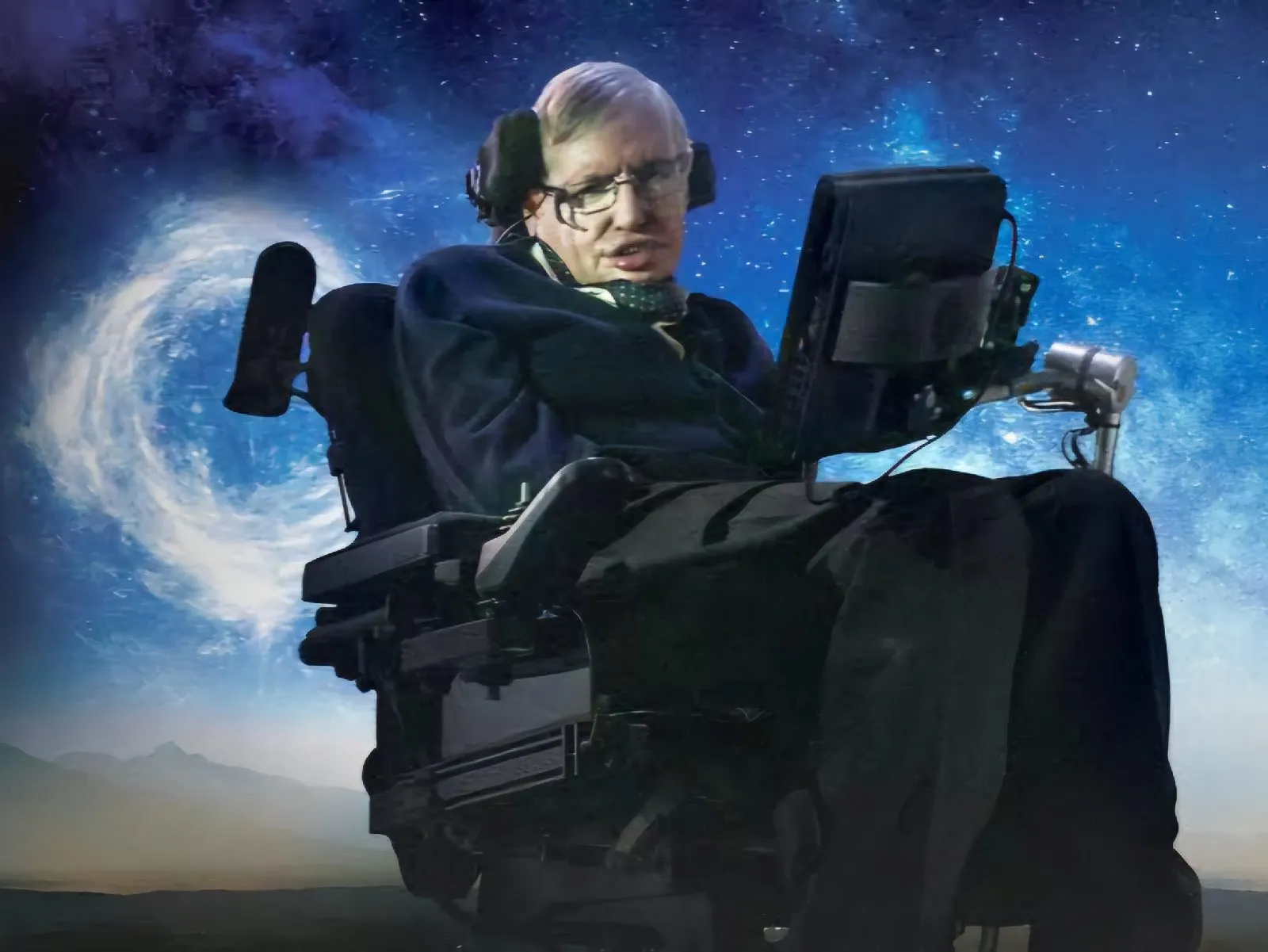
During his early graduate studies at age 21, Hawking received a devastating medical diagnosis: motor neuron disease (amyotrophic lateral sclerosis, or ALS). Physicians projected he had barely two years to live. As the neuromuscular disease relentlessly stripped away his motor functions, eventually confining him to a wheelchair and depriving him of speech following a 1985 tracheotomy, his intellectual vitality remained unbowed. Communicating via an innovative computerized voice synthesizer operated by subtle cheek muscle twitches, Hawking produced foundational cosmological discoveries across half a century of active research.
The Discovery of Hawking Radiation
Hawking’s most celebrated theoretical milestone arrived in 1974. Classical general relativity posited that nothing—not even electromagnetic radiation—could ever escape the gravitational event horizon of a black hole. However, Hawking ingeniously united relativistic gravity with quantum field theory.
He demonstrated that near the event horizon, quantum vacuum fluctuations produce pairs of virtual particles and antiparticles. Before they can mutually annihilate, one particle may plunge past the horizon while the other escapes into outer space. To an outside observer, the black hole appears to emit a faint blackbody spectrum, now universally known as Hawking radiation. Over astronomical timescales, this thermal emission causes black holes to lose mass, shrink, and ultimately evaporate in a colossal quantum explosion.
The Penrose-Hawking Singularity Theorems
Collaborating closely with mathematical physicist Roger Penrose, Hawking applied topological and differential geometry to Einstein’s gravitational field equations. Together, they formulated the Penrose-Hawking singularity theorems, mathematically demonstrating that if general relativity holds, the universe must have originated from a gravitational singularity of infinite density and curvature at the Big Bang, and that collapsing massive stars inevitably terminate in black hole singularities. This groundbreaking work formed part of the theoretical foundation for Penrose’s 2020 Nobel Prize in Physics.
A Global Ambassador for Popular Science
Beyond esoteric mathematics, Hawking championed the democratization of scientific knowledge. In 1988, he published his monumental masterpiece, A Brief History of Time. Written in accessible prose without complex tensor equations, the book elucidated cosmology, quantum mechanics, the arrow of time, and the quest for a unified theory of everything. It became an unprecedented international phenomenon, remaining on the Sunday Times bestseller list for a record 237 weeks, selling over 25 million copies in dozens of translations.
Humanitarian Vision and Enduring Inspiration
Serving for thirty years as the prestigious Lucasian Professor of Mathematics at Cambridge—a chair once occupied by Sir Isaac Newton—Hawking remained an outspoken advocate for disability rights, global health, and peaceful space exploration until his death on March 14, 2018. His life demonstrated that no physical boundaries can constrain the soaring flight of the human imagination.