Prime Editing: Highly Precise Search-and-Replace Genes
Beyond the Double-Strand Break
In October 2019, a landmark research paper published in the journal Nature by David Liu’s laboratory at the Broad Institute of MIT and Harvard unveiled a revolutionary new biotechnology: prime editing. Described as a molecular “search-and-replace” word processor for the human genome, this next-generation gene-editing platform addresses fundamental limitations that historically restricted standard CRISPR-Cas9 technology.
The Pitfalls of Traditional CRISPR-Cas9
Classical CRISPR-Cas9 operates by directing the Cas9 nuclease to cut cleanly through both strands of the target DNA double helix, generating a blunt double-strand break (DSB). The host cell’s emergency repair pathways—primarily non-homologous end joining (NHEJ)—then attempt to stitch the severed strands back together. However, this repair process is inherently sloppy, frequently introducing random nucleotide insertions or deletions (indels) and triggering off-target cuts at unintended genomic sites.
How Prime Editing Works: Molecular Architecture
Prime editing achieves surgical precision by eliminating double-strand breaks entirely. The molecular engine integrates three core innovations:
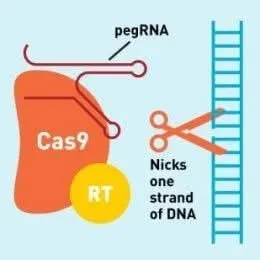
- Engineered Cas9 Nickase (H840A): Unlike the wild-type enzyme, this modified Cas9 nuclease cuts only a single strand of DNA (creating a “nick”) rather than cleaving both strands, dramatically lowering cellular toxicity and genomic instability.
- Reverse Transcriptase: Fused directly to the Cas9 nickase is an engineered reverse transcriptase enzyme capable of transcribing genetic information directly from RNA into fresh genomic DNA.
- Prime Editing Guide RNA (pegRNA): A multifunctional guide molecule that not only guides the nickase to the exact genomic target sequence, but also carries the template sequence specifying the desired genetic correction.
Once the target site is bound and nicked, the reverse transcriptase copies the correct genetic edit directly into the target DNA strand. The cell’s natural DNA mismatch repair machinery then seals the edit seamlessly into the complementary strand.
Therapeutic Potential and Correcting Genetic Diseases
Prime editing can execute all 12 possible base-to-base transitions and transversions, alongside targeted insertions and deletions up to dozens of base pairs long, without requiring double-strand breaks or exogenous donor DNA templates. Researchers estimate that prime editing can theoretically correct approximately 89 percent of all known pathogenic human genetic variants, including causative mutations for sickle cell anemia, Tay-Sachs disease, and cystic fibrosis.
Optimized Architectures: PE-max and Clinical Horizons
Subsequent iterations, such as PE-max and engineered pegRNAs (epegRNAs), have enhanced editing efficiencies while driving off-target modifications to nearly undetectable levels. Biotechnology companies have initiated pre-clinical and early-phase clinical evaluations targeting monogenic liver disorders, severe hemoglobinopathies, and inherited retinal dystrophies. As viral and non-viral delivery vectors continue to improve, prime editing stands at the forefront of curative precision medicine.