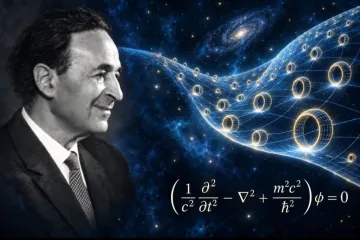
Why Atoms Are Mostly Empty Space: The Quantum Reality
The Illusion of Solid Matter
From the wooden chair beneath us to the granite rocks of mountain ranges, the material world appears reassuringly dense, continuous, and solid. Classical intuition leads us to picture atoms like tiny interlocking building blocks. Yet modern atomic and subatomic physics reveals a staggering paradox: atoms are mostly empty space. In fact, more than 99.9999999 percent of every atom’s physical volume consists of sheer spatial vacuum.
The Stadium and the Marble: Visualizing the Scale
To grasp the vastness within an atom, consider a classic scale analogy: if the atomic nucleus were scaled up to the size of an ordinary marble placed at the center of a massive soccer stadium, the surrounding electrons would orbit along the uppermost perimeter of the distant spectator stands. The entire expanse of the playing field and lower grandstands between the marble and the perimeter is completely devoid of macroscopic matter. The collective volume of our bodies, planets, and galaxies is overwhelmingly dominated by empty void.
Particles as Quantum Probability Clouds
In the quantum domain, electrons do not orbit the nucleus like planets circling a sun. Governed by Werner Heisenberg’s Uncertainty Principle and Erwin Schrödinger’s wave equation, an electron behaves as a standing probability wave—a dynamic, shimmering “electron cloud.” Rather than occupying a single trajectory, the electron exists as a probability distribution across space, oscillating at breathtaking quantum frequencies.
Quantum Field Theory: Ripples in the Fabric
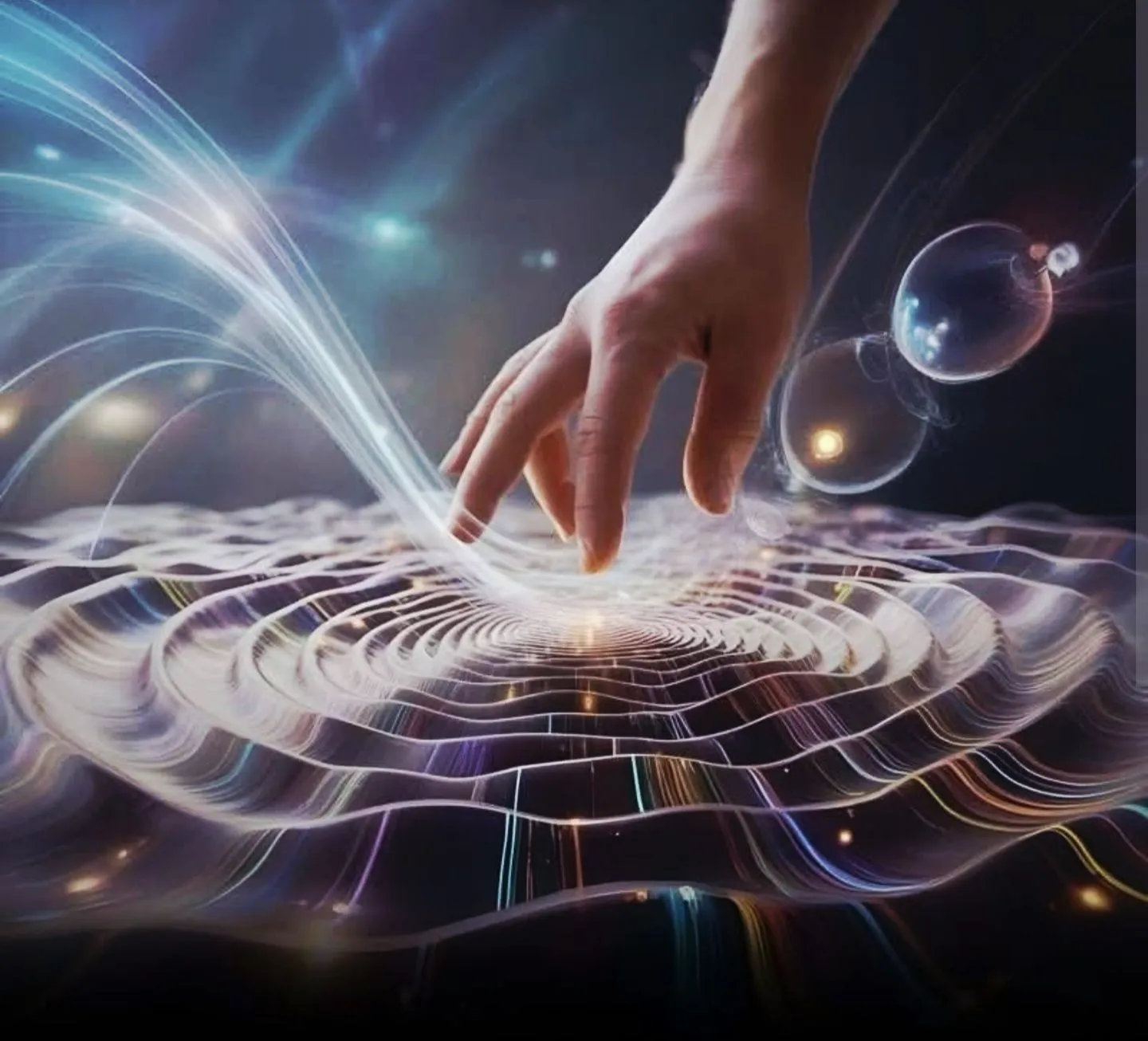
Digging even deeper, Quantum Field Theory (QFT) reveals that particles are not independent mechanical pellets. Instead, the universe is permeated by universal underlying quantum fields—the electron field, the quark field, the electromagnetic field. What we observe as a particle is merely a localized vibrational excitation or “ripple” within its corresponding field, akin to a dynamic wave swelling across the surface of an ocean.
Why Can’t We Walk Through Walls?
If atoms are almost entirely empty space, why doesn’t our hand pass straight through a solid brick wall? Two powerful quantum phenomena prevent matter from collapsing into itself:
1. Electromagnetic Repulsion
As your hand approaches the wall, the negatively charged electron clouds in your skin atoms repel the negatively charged electron clouds of the wall’s surface atoms via Coulomb electrostatic forces, exerting immense repulsive resistance at microscopic distances.
2. The Pauli Exclusion Principle
Even more fundamentally, Austrian physicist Wolfgang Pauli proved that two identical fermions (particles with half-integer spin, such as electrons) cannot occupy the identical quantum state simultaneously. When two electron clouds are pressed into proximity, they resist compression into identical quantum orbital energy levels. This quantum degeneracy pressure provides the structural rigidity that makes matter feel solid.
The Cosmic Symphony of Energy
As Albert Einstein demonstrated with (E=mc^2), mass and energy are equivalent. Matter is not passive inert substance, but highly concentrated energy orchestrated by quantum fields and fundamental symmetries. The void within the atom is not barren nothingness, but a vibrant arena of dynamic forces that sustains our cosmos.