The Standard Model: Inside the Quantum World of Matter
The Quest for Nature’s Ultimate Ingredients
For centuries, philosophers and natural scientists sought the irreducible building blocks of nature. In the early twentieth century, physics seemed simple: everything was composed of protons, neutrons, and electrons. But the advent of high-energy particle accelerators shattered that neat picture, producing a confusing “particle zoo” of hundreds of short-lived subatomic resonances. Out of this chaos emerged one of human intellect’s most triumphant frameworks: the Standard Model of particle physics.
Fermions: The Bricks of Matter
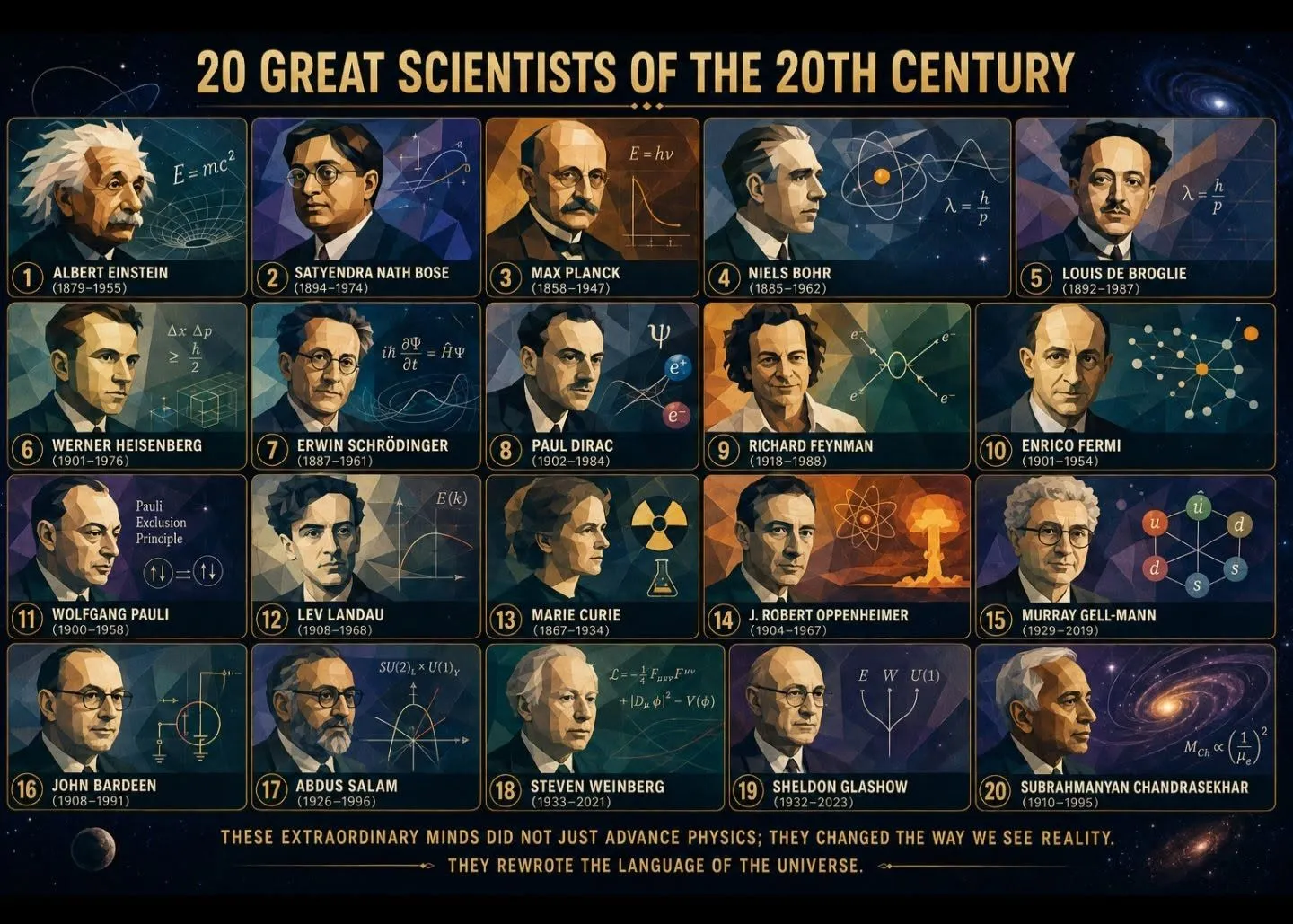
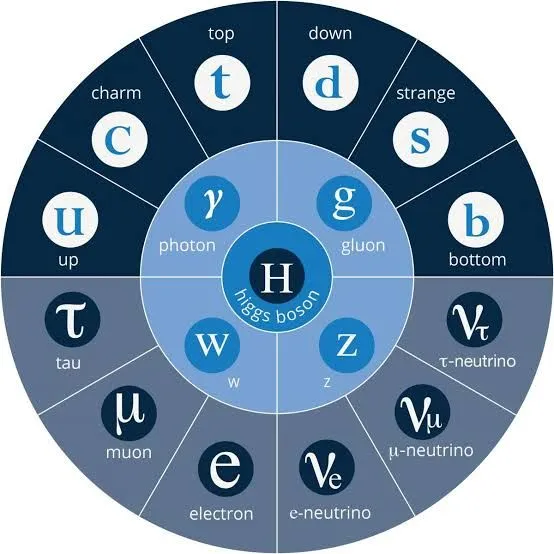
In the Standard Model, all observable matter in the cosmos is constructed from twelve fundamental spin-1/2 particles called fermions (named after Enrico Fermi), divided into two families: quarks and leptons.
1. The Six Quarks
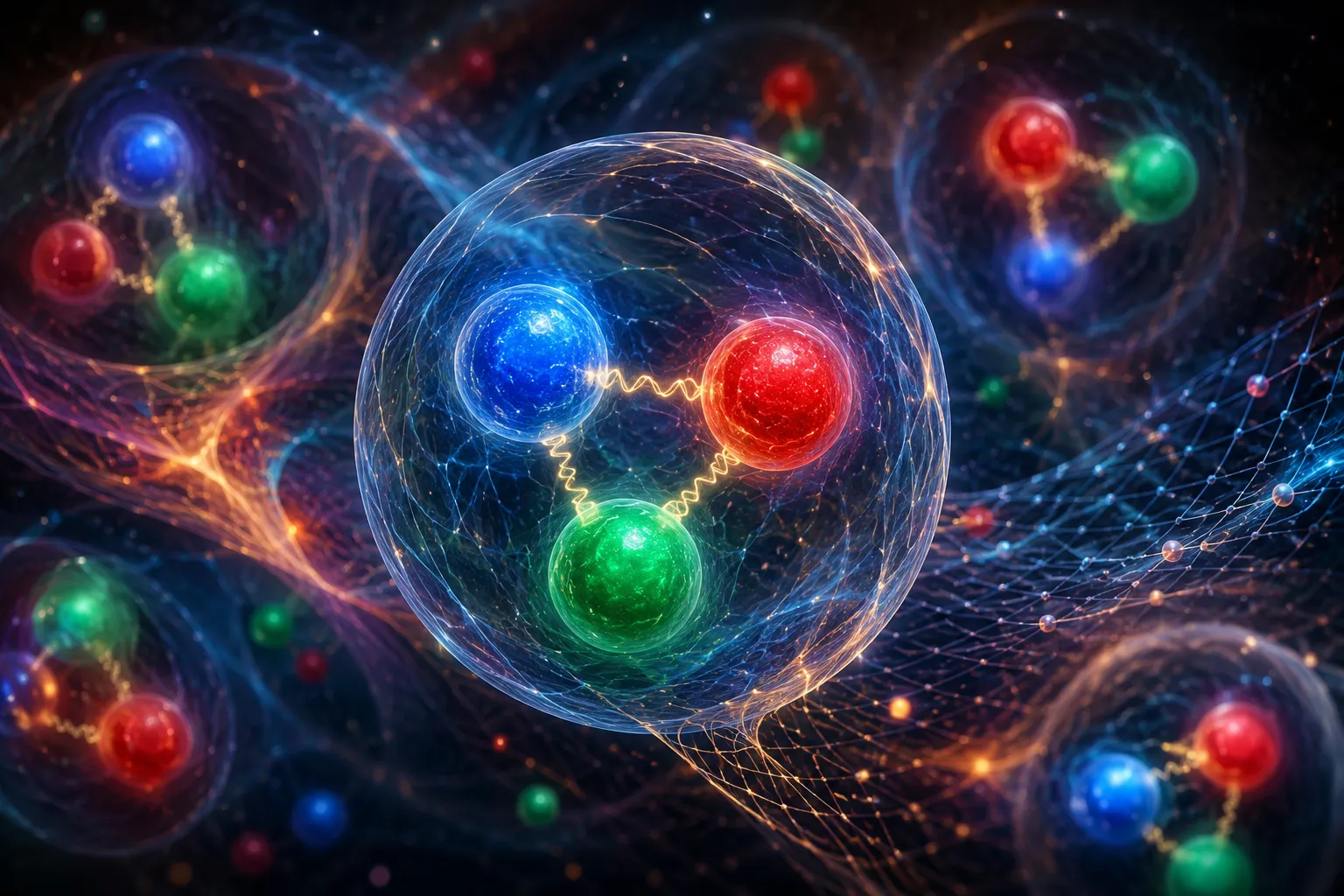
Quarks experience the strong nuclear force and combine in groups of three to form hadrons (protons and neutrons):
- Up and Down: The stable first generation that builds all atomic nuclei in the universe. A proton consists of two up quarks and one down quark ((uud)); a neutron consists of one up and two down quarks ((udd)).
- Charm and Strange: The heavier, unstable second generation observed in cosmic rays and accelerator collisions.
- Top and Bottom: The ultra-massive third generation, with the top quark weighing as much as an entire gold atom.
2. The Six Leptons
Leptons do not feel the strong nuclear force:
- Electron, Muon, and Tau: Electrically charged leptons, with muons and taus behaving as heavier, unstable cousins of the electron.
- Three Neutrinos: Ghostly neutral leptons (electron neutrino, muon neutrino, tau neutrino) that rarely interact with matter.
Bosons: The Force Carriers
Matter particles interact by exchanging integer-spin force carriers called gauge bosons, named after Indian physicist Satyendra Nath Bose:
- Gluons (Spin-1): Transmit the strong nuclear force, binding quarks together inside nucleons and holding atomic nuclei together.
- Photons (Spin-1): Carry the electromagnetic force, governing light, electricity, magnetism, and atomic chemistry.
- W and Z Bosons (Spin-1): Massive bosons that mediate the weak nuclear force, responsible for radioactive beta decay and fueling nuclear fusion in stars.
- The Higgs Boson (Spin-0): The only fundamental scalar boson in the Standard Model. Discovered at CERN’s Large Hadron Collider in 2012, its associated Higgs field imparts inertial mass to fundamental fermions and weak bosons through electroweak symmetry breaking.
The Theory of “Almost Everything” and Its Limits
The Standard Model’s predictions have been tested and verified to extraordinary decimal precision across thousands of collider experiments. Yet physicists recognize it is an incomplete picture—a “theory of almost everything.” It fails to incorporate gravity (lacking a quantum theory of the graviton), offers no explanation for dark matter or dark energy, and cannot explain why neutrinos have non-zero rest masses. Exploring physics beyond the Standard Model remains the greatest adventure in modern fundamental physics.