String Theory: The Cosmic Symphony and Theory of Everything
A Radical Letter to Albert Einstein
In April 1919, Albert Einstein received a startling manuscript from an obscure German mathematician named Theodor Kaluza. Kaluza demonstrated that by adding a hypothetical fifth spatial dimension to the field equations of general relativity, James Clerk Maxwell’s laws of electromagnetism emerged automatically from the gravitational geometry. While Kaluza and Swedish physicist Oskar Klein established the mathematical possibility of curled-up, invisible extra dimensions, their pioneering insight lay dormant for decades until it became the foundation of modern string theory.
The Irreconcilable Clash in Modern Physics
Modern physics rests upon two pillars that speak mutually incompatible mathematical languages: Einstein’s General Relativity (which describes smooth, continuous spacetime curved by massive stars and galaxies) and Quantum Mechanics (which describes a jittery, discontinuous quantum foam at subatomic scales). Whenever physicists attempt to merge relativistic gravity with quantum mechanics, equations yield nonsensical infinities. String theory emerged to resolve this fundamental crisis.
Vibrating Strands at the Planck Scale
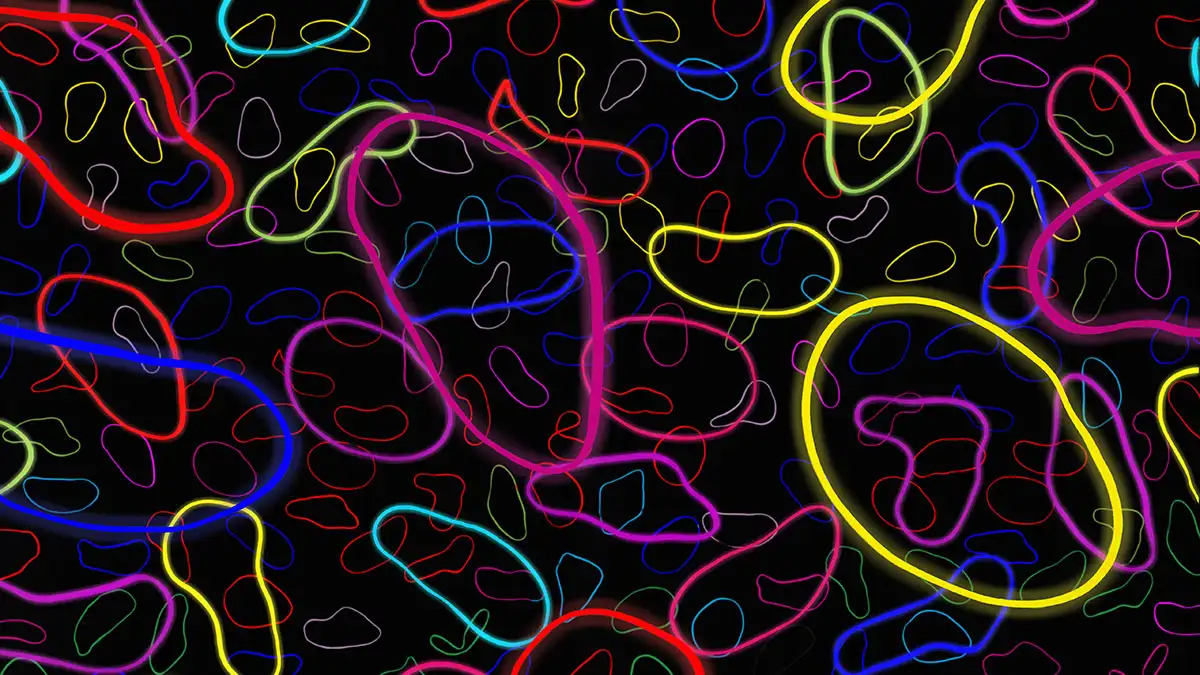
In standard particle physics, elementary constituents like quarks and electrons are modeled as zero-dimensional mathematical point particles. String theory proposes instead that the fundamental fabric of reality consists of tiny, one-dimensional vibrating energy filaments called strings.
These strings measure approximately (1.6 imes 10^{-35}) meters—the Planck length. Just as a violin string produces distinct musical notes (A, C#, E) depending on its vibrational tension and frequency, an ultra-microscopic string produces distinct particles depending on its vibrational mode. An electron is one harmonic; a quark is another; a photon is yet another.
Open vs. Closed Strings and the Elusive Graviton
String theory naturally accommodates two topological varieties of strings:
- Open Strings: Possess free endpoints anchored to spatial membranes (D-branes), producing the gauge bosons of the electromagnetic, weak, and strong nuclear forces.
- Closed Strings: Form closed loops with no endpoints, capable of moving freely across dimensions. Remarkably, the lowest vibrational harmonic of a closed string corresponds exactly to a massless, spin-2 tensor particle—the graviton, the long-sought quantum messenger of gravity!
M-Theory and Hidden Calabi-Yau Dimensions
For string equations to remain mathematically consistent without anomalies, calculations require extra spatial dimensions beyond our familiar three. In 1995, theoretical physicist Edward Witten unified five competing string formulations into M-Theory, which operates in an eleven-dimensional spacetime (10 spatial dimensions plus 1 time dimension).
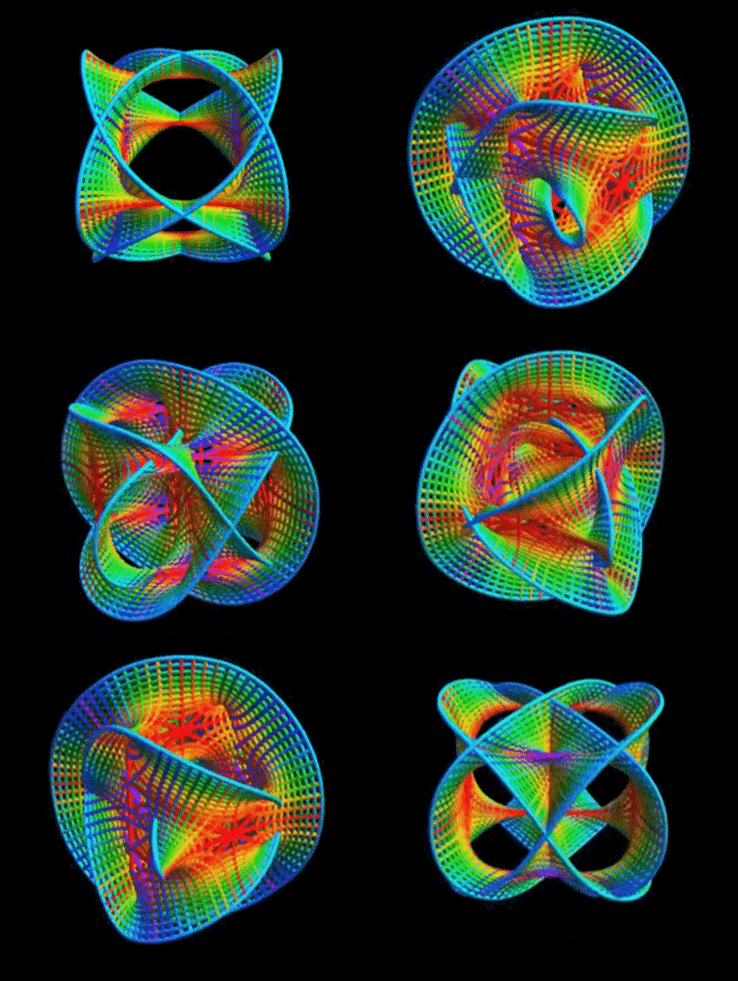
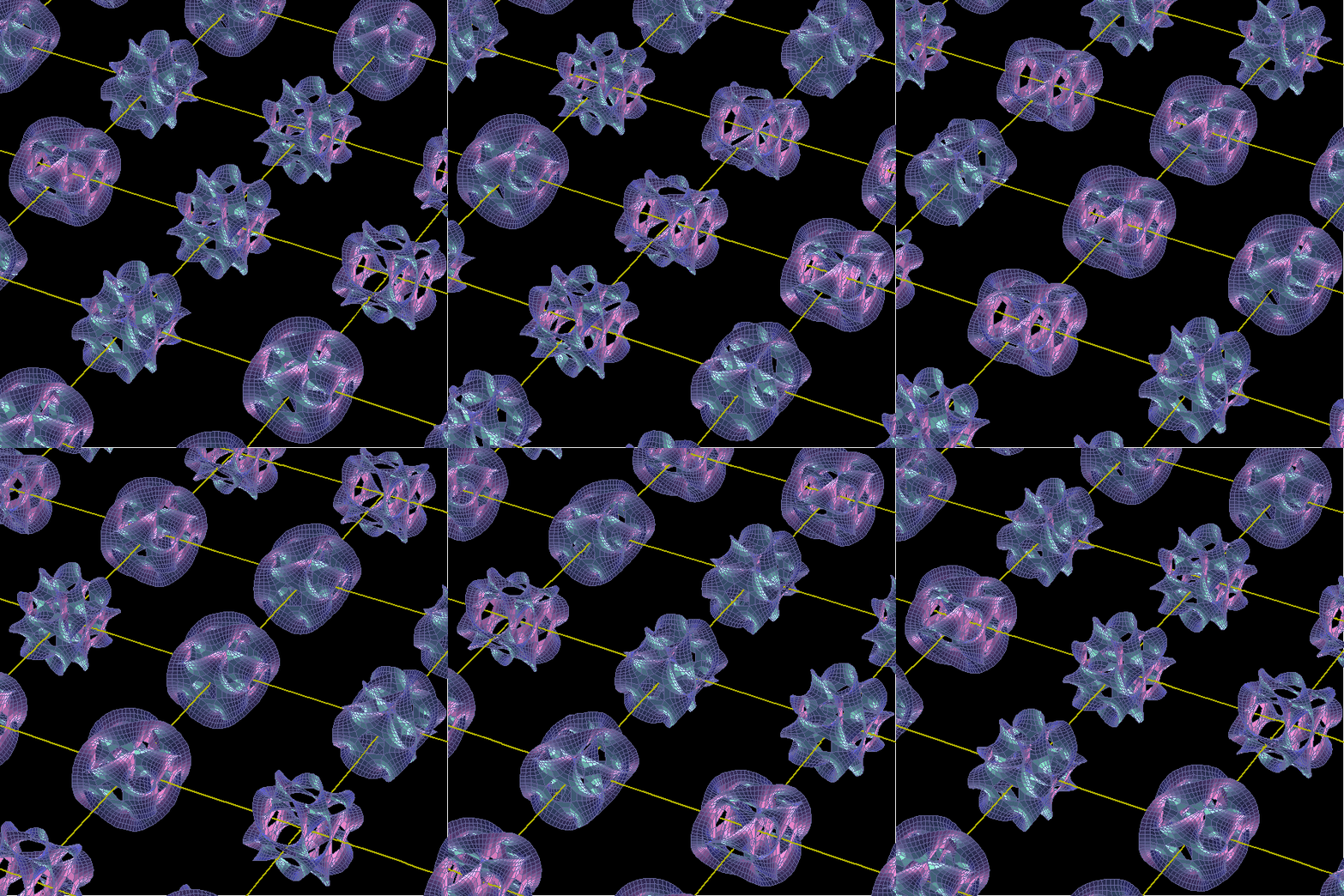
The seven unseen spatial dimensions are tightly compactified into intricate, multi-folded geometric shapes known as Calabi-Yau manifolds. The specific topological geometry of these internal manifolds dictates how strings vibrate, defining the fundamental constants, particle masses, and coupling charges of our universe.
The Symphony of the Cosmos
As theoretical physicist Michio Kaku eloquently observes, string theory presents an aesthetically sublime view of nature: matter is the musical notes vibrating on Planck-scale strings, physics is the laws of harmony, chemistry is the melodies played on these strings, and the universe is a majestic cosmic symphony. While testing string theory directly requires energies far beyond modern colliders, it remains our most promising candidate for the ultimate Theory of Everything.