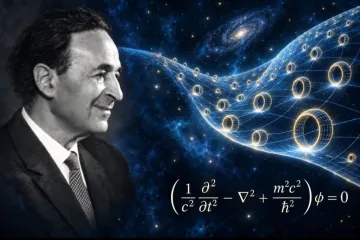
Quantum Field Theory: The Invisible Ocean of Modern Physics
The Deceptive Solidity of the Macroscopic World
Our everyday senses convince us that the universe is made of isolated solid particles separated by empty space. Yet modern high-energy physics reveals a radically different portrait of nature through quantum field theory (QFT)—the most successful theoretical framework in all of physical science. QFT asserts that the fundamental constituents of reality are not discrete particles, but continuous, space-filling invisible fields.
Particles as Quantum Fluctuations
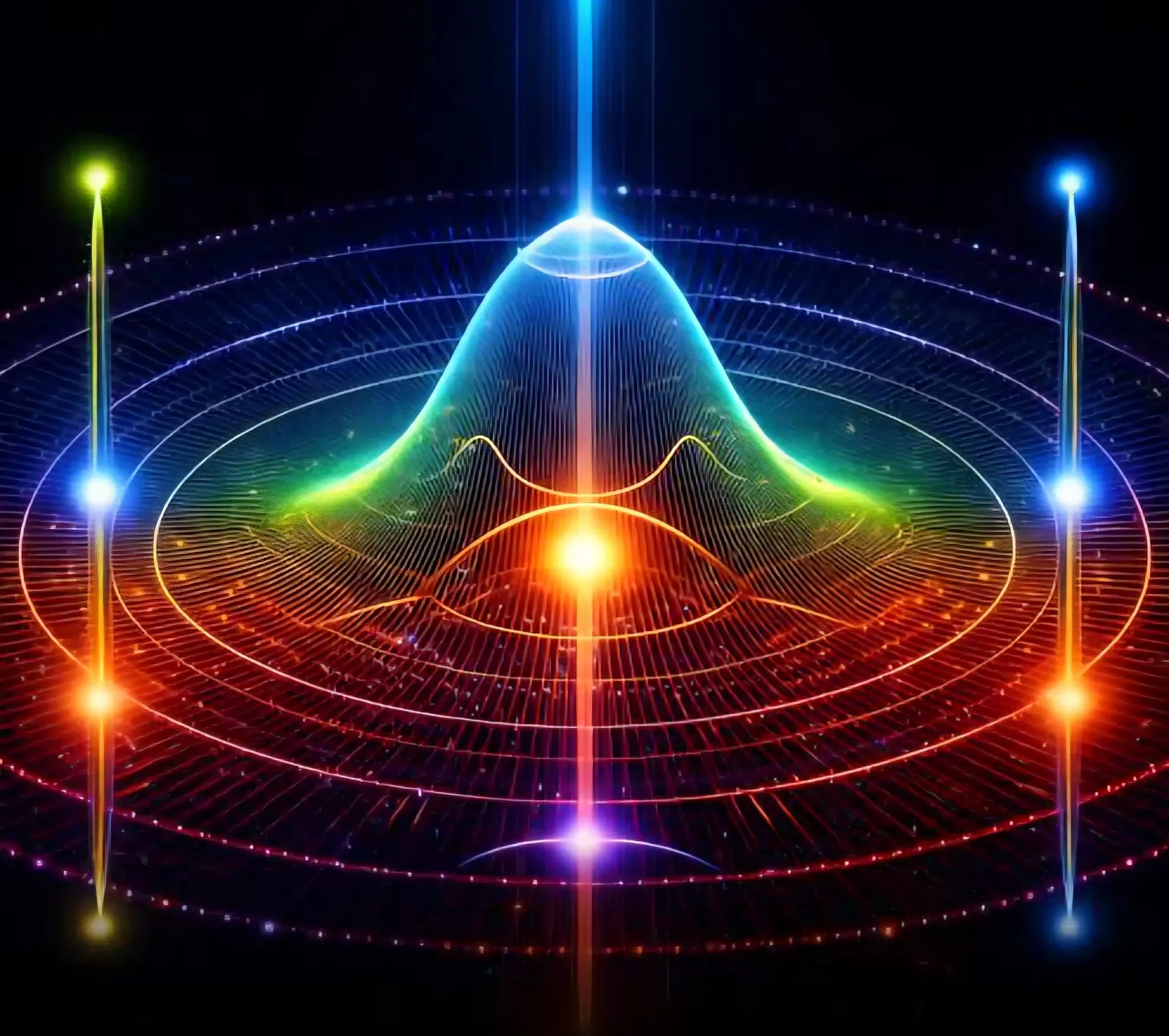
Under QFT, universal fields permeate the cosmos: an electron field, a photon field, a quark field, and a Higgs field. What we conventionally identify as a particle is simply a localized quantum excitation—a quantized ripple or wave—propagating through that field, much as a cresting wave moves across a quiet lake. When you “create” an electron, you are injecting a packet of energy into the pre-existing electron field.
The Boiling Quantum Vacuum and the Casimir Effect
QFT radically redefines our understanding of nothingness. A vacuum is never truly empty. At the subatomic scale, Heisenberg’s uncertainty principle dictates that fields constantly fluctuate around their zero-point energy, spontaneously generating pairs of virtual particles and antiparticles that flash into existence and annihilate within fractions of a yoctosecond.

These quantum vacuum fluctuations produce real, measurable physical forces. In 1948, Dutch physicist Hendrik Casimir predicted that when two uncharged, parallel conducting metal plates are placed nanometers apart in a vacuum, longer vacuum fluctuation wavelengths are excluded between the plates. The higher vacuum pressure outside pushes the plates together—a phenomenon verified experimentally as the Casimir effect.
Quantum Electrodynamics (QED) and Feynman Diagrams
The branch of QFT governing the interaction between charged matter and light is Quantum Electrodynamics (QED), pioneered by Richard Feynman, Julian Schwinger, and Shin’ichirō Tomonaga (who shared the 1965 Nobel Prize in Physics). Feynman revolutionized computational physics by introducing intuitive graphical illustrations known as Feynman diagrams. These diagrams map the precise probabilistic paths of electron-photon scattering, enabling theoretical calculations that match experimental measurements to an astonishing twelve decimal places.
Quantum Chromodynamics (QCD) and Quark Confinement
Extending QFT to the atomic nucleus yields Quantum Chromodynamics (QCD), which describes how quarks interact via the exchange of gluons carrying “color charge.” Theoretical physicists David Gross, Frank Wilczek, and David Politzer received the 2004 Nobel Prize for discovering asymptotic freedom: at ultra-high energies, quarks interact weakly, but as they are pulled apart, the strong force between them grows constant and unbreakable. This explains quark confinement—why isolated, free quarks can never be observed alone in nature.
The Unfinished Synthesis
From the atomic bonds of chemistry to the high-energy fire of the early universe, quantum field theory provides the mathematical language that decodes the subatomic cosmos. While uniting QFT with general relativistic gravity remains an open frontier, it stands as an enduring monument to human comprehension of the quantum fabric of reality.