Hyperdimensions: Hidden Spatial Dimensions in Physics

Beyond Our Three-Dimensional Horizon
Human perception is hardwired to experience space in exactly three dimensions: length, width, and height. Together with the progressive arrow of time, these coordinates construct the four-dimensional spacetime arena of daily existence. Yet theoretical physics has long asked: is three-dimensional space all that exists, or does reality harbor hidden hyperdimensions—spatial coordinates stretching beyond human sensory reach?
The Geometry of Dimensions: Stepping into the 4th Dimension
To conceptualize extra dimensions, dimensional analogies provide powerful intuition:
- A zero-dimensional point has neither length nor width.
- Extending a point produces a 1D line (forward/backward).
- Extending a line perpendicularly generates a 2D square (left/right).
- Lifting a square perpendicularly forms a 3D cube (up/down).
By extending a 3D cube into a fourth spatial direction perpendicular to all three existing axes, we define the four-dimensional hypercube, or tesseract.

Just as a 3D object casts a flat 2D shadow onto a wall, a 4D tesseract casts a dynamic, folding 3D shadow into our perceptual realm. The strange interlocking facets of a tesseract model do not reflect its true hyper-geometry, but rather our sensory limitation in viewing higher-dimensional constructs.
Kaluza-Klein Theory and Compactified Dimensions
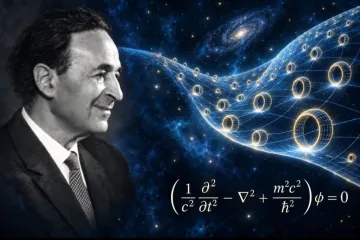
In 1919, Theodor Kaluza and Oskar Klein proved that adding a compact fourth spatial dimension unified Einstein’s general relativity with Maxwell’s electromagnetism. Why don’t we see these extra dimensions? Consider a long garden hose: to a hawk soaring high overhead, the hose appears as a zero-width, one-dimensional line. But to an ant crawling on its surface, the hose reveals a second, circular dimension wrapping around its circumference. In the same way, modern physics suggests extra dimensions may be compactified at infinitesimal subatomic scales.
String Theory and the 11-Dimensional Multiverse
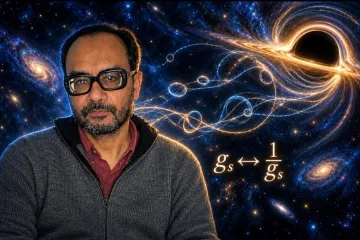
In modern superstring theory and M-theory, hyperdimensions are not just mathematical curiosities; they are absolute mathematical necessities. The equations that successfully describe particle physics and eliminate quantum anomalies demand ten or eleven dimensions of spacetime. The seven unseen spatial dimensions are tightly curled into geometric manifolds known as Calabi-Yau spaces, dictating the physical constants and fundamental particle masses of our universe.
Why Is Gravity So Weak? The Braneworld Hypothesis
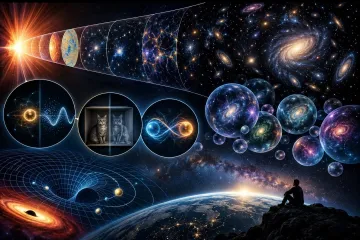
Hyperdimensions offer an elegant resolution to the hierarchy problem: why gravity is trillions of times weaker than the electromagnetic and nuclear forces (a small kitchen magnet easily lifts a paperclip against the gravitational pull of the entire planet Earth). According to braneworld cosmology, our observable universe may be a three-dimensional membrane (a “3-brane”) floating inside a higher-dimensional “bulk.” While gauge forces like electromagnetism are anchored to the brane, closed gravitational strings (gravitons) can leak into the higher dimensions, diluting gravity’s perceived strength in our world.
By expanding our mathematical horizons into hyperdimensions, physics reminds us that our sensory world may represent only the surface ripples of a vastly deeper cosmic architecture.