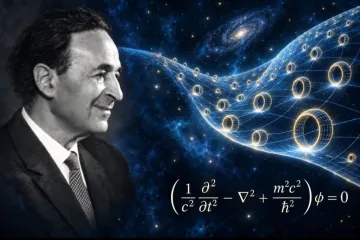
Quantum Geometry of the Electron: MIT's Breakthrough
Challenging the Zero-Dimensional Particle Paradigm
Throughout the history of modern physics, textbooks have described the electron as a fundamental point particle: a zero-dimensional entity endowed with mass, negative electric charge, and half-integer quantum spin, but completely lacking spatial shape, internal volume, or measurable geometric structure. While quantum mechanics describes electrons through wavefunctions and probability amplitudes, direct empirical mapping of their internal geometric configurations inside matter long eluded experimental science.
MIT’s Landmark Discovery
That paradigm shifted decisively with a breakthrough led by researchers at the Massachusetts Institute of Technology (MIT). Using advanced condensed matter spectroscopic techniques, the physicists succeeded in experimentally mapping the quantum geometry of the electron within crystalline solid states. Their findings revealed that inside correlated quantum materials, the electron’s collective wavefunction adopts a rich, twisting geometric morphology that dictates the macroscopic electrical and magnetic behaviors of materials.
The Kagome Lattice: A Topological Quantum Crucible
To expose this elusive geometric structure, the researchers synthesized exotic metals featuring a kagome lattice—an atomic crystal structure inspired by traditional Japanese basketweaving, composed of interlaced corner-sharing triangles and hexagons. This geometric configuration induces geometric frustration and flat electronic energy bands, trapping electrons and forcing them into strong quantum interactions that amplify their intrinsic geometric characteristics.
Revealing Secrets with ARPES Spectroscopy
To extract the electron’s quantum structure, the team employed Angle-Resolved Photoemission Spectroscopy (ARPES):
- Monochromatic, high-energy synchrotron photons are directed at the kagome crystal surface.
- The photoelectric effect ejects electrons from within the crystal lattice.
- Sensitive detectors record the precise kinetic energy, ejection angles, and momentum vectors of departing photoelectrons.
By computationally analyzing the angular distribution of emitted electrons, researchers reconstructed the internal quantum wavepacket configuration, illuminating its internal curvature much like flashing a strobe light reveals hidden eddies in swirling smoke.
The Quantum Geometric Tensor (QGT)
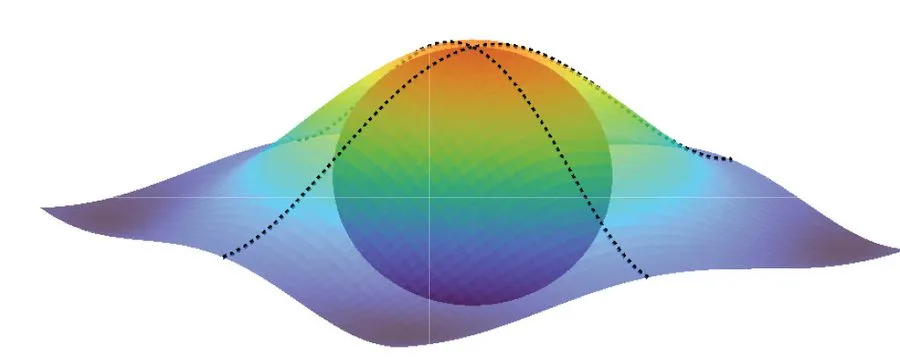
The parameter measured in this breakthrough is formally designated the Quantum Geometric Tensor (QGT). The QGT encompasses two vital components:
- Berry Curvature (Imaginary Part): Measures the topological twisting of the quantum wavefunction, governing anomalous quantum Hall effects and dissipationless edge currents.
- Quantum Metric (Real Part): Defines the mathematical distance between nearby quantum states, determining how wavepackets deform and overlap.
The MIT experiments confirmed that the electron’s quantum state possesses non-trivial topological curvature and geometric twisting, providing direct empirical proof of quantum metric influences in solid-state physics.
Catalyzing Next-Generation Technologies
Decoding the electron’s quantum geometry is poised to revolutionize condensed matter engineering:
- High-Temperature Superconductivity: Understanding how quantum geometric metrics promote electron pairing without phonon mediation could guide the design of ambient-temperature superconductors.
- Fault-Tolerant Quantum Computing: Harnessing topologically protected electron geometries enables robust qubits immune to local thermal decoherence.
- Topological Spintronics: Developing ultra-low-power microelectronic devices that transport information via geometric electron twists rather than electric currents.
By peering deep into the geometric soul of the electron, modern physics proves once again that nature’s smallest constituents harbor breathtaking, unexplored complexities.