Total Solar Eclipse: Baily's Beads and Diamond Rings
The Celestial Alignment of Totality
Among all astronomical spectacles observable from the surface of Earth, none rivals the sheer majesty of a total solar eclipse. Occurring when the Moon passes directly between the Sun and Earth, casting its deep umbral shadow cone onto our planet, totality temporarily transforms daytime into eerie twilight. On April 8, 2024, millions of stargazers across North America witnessed this cosmic dance as the lunar shadow swept from Mexico across Texas and into Canada.
Approaching the Path of Totality
Observing a total eclipse requires navigating dynamic meteorological obstacles. Cloud cover frequently threatens viewing sites along the path of totality, forcing eclipse chasers to monitor atmospheric soundings, satellite cloud tracks, and real-time weather radars. In places like the Texas Hill Country, persistent spring overcast gave way just in time, rewarding observers with unhindered views of the celestial drama.
The Astronomical Mechanism of Baily’s Beads
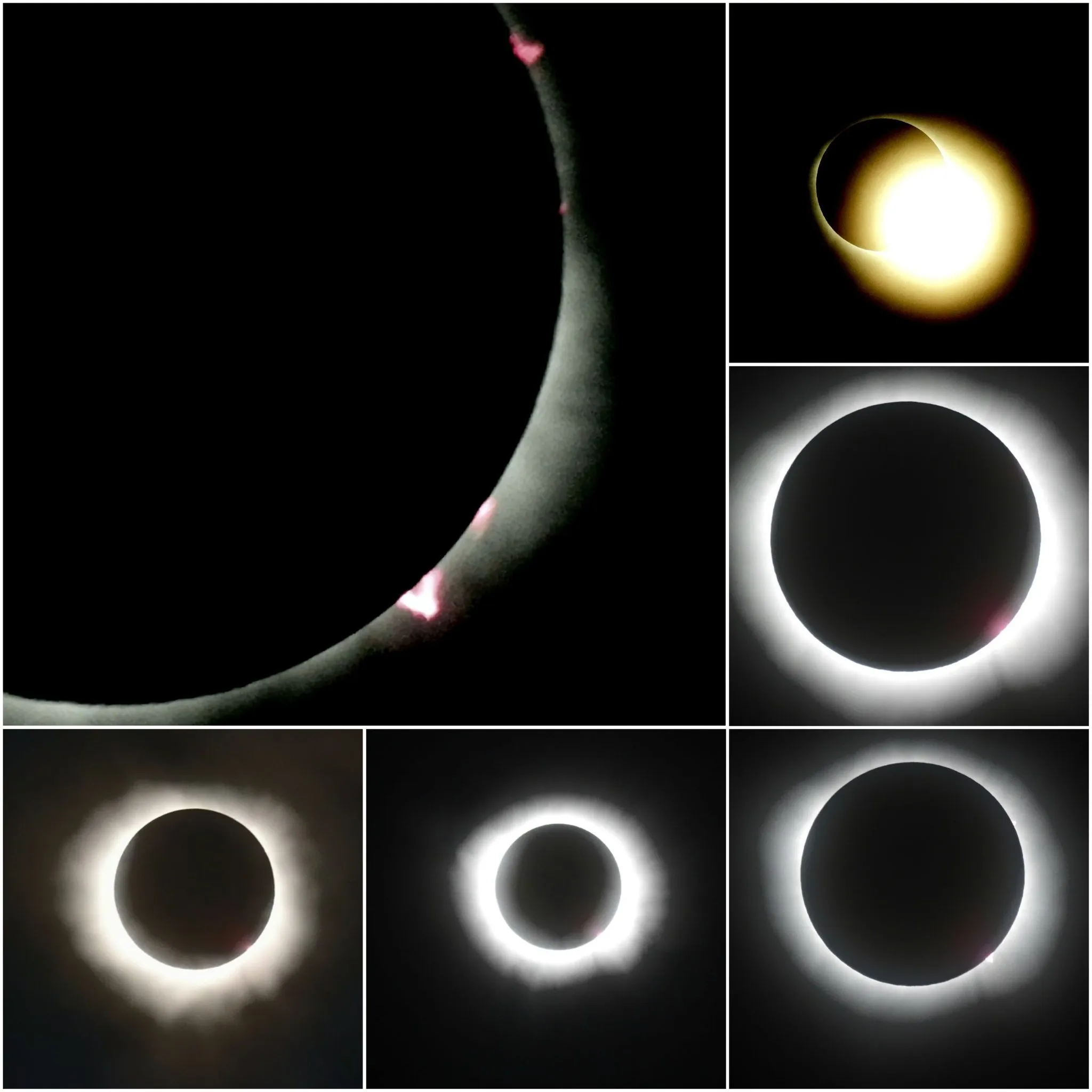
As the lunar disk moves to obscure the final sliver of the brilliant photosphere, an exquisite phenomenon appears along the Moon’s dark limb: a shimmering necklace of brilliant, bead-like points of light known as Baily’s Beads.
First scientifically explained in 1836 by English astronomer Francis Baily, these bright beads occur because the Moon is not a smooth sphere. Its surface is punctuated by jagged mountain peaks, crater rims, and deep volcanic valleys. As the Moon slides across the Sun, solar rays pierce through low-elevation lunar canyons while adjacent peaks block the light, creating glowing points along the lunar silhouette.
Totality and the Shimmering Solar Corona
When the final bead vanishes, totality arrives. Daytime plunges into an otherworldly indigo darkness. Temperatures drop noticeably, brighter planets and stars sparkle in midday, and animal behaviors shift in confusion. With the overwhelming glare of the photosphere completely blocked, the Sun’s ethereal outer atmosphere—the corona—blossoms into view. Whispering streamers of ionized white plasma trace magnetic field lines millions of kilometers into space, while glowing pink hydrogen tongues, known as solar prominences, leap from the solar limb.
The Magnificent Diamond Ring Effect
Totality lasts only a few fleeting minutes. As the Moon begins to uncover the opposite limb of the Sun, a single intense beam of raw sunlight bursts through a solitary lunar valley while the faint pearly corona still rings the surrounding disk. For several breathtaking seconds, the sky displays a colossal cosmic diamond ring.
This magnificent flash signals the end of totality. Solar filters must be immediately replaced as daylight rapidly floods the terrestrial landscape. For all who behold it, a total solar eclipse leaves an indelible impression—a visceral, unforgettable demonstration of orbital geometry and celestial grandeur.