Inside the Sun: Nuclear Fusion and Violent Solar Storms
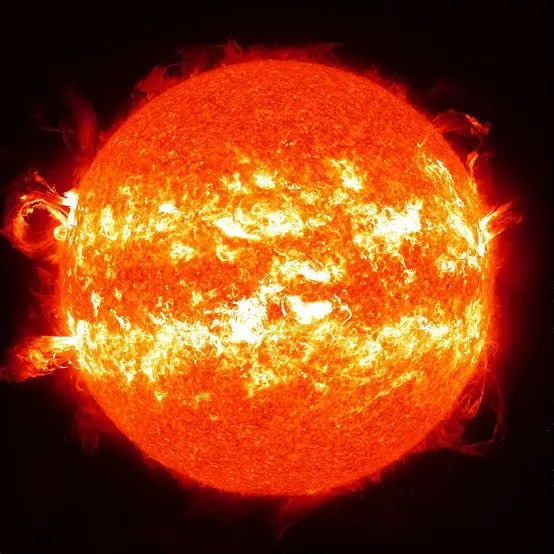
Our Closest Cosmic Furnace
Every morning, the gentle light of sunrise rouses Earth to life, warming continents, evaporating oceans, and sustaining all biological metabolism. Yet behind this familiar golden glow lies a monstrous powerhouse: the Sun. Located roughly 150 million kilometers away, our host star is a medium-sized yellow dwarf (spectral type G2V) with a volume capable of engulfing 1.3 million Earths. Its light traverses the gulf of interplanetary space in just eight minutes and twenty seconds, anchoring our solar system in gravitational harmony.
The Core: Where Matter Becomes Pure Energy
The interior of the Sun is an extraordinary high-energy realm. At its core, where gravitational compression drives temperatures to 15 million degrees Celsius and pressures exceed 250 billion atmospheres, hydrogen nuclei undergo continuous nuclear fusion via the proton-proton chain.
Every single second, the Sun fuses approximately 600 million tons of hydrogen into helium. In the process, roughly 4 million tons of matter are annihilated directly into radiant energy according to Albert Einstein’s celebrated formula, (E = mc^2). This continuous thermonuclear furnace generates the immense outward radiation pressure that prevents the Sun from collapsing under its own colossal gravity.
The 100,000-Year Journey of a Photon
Remarkably, the gamma-ray photons birthed in the core cannot simply stream outward. Traversing the dense plasma of the radiative zone, photons encounter an impenetrable maze of free electrons and nuclei, repeatedly colliding, absorbing, and re-emitting in an ultra-slow random walk that can take between 10,000 and 100,000 years to reach the next layer.
Above the radiative zone lies the convection zone, where superheated plasma boils like a cauldron, carrying heat outward through massive circulating convection cells. By the time this energy reaches the visible surface—the photosphere at 5,500°C—gamma rays have degraded into visible light. Thus, the sunshine warming our skin today began its journey deep inside the solar core before the dawn of human civilization.
The Coronal Enigma and Helioseismology
Beyond the photosphere lies the outer solar atmosphere, the corona, visible during total solar eclipses as an ethereal pearly halo. Bafflingly, while the surface sits at several thousand degrees, the corona skyrockets to over 1 to 2 million degrees Celsius. Solar physicists believe this heating is driven by magnetic reconnection events and nanoflares, though research continues.
To peer deep beneath the blinding surface, scientists practice helioseismology—analyzing resonant acoustic pressure waves that reverberate through the solar interior with a characteristic five-minute rhythm, mapping internal rotation and magnetic dynamics.
Sunspots, Solar Cycles, and Space Weather Threats
The Sun is wrapped in a turbulent magnetic field. Where intense magnetic flux tubes choke convective heat transfer, the surface cools locally by about 1,500°C, producing dark blemishes called sunspots. Sunspot numbers ebb and flow across a regular 11-year solar cycle, alternating between solar minimum and violent solar maximum.
During peak activity, magnetic field lines snap and reconnect explosively, launching solar flares and coronal mass ejections (CMEs)—billions of tons of magnetized plasma hurtling through space at millions of kilometers per hour. When directed toward Earth, these geomagnetic storms trigger dazzling auroras, but also threaten electrical power grids, destroy orbital satellites, and disrupt global GPS navigation networks. Understanding our turbulent star is essential to shielding our technologically dependent world from space weather hazards.