Astronomical Events 2026: Skywatcher’s Year Guide
A Celebratory Year for Stargazers
The year 2026 is poised to be an unforgettable chapter for astronomy enthusiasts. For anyone who delights in watching the Moon from an evening balcony, travels away from urban glow to seek unblemished starry skies, or aims a camera upward to capture shooting stars, 2026 offers a grand cosmic festival arranged by nature itself.
Across all twelve months, celestial phenomena will not only dazzle the eye but also remind us of the sublime rhythm and scale of our universe.
January: Quadrantid Meteors and Jupiter at Opposition
The cosmos opens the year with remarkable celestial fireworks:
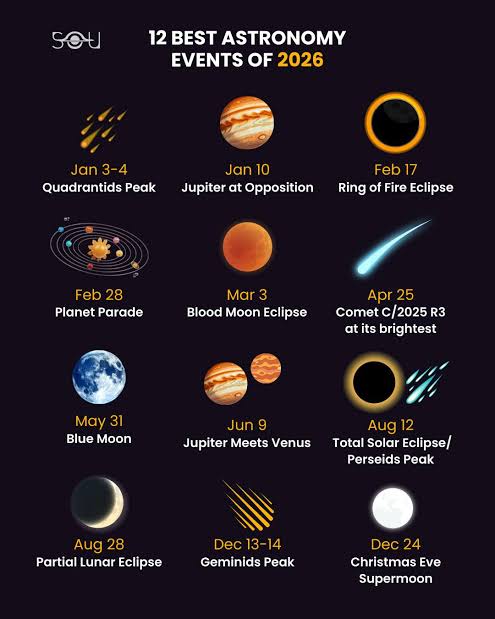
- January 3–4: The Quadrantid meteor shower peaks shortly after the new year. Skywatchers in the Northern Hemisphere who gaze toward the constellation Boötes in the pre-dawn hours can witness bright, rapid meteors and radiant fireballs.
- January 10: Jupiter reaches opposition, aligning directly with Earth and the Sun. The gas giant will shine at its brightest and largest apparent diameter of the year, visible all night long, with its Galilean moons readily discernible in small telescopes.
February: ‘Ring of Fire’ Eclipse and Planetary Parade
February brings heightened astronomical drama:
- February 17: An annular solar eclipse (“Ring of Fire”) occurs over Antarctica, forming a brilliant circle of sunlight around the Moon’s silhouette. Observers across southern South America and southern Africa will witness a partial solar eclipse.
- February 28: A pre-dawn planetary parade graces the eastern horizon as Mercury, Venus, Mars, Jupiter, and Saturn line up before sunrise in an enchanting celestial alignment.
March & April: Blood Moon and a Visiting Comet
- March 3: A total lunar eclipse—frequently called a Blood Moon—casts a rich copper-red hue across the night sky, visible across East Asia, Australia, the Pacific, and the Americas.
- April 25: The celestial traveler Comet C/2025 R3 reaches peak brightness. Under clean, dark rural skies, binoculars or even the naked eye may trace the graceful arc of its glowing tail.
May & June: Blue Moon and Planetary Conjunction
- May 31: A rare Blue Moon rises—the second full moon occurring within a single calendar month.
- June 9: A striking conjunction of Venus and Jupiter illuminates the western sky shortly after sunset, appearing as two bright twin lanterns in the evening twilight.
- June 21: The Summer Solstice marks the longest day of the year in the Northern Hemisphere.
August: Solar Eclipse and the Perseids Double Header
August 2026 promises to be the most exhilarating month of the astronomical calendar:
- August 12: A magnificent total solar eclipse sweeps across Greenland, western Iceland, and northern Spain, plunging daytime landscapes into ethereal twilight.
- August 12 (Night): On that exact same night, the renowned Perseid meteor shower reaches its maximum activity, producing up to 100 meteors per hour under moonless skies—an extraordinary double spectacle.
- August 28: A partial lunar eclipse gently shades the lunar surface.
December: Geminid Meteors and a Christmas Eve Supermoon
The year concludes in festive grandeur:
- December 13–14: The reliable Geminid meteor shower fills dark winter skies with slow, luminous multi-colored streaks.
- December 21–22: The Winter Solstice brings the longest night of the year in the Northern Hemisphere.
- December 24: A luminous Christmas Eve Supermoon reaches perigee, appearing larger and noticeably brighter in the night sky.
Conclusion
From fiery eclipses to meteor showers, the major astronomical events 2026 offer an open invitation to look up and reconnect with the timeless wonders of our cosmos.