The Great Attractor: Cosmic Mystery of Galactic Pull
An Invisible Cosmic Current
We often visualize the universe as an orderly celestial clockwork where planets, stars, and galaxies quietly trace their harmonious orbits. Yet beneath this serene picture lies a colossal, unseen gravitational force drawing everything across hundreds of millions of light-years.
Galaxies are not simply spinning peacefully in place; they are hurtling at extraordinary speeds toward an unseen gravitational focal point known as the Great Attractor.
The Peculiar Motion of Galaxies
Our Milky Way galaxy is far from stationary. Cosmologists measuring the cosmic microwave background discovered that the Milky Way, our neighbor Andromeda, the entire Virgo Cluster, and hundreds of surrounding galaxies are accelerating at over two million kilometers per hour toward a common destination.
This massive, coherent cosmic flow is known as peculiar velocity—a deviation from the uniform expansion of the universe caused by an immense localized gravitational concentration.
The Zone of Avoidance: Nature’s Cosmic Curtain
Why has identifying this gravitational behemoth proven so difficult? The Great Attractor is situated directly behind the dense galactic plane of our own Milky Way—in a celestial blind spot astronomers call the Zone of Avoidance.
Thick blankets of interstellar gas, obscuring cosmic dust, and countless foreground stars completely block visible optical light, effectively concealing this mysterious region from traditional telescopes.
Unveiling the Laniakea Supercluster
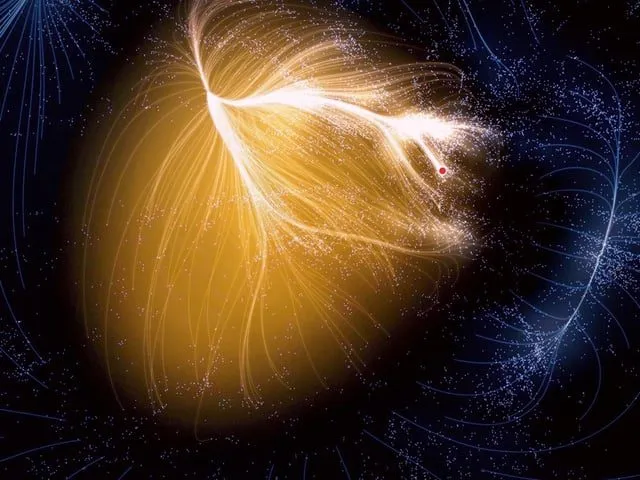
Refusing to be thwarted, astrophysicists turned to radio astronomy, X-ray observatories, and infrared surveys capable of peering through the dust veil. Their observations unveiled a staggering cosmic structure: the Laniakea Supercluster.
Spanning over 500 million light-years and encompassing roughly 100,000 galaxies, Laniakea defines our cosmic neighborhood. Within this vast watershed of galaxies, cosmic gravitational streamlines flow directly toward the central basin where the Great Attractor resides.
The Shapley Supercluster: An Even Greater Titan
Recent cosmic mapping reveals that the Great Attractor is not the final terminus of this journey. Beyond it lies an even more gargantuan structure: the Shapley Supercluster, containing thousands of galaxies bound in the largest known gravitationally interacting basin in the local universe.
Thus, our galaxy is navigating a multi-tiered cosmic hierarchy of gravity, in which the Great Attractor represents a massive gravitational waystation along a vast cosmological river.
Conclusion
The silent pull of the Great Attractor serves as a humbling reminder of how much remains to be discovered about cosmic architecture. Across unfathomable distances, gravity orchestrates the grand dance of galaxies, drawing us ever onward into the mysteries of the deep universe.