January 3 2026: Rare Supermoon, Perihelion, and Meteors
A Rare Celestial Rendezvous
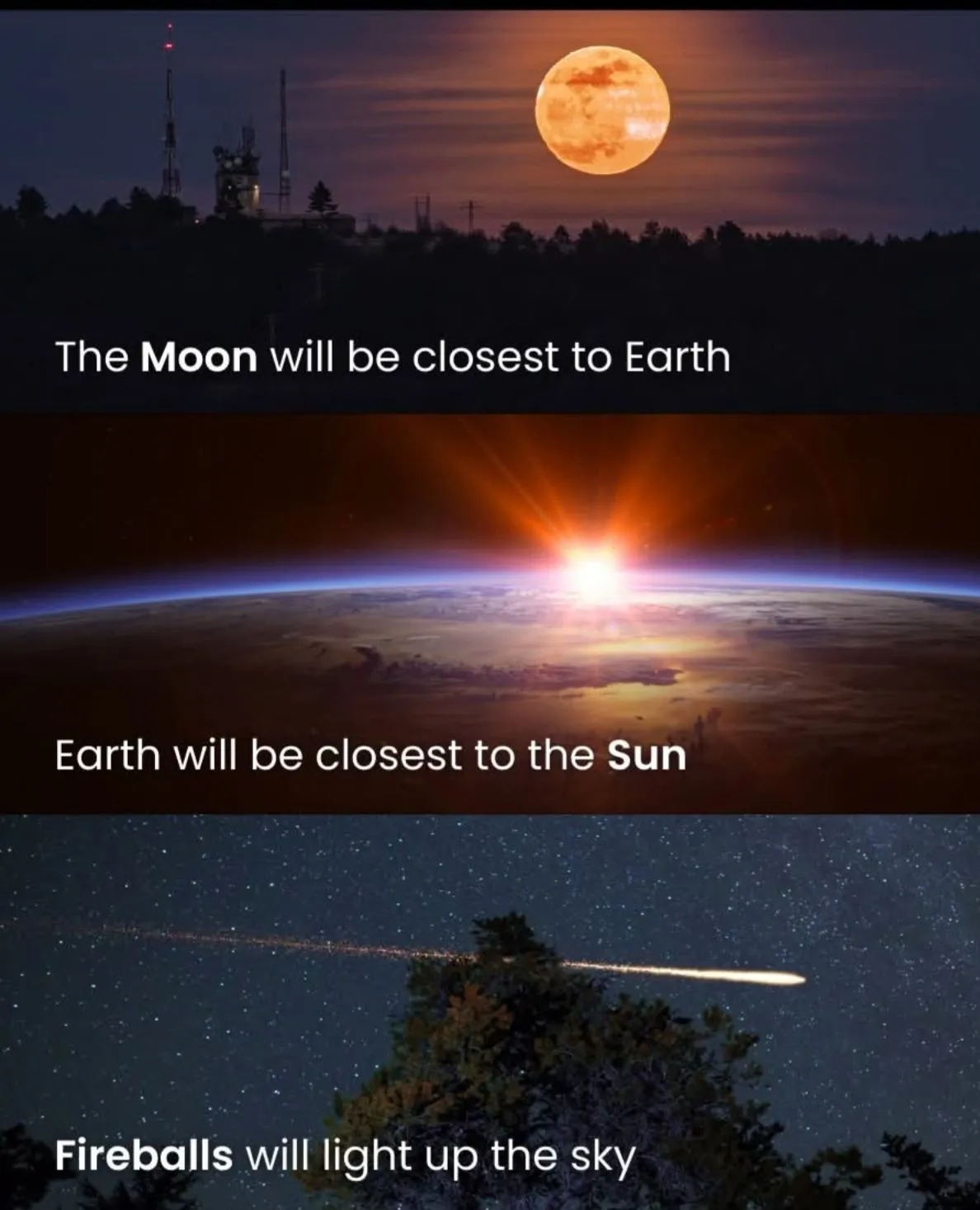
On January 3 2026, what appeared to be an ordinary Saturday on the calendar unfolded into a rare astronomical spectacle. Overhead in the solar system, three distinct celestial phenomena converged within a single twenty-four-hour window.
Witnessing three major astronomical events on the exact same date is extraordinarily uncommon. Here is how the cosmos put on a masterclass in celestial mechanics.
1. Perigee and the Wolf Supermoon
The Moon reached perigee—the closest point to Earth along its elliptical orbit—precisely as it achieved full illumination. Traditionally known as the “Wolf Moon” in January, this orbital alignment produced a magnificent supermoon:
- The Moon appeared roughly 14 percent larger in apparent diameter than during an apogee micromoon.
- It shone with nearly 30 percent greater luminosity.
The intense moonlight cast crisp, distinct nocturnal shadows across the landscape, cutting effortlessly through urban light pollution.
2. Perihelion: Earth at Its Closest to the Sun
Simultaneously, Earth reached perihelion—the closest point to the Sun along its annual orbital path. Although the Northern Hemisphere was experiencing the depth of winter, Earth was actually approximately 3 million miles closer to the Sun than it is in July.
Under the Sun’s increased gravitational pull at perihelion, Earth accelerated to its maximum orbital speed of the year, racing through space at approximately 67,000 miles per hour (roughly 30 kilometers per second).
3. The Quadrantid Meteor Shower and Fireballs
To crown this celestial celebration, the Quadrantid meteor shower peaked on the very same night. As Earth swept through the dusty debris trail shed by asteroid 2003 EH1, shooting stars streaked across the northeastern sky near the constellation Boötes.
While the brilliance of the Wolf Supermoon washed out fainter streaks, the Quadrantids are famed for producing vivid, slow-moving fireballs. These radiant meteors left incandescent trails in the upper atmosphere that penetrated the luminous moonlight.
Conclusion
Experiencing a Supermoon, Perihelion, and a premier meteor shower within twenty-four hours was a rare cosmic gift. The events of January 3 2026 served as a vivid reminder of the ceaseless, elegant motion governing our solar neighborhood.