Richard Feynman: From Los Alamos to the Challenger
The Fortress of Los Alamos and a Scientific Hacker
During the 1940s Manhattan Project, Los Alamos was an impenetrable military fortress in New Mexico dedicated to developing the atomic bomb. Surrounded by armed sentries, barbed wire, and heavy steel safes, military commanders proudly declared it the most secure installation on Earth.
Yet a brilliant young physicist named Richard Feynman never viewed security as a simple matter of locks and bolts. He recognized that the greatest vulnerabilities lay in human nature: habit, laziness, and bureaucratic complacency.
Cracking Safes and a Polite Warning
Using keen observational skills and a borrowed screwdriver, Feynman quietly picked open a sealed iron safe containing classified research and handed the sensitive documents to astonished physicists. While military officers boasted about intricate combination locks, Feynman looked for subtle scuff marks, repeated numerical habits, and common personal dates like birthdays.
Over a few weeks, he cracked dozens of high-security filing cabinets, leaving behind a polite typewritten note: “Please improve your security.” He never stole anything; to Feynman, this was not mischief, but a vital warning. Science and security both demand unflinching honesty and the courage to admit systemic weaknesses.
Personal Grief and Scientific Philosophy
Beneath his lively humor lay deep personal sorrow. Shortly before arriving at Los Alamos, Feynman lost his beloved first wife, Arline, to tuberculosis. Yet he continued writing letters to her, keeping them sealed in a small box in his dormitory.
To clear his restless mind at night, he played bongo drums and worked out equations on cafeteria napkins. In seminars with senior directors, he asked disarmingly direct questions that pierced conventional orthodoxy: Why do we assume this is true? Have we tested it, or do we accept it out of habit?
A Transformative Educator
After World War II, Feynman brought that same infectious energy to academia, teaching at Cornell and later Caltech. His physics lectures crackled with electric enthusiasm; his chalk flew across blackboards faster than students could take notes.
He scribbled diagrams wherever inspiration struck—on window frames, dining plates, and restaurant menus. When explaining complex quantum electrodynamics (QED), he devised intuitive pictorial representations known as Feynman Diagrams. For Feynman, knowledge was never an elitist ornament; it was a joy to be shared.
The Challenger Disaster and the Rogers Commission
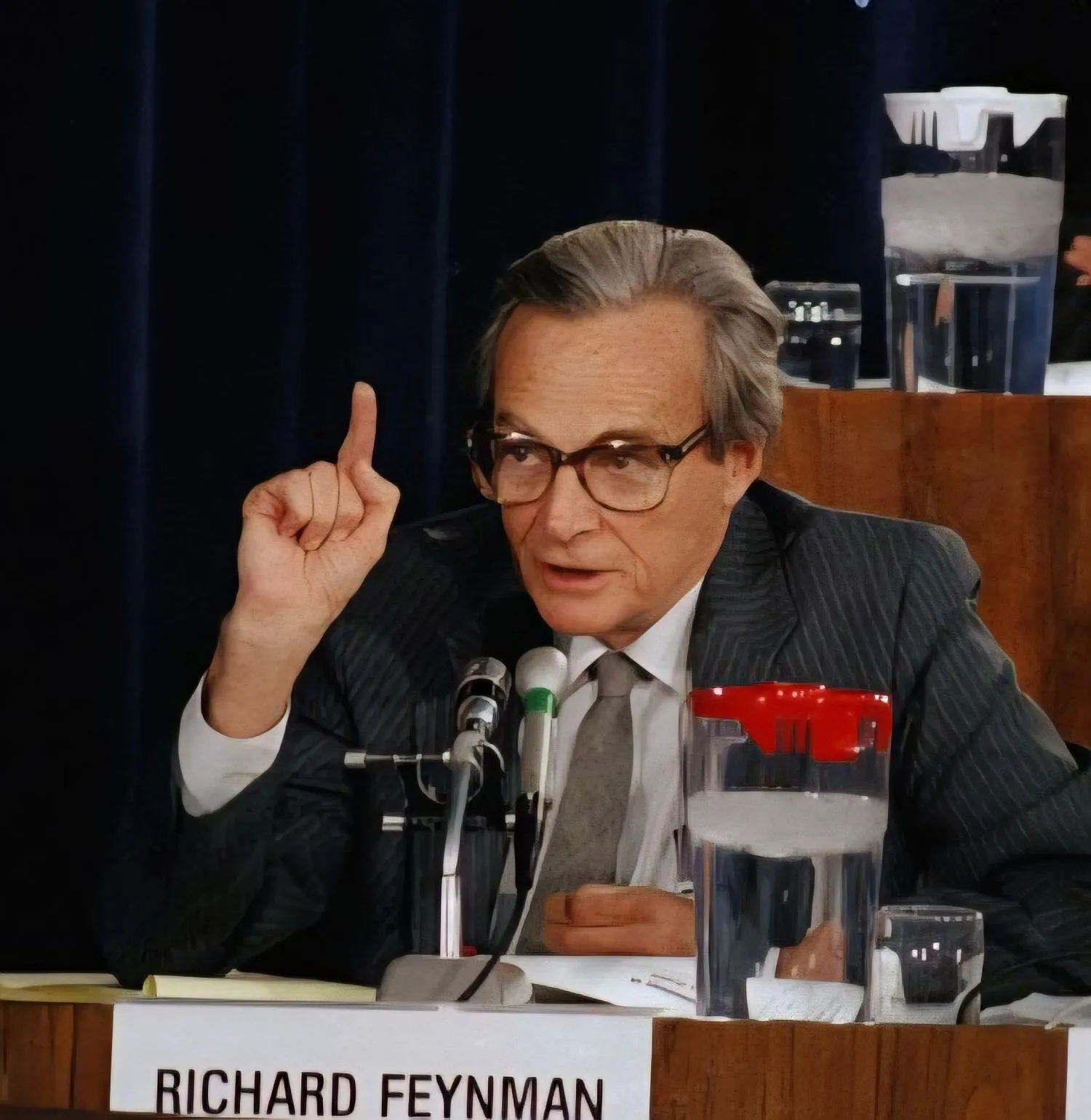
Feynman’s commitment to verifiable empirical truth defined his role in the investigation of the Space Shuttle Challenger disaster. Following the 1986 explosion, he was appointed to the presidential Rogers Commission.
He grew deeply frustrated by bureaucratic obfuscation. NASA officials presented dense jargon, treated the loss as an unpredictable anomaly, and deflected institutional responsibility. Feynman bypassed formal briefings, heading straight to the hangars to speak with working engineers. There, he learned that the rubber O-rings sealing the solid rocket booster joints stiffened in freezing temperatures—a risk raised repeatedly by engineers but dismissed by management.
The Historic Ice-Water Demonstration
During a televised commission hearing, Feynman performed one of the most famous demonstrations in scientific history. Without rhetorical flourish, he clamped a piece of O-ring rubber and submerged it in a glass of ice water on his desk. After pulling it out, he showed that the rubber remained compressed and failed to rebound.
A stunned silence fell over the room as Feynman quietly concluded that this loss of resiliency caused the catastrophic failure. In his personal appendix to the commission’s official report, he delivered his legendary verdict:
“For a successful technology, reality must take precedence over public relations, for nature cannot be fooled.”
Conclusion
Though awarded the Nobel Prize in Physics, Richard Feynman never cared for solemn prestige. From cracking safes at Los Alamos to unveiling the tragic truth behind the Challenger, he proved that intellectual clarity paired with moral courage will always dismantle bureaucratic arrogance.