The Gregorian Calendar: How Humanity Fixed Time
The Ancient History Behind the Modern Year
Every New Year brings a fresh date to our calendars. Yet behind that familiar grid of dates lies centuries of astronomy, politics, religion, and mathematical ingenuity. The Gregorian calendar we rely upon daily was not born overnight; it is the product of centuries of astronomical calibration.
The Julian Calendar and the 11-Minute Flaw
For centuries across Europe, time was governed by the Julian calendar, established by Julius Caesar in 46 BCE. Designed to replace complex Roman lunar reckonings, Caesar introduced a 365-day solar calendar with an extra leap day added every four years.
However, the Julian system contained a fundamental mathematical flaw: a true tropical solar year is approximately 365.2422 days long, making the Julian calendar year about 11 minutes too long. While 11 minutes seems negligible, it accumulated into a full day every 128 years. Over centuries, the calendar drifted away from the solar seasons. Spring arrived on paper long before it arrived in nature, disrupting agriculture, civic life, and the calculation of religious holidays like Easter.
Pope Gregory XIII and the Ten Missing Days
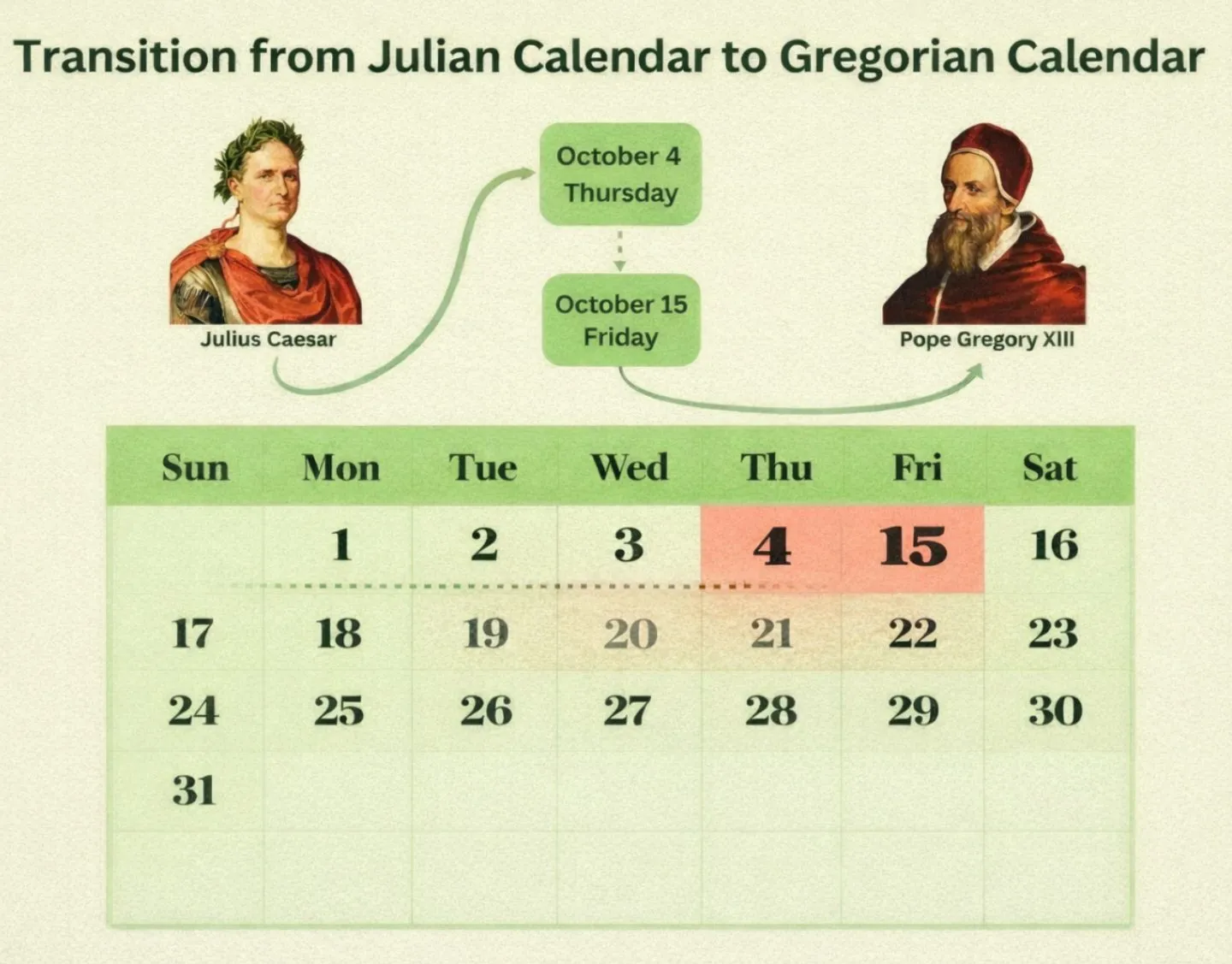
To correct this growing seasonal disparity, Pope Gregory XIII enacted a comprehensive calendar reform in 1582, introducing what is now known as the Gregorian calendar.
To realign the calendar with the vernal equinox, ten days were eliminated overnight throughout Catholic Europe. Citizens went to bed on Thursday, October 4, 1582, and awoke the next morning on Friday, October 15. Across Spain, Italy, Portugal, and Poland, ten days simply ceased to exist.
British Hesitation and the 1752 Realignment
Because the reform was initiated by the Vatican, Protestant nations initially refused to adopt it. Great Britain and its American colonies continued using the Julian calendar for another 170 years, falling eleven days out of sync with continental Europe.
Britain finally adopted the reform in 1752, decreeing that September 2 be followed directly by September 14. Rioters reportedly took to the streets demanding: “Give us our eleven days!”
The Precise Mathematics of Leap Years
The core achievement of the Gregorian reform was refining the leap year rule. While leap years continue every four years, century years are exempt unless they are divisible by 400:
- The year 2000 was a leap year because it is divisible by 400.
- The years 2100, 2200, and 2300 will not be leap years.
- The year 2400 will be a leap year.
This ingenious adjustment reduces the error to a mere 26 seconds per year, meaning the Gregorian calendar will deviate by only one single day over approximately 3,300 years.
The Universal Rhythm of Modern Society
Today, the Gregorian calendar serves as the global standard for international commerce, civil governance, civil aviation, and science. Even cultures that maintain traditional lunar or religious calendars rely on Gregorian dates for their international operations.
Every time we begin a new year, we participate in an ancient scientific journey—humanity’s enduring effort to synchronize civil life with the steady movements of the cosmos.