21st Century Science: A Quarter-Century of Discovery
The Close of a Quarter-Century
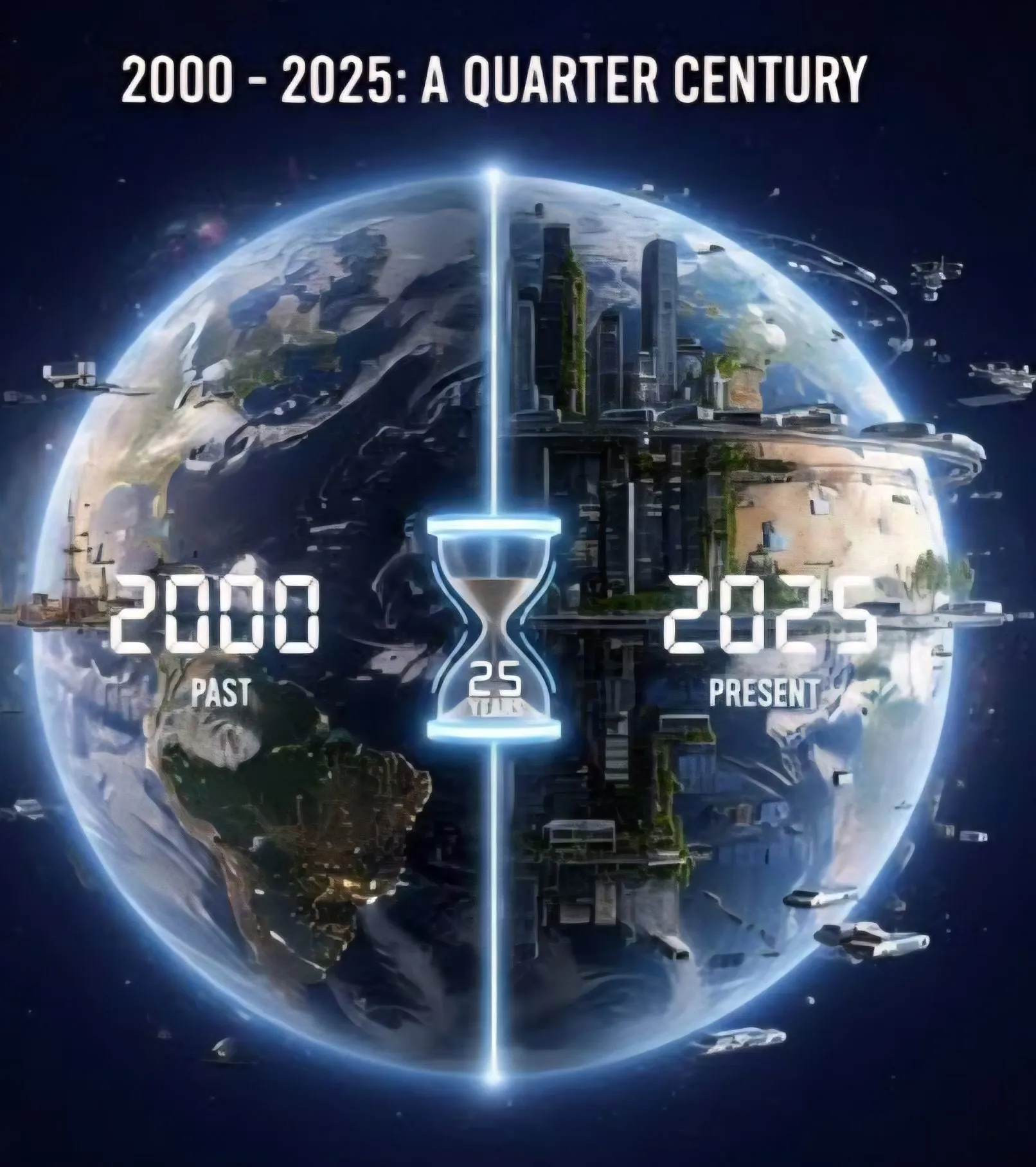
The conclusion of 2025 marks the end of the first quarter of the twenty-first century. Across these twenty-five years, scientific exploration has advanced with astonishing momentum. Humanity now stands at a historic crossroads where the achievements of past decades provide the springboard for emerging future technologies.
The Past 25 Years: A Quiet Revolution (2001–2025)
The dawn of the century saw the completion of the Human Genome Project, deciphering the chemical language of human DNA and catalyzing the era of molecular medicine. Targeted oncology, hereditary disease screening, and individualized therapies all took root from this fundamental breakthrough.
This was followed by the advent of CRISPR gene editing, proving that the genetic code could not merely be read, but edited with precision. When the COVID-19 pandemic struck, mRNA vaccine technology delivered safe, highly effective vaccines in record time, fundamentally altering global immunology.
Cosmic and Particle Physics Triumphs
Astrophysics experienced unprecedented breakthroughs. The James Webb Space Telescope opened an infrared window onto the primordial universe, imaging galaxies formed shortly after the Big Bang.
Simultaneously, the Laser Interferometer Gravitational-Wave Observatory (LIGO) achieved the first direct detection of gravitational waves, confirming Einstein’s century-old prediction of ripples in spacetime. Meanwhile, CERN’s Large Hadron Collider discovered the Higgs boson, resolving the long search for the mechanism that imparts mass to elementary particles.
The Rise of Information Technology and AI
Over the last twenty-five years, digital technologies restructured scientific methodologies. Ubiquitous connectivity, GPS networks, cloud infrastructure, and big data analysis revolutionized laboratory workflows, allowing researchers across continents to collaborate seamlessly.
Simultaneously, artificial intelligence transitioned from a speculative subfield into science’s premier investigative companion. AI models now predict complex protein structures, accelerate climate simulations, and detect subtle radiological anomalies with superhuman efficiency.
The Next 25 Years: Emerging Frontiers (2026–2050)
Looking toward 2050, clean energy generation could undergo a fundamental shift. Controlled nuclear fusion—harnessing the power source of the stars—is progressing steadily toward commercial viability, potentially resolving global energy crises.
In computing, scalable quantum processors are moving toward maturity. Problems in quantum chemistry, catalyst design, and cryptography that currently demand decades on supercomputers will be computed in minutes.
Nanotechnology and Regenerative Medicine
Controlling matter at the molecular scale will unlock profound breakthroughs in medicine and materials science:
- Targeted medical nanobots capable of destroying localized cancer cells.
- Lightweight, ultra-durable nanomaterials for aerospace and structural engineering.
- Molecular membranes providing energy-efficient water desalinization and purification.
In healthcare, patient-derived stem cells may enable 3D-bioprinted organs, ending transplant donor waiting lists. Neural interfaces could soon bridge human cognition with computing devices.
Deep Space Exploration and Ethical Responsibility
Humanity’s footprint will expand into deep space. Permanent research bases on the Moon and crewed voyages to Mars will transition from conceptual sketches into operational reality.
Yet as science becomes vastly more powerful, ethical responsibility must keep pace. From climate stewardship to genetic modification and algorithmic governance, scientific progress must align with human dignity.
Conclusion
The first quarter of 21st century science proved that humanity can continually push back the boundary of the impossible. Over the coming twenty-five years, the critical question is not merely what technologies we can create, but how wisely and ethically we will guide them.