Time Travel: Science, Relativity, and Paradoxes

Journeying on the River of Time
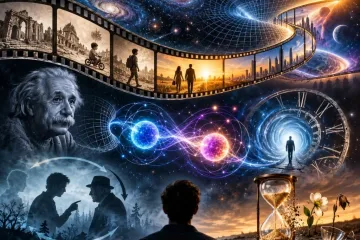
The concept of time travel has perpetually captured human imagination. It has inspired countless science fiction novels, speculative stories, and Hollywood blockbusters. In popular fiction, traversing time seems effortless: step inside an eccentric contraption, press a button, and journey seamlessly into the remote past or distant future.
Imagine dialing back to witness historical milestones firsthand, or skipping forward millennia to marvel at advanced civilizations. While the idea is endlessly fascinating, is temporal navigation genuinely possible within the laws of physics?
The scientific community remains nuanced. One school of thought contends that backward travel violates fundamental causality, while another suggests that forward time dilation is already an established reality and certain extreme general relativistic scenarios might theoretically bridge distant eras.
Is Time Strictly One-Way?
In our daily lives, time resembles a relentless river flowing steadily in a single direction. Every passing second carries us irrevocably from the present into the future. What was present moments ago is now irrevocably past. From birth to death, this march continues without pause.
In that sense, every one of us is already traveling forward through time. But can we ever turn backward against the current, or leap dramatically ahead? To answer this, we must first examine what time truly is and how it originated.
The Birth of Time: The Big Bang and Spacetime
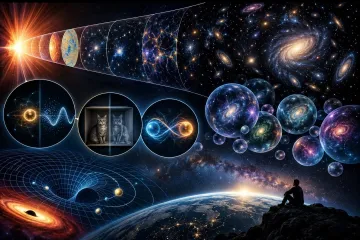
Modern astrophysics indicates that our universe began roughly 13.8 billion years ago in a cosmic expansion known as the Big Bang. As space inflated, the three familiar spatial dimensions—length, width, and height—were established.
Yet Einstein demonstrated that space cannot be disentangled from a fourth dimension: time. To define any event in the cosmos unambiguously, one must specify both its spatial coordinates and its exact temporal moment. Prior to the Big Bang, neither space nor time existed as independent entities; they were forged simultaneously into a single, cohesive four-dimensional fabric known as spacetime.
Einstein and the Relativity of Time
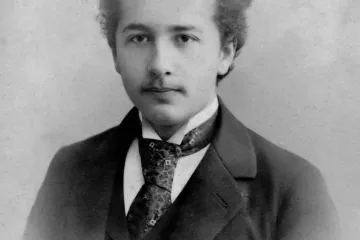
Albert Einstein overturned classical Newtonian physics with his Special Theory of Relativity. He revealed that time is not a universal, immutable constant ticking identically everywhere. Rather, time is strictly relative to the observer’s motion. As an object’s velocity approaches the speed of light, time for that object slows down relative to a stationary observer—a phenomenon known as time dilation.
Consider the classic twin paradox:
- Imagine identical twin brothers. One boards a spacecraft traveling at 99% of the speed of light for a five-year voyage, while the other remains on Earth.
- Upon returning, the astronaut brother has aged only five years, but on Earth, approximately thirty-six years have elapsed.
- The traveling brother returns thirty-one years younger than his twin. In physical reality, he has traveled into Earth’s future.
While this sounds like pure science fiction, it is verified empirical physics, confirmed by countless laboratory experiments using atomic clocks.
GPS and Practical Time Dilation
Every smartphone and modern vehicle uses time dilation daily through the Global Positioning System (GPS). Satellites orbit Earth at roughly 3.9 kilometers per second. Due to their high velocity, special relativity causes their onboard atomic clocks to tick roughly 7 microseconds slower per day than clocks on Earth.
Conversely, because the satellites operate higher in Earth’s gravitational well, general relativity dictates that weaker gravity causes their clocks to run faster—by approximately 45 microseconds per day. Subtracting the two effects yields a net gain of approximately 38 microseconds each day. If satellite computer systems did not continuously calibrate for relativistic time dilation, GPS navigation would drift by kilometers within a single day.
Traveling to the Future: Proven but Constrained
Can we harness time dilation for human travel into the far future? Theoretically, yes. Practically, we are constrained by technological boundaries. Accelerating a macroscopic spacecraft anywhere near the speed of light demands unfathomable quantities of energy, as an object’s relativistic mass increases without bound as it nears light speed.
Gravity, Curved Spacetime, and Wormholes
Einstein’s General Theory of Relativity revealed that mass and energy warp spacetime, much like a heavy sphere depressing a flexible rubber sheet. The greater the mass, the more profound the curvature. In extreme gravitational regimes, such as black holes, spacetime curves so severely that light itself cannot escape, culminating in a gravitational singularity.
In 1935, Einstein and Nathan Rosen demonstrated that general relativity theoretically permits bridges connecting two distant regions of spacetime—structures known mathematically as Einstein-Rosen bridges or wormholes. If a traversable wormhole could be stabilized using exotic matter with negative mass-energy, it might theoretically connect different points in space and time.
The Paradoxes of Time Travel
While forward travel is physically achievable via velocity and gravity, traveling backward into the past introduces profound logical dilemmas. The most famous is the Grandfather Paradox:
- If a traveler journeys into the past and prevents their grandfather from meeting their grandmother, their parent would never be born.
- Consequently, the time traveler would never exist.
- Yet if the traveler does not exist, who traveled back in time to alter history?
Physicists like Stephen Hawking proposed the “Chronology Protection Conjecture,” suggesting that the laws of physics inherently prevent closed timelike curves to preserve causality. Furthermore, Enrico Fermi’s observation echoes here: if backward time travel were ever mastered in the future, where are the time tourists today?
Conclusion
Our curiosity about traversing the corridors of time reflects our deepest yearning to understand reality. While relativistic physics undeniably enables forward leaps through time dilation, backward journeys remain shrouded in paradoxical impossibilities. For now, backward time travel remains the domain of brilliant literature and cosmic imagination.