V404 Cygni: Inside the Violent Cosmic Light Show
Cosmic Silence and Sudden Flashes
We often picture deep space as a tranquil, frozen expanse where distant stars quietly glimmer. Yet beneath this stillness lurk extraordinary phenomena capable of detonating into radiant brilliance without warning—as though the cosmos suddenly illuminates the dark to announce its restless vitality.
One of the most remarkable stages for this celestial drama is V404 Cygni, a dynamic black hole system that periodically transforms cosmic quiet into spectacular violence.
Identity and Astronomical Coordinates
V404 Cygni is not a solitary black hole wandering alone; it is a binary star system located approximately 8,000 light-years from Earth in the constellation Cygnus within our Milky Way galaxy.
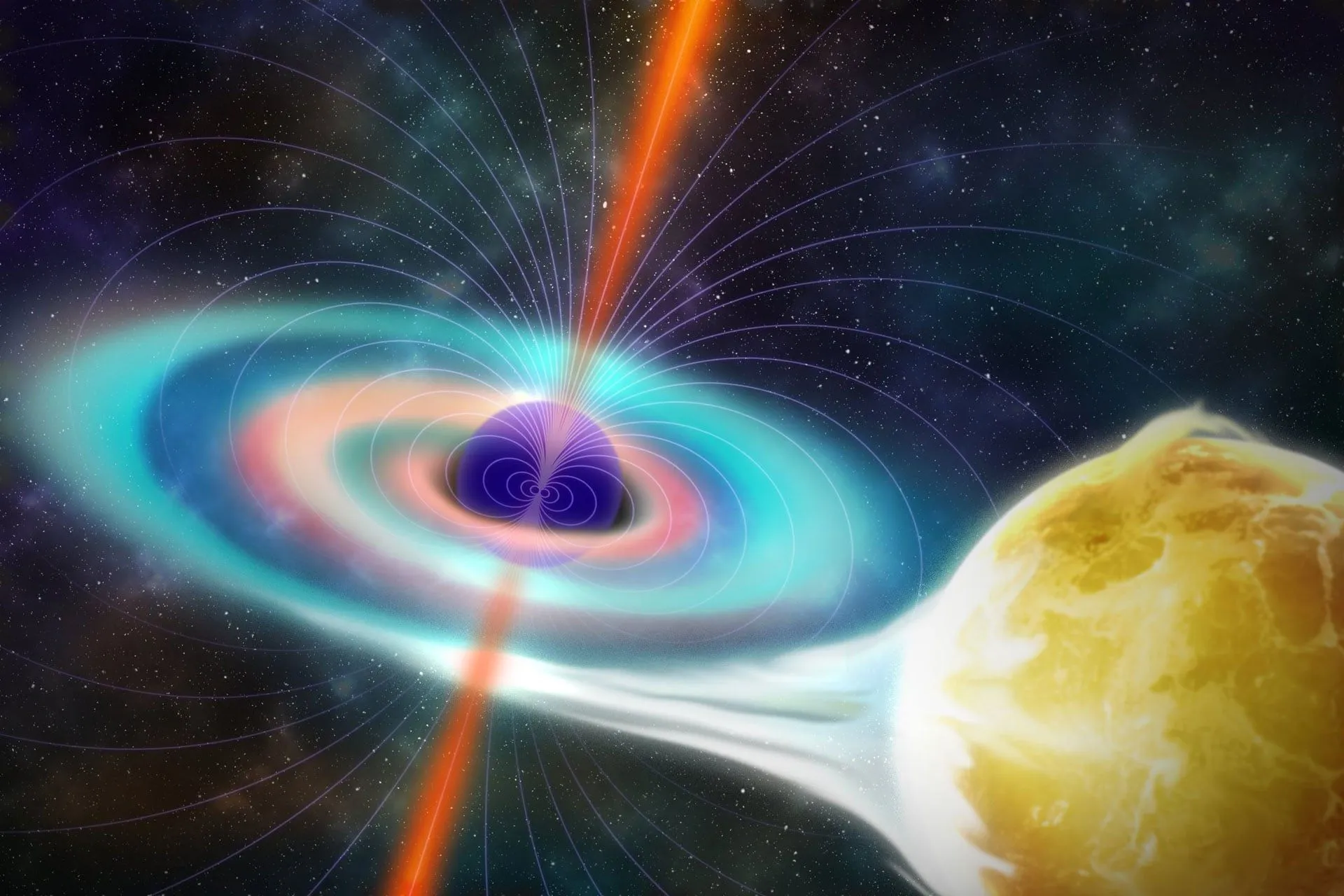
The system consists of a regular star—roughly half the mass of our Sun—locked in a tight gravitational embrace with a stellar-mass black hole roughly nine times as massive as the Sun. Orbiting in close proximity, the black hole steadily siphons stellar material away from its companion companion.
The Accretion Disk: A Whirlpool of Energy
Gas stripped from the companion star does not fall directly into the black hole. Instead, angular momentum forces it into a rapidly swirling, superheated vortex known as an accretion disk.
Within this disk, extreme gravitational shear and friction heat the matter to millions of degrees, storing vast amounts of energy. For decades, V404 Cygni appears deceptively quiescent from our vantage point, maintaining a faint presence that masks the immense pressure building inside the disk.
The Cosmic Light Show and Relativistic Jets
Then, suddenly and without warning, the system erupts. Within hours, its brightness in X-ray and radio wavelengths surges by a factor of thousands. Beams of ionized plasma are propelled from the black hole’s poles at near-relativistic velocities, blasting across interstellar space.
This dramatic eruption led celebrated physicist Brian Cox to describe V404 Cygni as one of nature’s most dazzling “cosmic light shows.” The event is not an explosion of the black hole itself—since black holes cannot detonate—but rather the violent release of excess energy and ejected matter when the accretion disk becomes critically unstable.
The 2015 Outburst: A Window into Extreme Physics
In June 2015, following twenty-six years of dormancy, V404 Cygni burst into renewed activity. Ground- and space-based observatories across the globe pivoted their instruments to track the event in real time. Astronomers witnessed the black hole simultaneously consuming gas while ejecting high-energy plasma jets that flickered on timescales of milliseconds.
These energetic displays offer astrophysicists an invaluable natural laboratory to investigate:
- The foundational predictions of Einstein’s General Theory of Relativity.
- Matter under the most extreme gravitational conditions imaginable.
- The dynamics of relativistic plasma and magnetic field collimation.
Future Prospects and Cosmic Safety
Despite the immense violence of these outbursts, V404 Cygni poses no danger to life on Earth. At a distance of 8,000 light-years and with its relativistic jets angled far away from our line of sight, its flares present purely as a scientific spectacle.
Astronomers project a high likelihood of another major outburst within the next decade. When V404 Cygni awakens once more, it will grant humanity another front-row seat to the dazzling, dynamic mechanics of an active black hole.