Artemis Mission: Humanity’s Next Chapter on the Moon
There was a time when humans walked on the Moon, and then that grand adventure halted. Following the historic Apollo 11 mission in 1969, humanity voyaged to the lunar surface six times before the program concluded in 1972. For over half a century, the Moon’s pristine regolith has waited for human footprints to return.
Now, that long silence is finally ending. Human civilization is embarking on a bold new lunar quest known as the Artemis mission. This return is not merely a repetition of past triumphs; it is designed to be deeper, more sustainable, and fundamentally future-oriented.
From Apollo to Artemis: A Continuing Legacy
During the 1960s and 1970s, the Apollo program proved human technical and geopolitical capability by landing astronauts on another celestial body. However, Artemis follows a profoundly different philosophy. Its objective is not simply to touch down and leave, but to establish a permanent presence.
In classical mythology, Apollo was the god of the Sun, while his twin sister Artemis was the goddess of the Moon. Encoded in this moniker is a symbolic message: this new lunar voyage will be broader, more inclusive, and technologically far more sophisticated.
Core Objectives of the Artemis Program
The goals of Artemis cannot be summarized in a single headline; they represent an ambitious multi-phase roadmap:
- Return to the Lunar Surface: Landing astronauts on the Moon after more than five decades of absence.
- Making History: Landing the first woman and the first person of color on the lunar surface.
- Permanent Outpost: Establishing a sustained base camp at the lunar south pole, where water ice and vital resources abound.
- Stepping Stone to Mars: Serving as the ultimate proving ground for deep space habitation before launching human expeditions to Mars.
Step-by-Step Artemis Architecture
NASA’s modern lunar initiative is structured around several crucial evolutionary milestones:
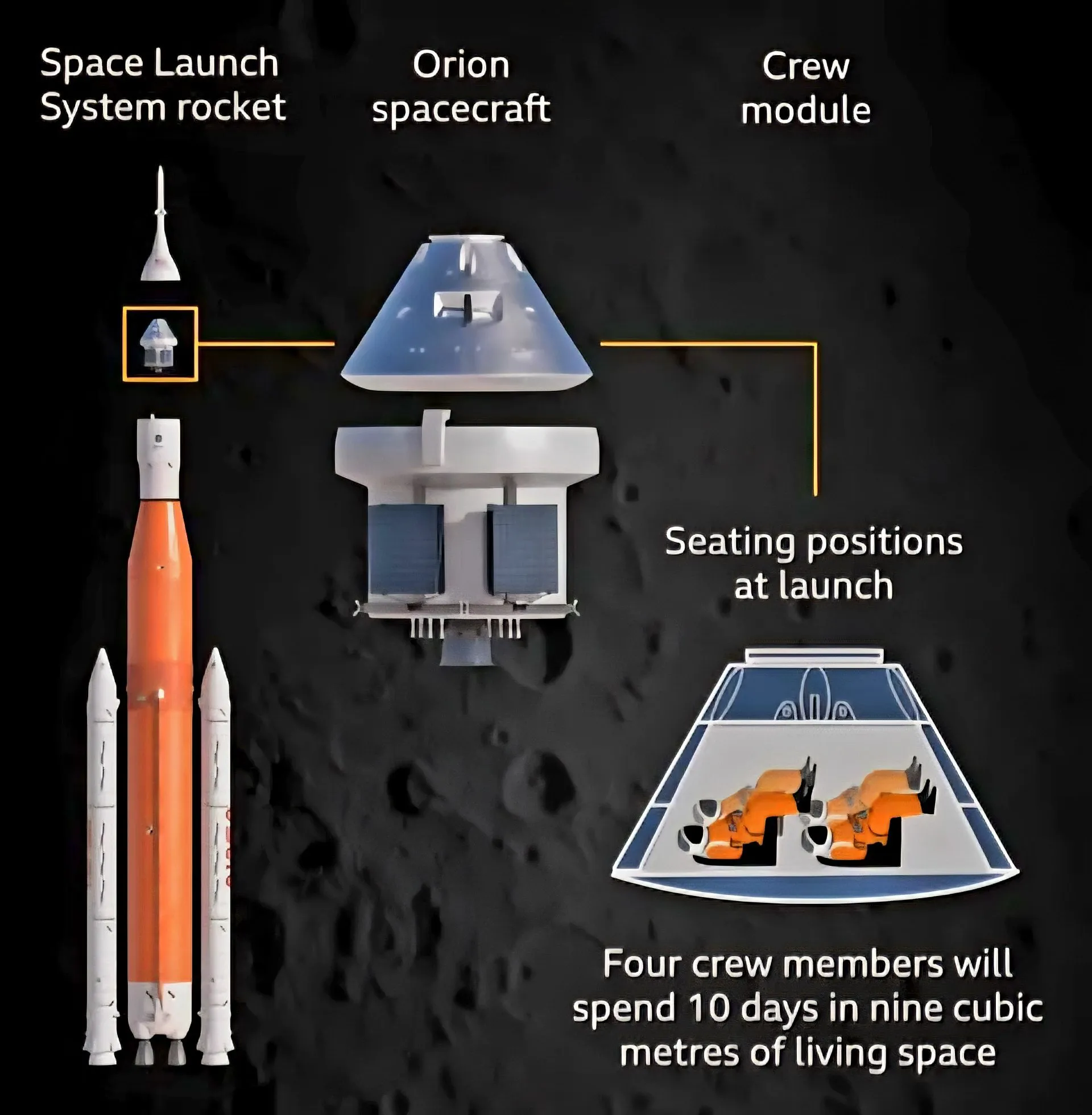
1. Artemis I (Completed): Launched in November 2022, Artemis I was an uncrewed flight test. Propelled by the mighty Space Launch System (SLS) rocket, the Orion capsule traveled into a distant retrograde lunar orbit before returning safely to Earth, validating the spacecraft’s heat shield and navigation systems.
2. Artemis II (Crewed Flyby): Scheduled for 2026, Artemis II will carry four astronauts on a ten-day journey around the Moon. While it will not land, humans will view lunar craters up close for the first time in generations. The international crew comprises Reid Wiseman, Victor Glover, and Christina Hammock Koch of NASA, alongside Jeremy Hansen of the Canadian Space Agency.
3. Artemis III (Historic Landing): Artemis III represents the historic pinnacle of the early program, returning astronauts directly to the lunar surface. Targeted for 2027, the crew will touch down near the Moon’s mysterious and resource-abundant south polar region.
The Lunar South Pole and the Search for Water
Unlike the equatorial landing zones of Apollo, the lunar south pole features permanently shadowed craters where temperatures drop lower than Pluto. Planetary scientists have confirmed that these dark frigid craters harbor billions of tons of water ice. This ice is far more than drinking water—it can be broken down into hydrogen and oxygen to manufacture breathable air and rocket fuel, unlocking self-sustaining deep space infrastructure.
A Sustainable Lunar Base and the Gateway
The defining innovation of Artemis is longevity. Rather than brief flag-and-footprint visits, NASA and its global partners are constructing permanent infrastructure:
- Artemis Base Camp: Surface habitats, pressurized rovers, and scientific laboratories allowing astronauts to live and work on the Moon for months at a time.
- Lunar Gateway: A compact space station stationed in a near-rectilinear halo orbit around the Moon, functioning as an orbital laboratory, communications hub, and transfer terminal for surface missions and future Mars departures.
Global Collaboration
Led by NASA, the Artemis program is fundamentally an international endeavor. Space agencies from Europe (ESA), Canada (CSA), Japan (JAXA), and dozens of signatory nations of the Artemis Accords are working together alongside commercial aerospace giants. In modern space exploration, international partnership is essential to manage the staggering complexity and capital required for deep-space colonization.
Why Artemis Matters
This mission reminds us that humanity was never meant to remain bound to Earth alone. Finding water on the Moon paves the way for interstellar supply chains; living on the Moon proves our adaptability in hostile cosmic environments. Most importantly, the Artemis mission revitalizes our spirit of discovery, preparing our species to cross the vast gulf of space toward Mars and beyond.